
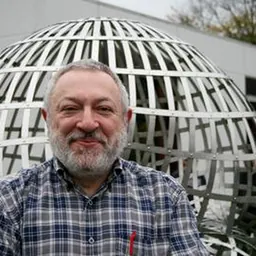
Hillel Furstenberg
German-born US–Israeli mathematician
About Hillel Furstenberg
Born 1935. Hillel Furstenberg is an Israeli and American mathematician, pedagogue and university teacher, known for Evenly spaced integer topology, Furstenberg boundary and Furstenberg's proof of the infinitude of primes.
Hillel "Harry" Furstenberg (; born September 29, 1935) is a German-born American-Israeli mathematician and professor emeritus at the Hebrew University of Jerusalem. He is a member of the Israel Academy of Sciences and Humanities and U.S. National Academy of Sciences and a laureate of the Abel Prize and the Wolf Prize in Mathematics. He is known for his application of probability theory and ergodic theory methods to other areas of mathematics, including number theory and Lie groups.
Biography Furstenberg was born to German Jews in Nazi Germany, in 1935 (originally named "Fürstenberg"). In 1939, shortly after Kristallnacht, his family escaped to the United States and settled in the Washington Heights neighborhood of New York City, escaping the Holocaust. He attended Marsha Stern Talmudical Academy and then Yeshiva University, where he concluded his BA and MSc studies at the age of 20 in 1955. Furstenberg published several papers as an undergraduate, including "Note on one type of indeterminate form" (1953) and "On the infinitude of primes" (1955). Both appeared in the American Mathematical Monthly, the latter provided a topological proof of Euclid's famous theorem that there are infinitely many primes.
Academic career Furstenberg pursued his doctorate at Princeton University under the supervision of Salomon Bochner. In 1958 he received his PhD for his thesis, Prediction Theory.
From 1959–1960, Furstenberg served as the C. L. E. Moore instructor at the Massachusetts Institute of Technology.
Furstenberg got his first job as an assistant professor in 1961 at the University of Minnesota. Furstenberg was promoted to full professor at Minnesota but moved to Israel in 1965 to join at Hebrew University's Einstein Institute of Mathematics. He retired from Hebrew University in 2003.
In 1993, Furstenberg won the Israel Prize and in 2007, the Wolf Prize in mathematics. He is a member of the Israel Academy of Sciences and Humanities (elected 1974), the American Academy of Arts and Sciences (international honorary member since 1995), and the U.S. National Academy of Sciences (elected 1989).
Furstenberg has taught generations of students, including Alexander Lubotzky, Yuval Peres, Tamar Ziegler, Shahar Mozes, and Vitaly Bergelson.
Research accomplishments
Furstenberg gained attention at an early stage in his career for producing an innovative topological proof of the infinitude of prime numbers in 1955.
In a series of articles beginning in 1963 with A Poisson Formula for Semi-Simple Lie Groups, he continued to establish himself as a ground-breaking thinker. His work showing that the behavior of random walks on a group is intricately related to the structure of the group—which led to what is now called the Furstenberg boundary—has been hugely influential in the study of lattices and Lie groups.
Awards 1977 – Rothschild Prize in Mathematics. 1993 – Furstenberg received the Israel Prize, for exact sciences. 1993 – Furstenberg received the Harvey Prize from Technion. 2006/07 – He received the Wolf Prize in Mathematics. 2006 – He delivered the Paul Turán Memorial Lectures. 2020 – He received the Abel Prize with Gregory Margulis "for pioneering the use of methods from probability and dynamics in group theory, number theory and combinatorics".
Selected publications Furstenberg, Harry, Stationary processes and prediction theory, Princeton, N.J., Princeton University Press, 1960.
Furstenberg, Harry, Recurrence in ergodic theory and combinatorial number theory, Princeton, N.J., Princeton Univ. Press, 1981.
Don’t just read it —
keep it.
Full-length biographies made to live with: read them, listen on the way to work, watch them tonight.
- E-book
- Audio
- Video
Instant download · yours to keep · every purchase keeps this site free
Important facts
People in Hillel Furstenberg's life
Named in this biography and alive at the same time




Related people
Same field, nearest in time

Contemporaries
People whose lives overlapped Hillel Furstenberg's




Frequently asked questions
Who is Hillel Furstenberg?
German-born US–Israeli mathematician
When was Hillel Furstenberg born?
Hillel Furstenberg was born on 29 September 1935 in Berlin.
What is Hillel Furstenberg's occupation?
Hillel Furstenberg is a mathematician, pedagogue and university teacher.
What is Hillel Furstenberg known for?
Hillel Furstenberg is known for Evenly spaced integer topology, Furstenberg boundary, Furstenberg's proof of the infinitude of primes, Furstenberg–Sárközy theorem, IP set and Szemerédi's theorem.
What nationality is Hillel Furstenberg?
Hillel Furstenberg is Israeli and American.
Sources & further reading
· Wikipedia: Hillel Furstenberg
Cite this page
APA: Biography.guide. (2026). Hillel Furstenberg. https://biography.guide/hillel-furstenberg/
MLA: "Hillel Furstenberg." Biography.guide, https://biography.guide/hillel-furstenberg/.
Chicago: "Hillel Furstenberg." Biography.guide. https://biography.guide/hillel-furstenberg/.
Data last updated: 2026-09-20 · Spot an error? Report a correction.
Page generated 2026-09-27 05:26 UTC