About Hieronymus Brunschwig
Lived 1450 – 1533 (aged 82–83). Hieronymus Brunschwig was a German physician, surgeon and botanist.
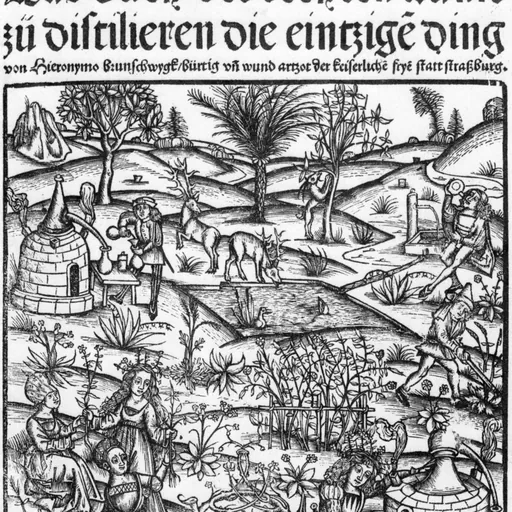
Hieronymus Brunschwig or Hieronymus Brunschwygk was a German surgeon ("Wundarzt"), alchemist and botanist. Around 1500, he published several works in German, including a plague treatise and two books on pharmaceutical distillation, aimed at non-academic practitioners. He was notable for his methods of treatment of gunshot wounds and for his early work on distillation techniques. His most influential book was the Liber de arte distillandi de simplicibus (also called Kleines Destillierbuch). These distillation books helped establish the genre of Destillierbücher, which became popular during the sixteenth century, especially among non-academic readers. He was also the author of the Buch der Cirurgia, the first printed surgical treatise in German, which compiled ancient and medieval medical knowledge and included some of the earliest detailed discussions of gunshot wounds, fractures, dislocations, and surgical treatments.
Life Brunschwig was born c. 1450 in the free imperial city of Strasbourg, which in his time was part of the Holy Roman Empire and an important center for printing and scientific study. He was trained as a craftsman in the guild of barbers and bathers and understood medicine (arznei) primarily as a practical craft (kunst or handwerk), grounded in manual skill and experience. Some notes in his Buch der Cirurgia may suggest that he studied in Bologna, Padua and Paris and that he participated in the Burgundian Wars, but all this is unfounded. Archival evidence records him among barbers drafted for military service in the Burgundy campaigns in the 1470s. After training as a surgeon, he traveled widely through regions such as Alsace, Swabia, Bavaria, Franconia, and the Rhineland as far as Cologne. in Olmütz. 1559.
1500 (19.08.): Liber pestilentialis de venenis epidemie.: It was an illustrated work of approximately seventy pages analyzing how medical practitioners and ordinary citizens could navigate epidemics such as the plague.
1505: Medicinarius: Containing: The Liber de arte distillandi de simplicibus. (Kleines Destillierbuch), The treatise De vita libri tres of Marsilio Ficino (translated into German by Johann Adelphi of Strasbourg), Glossaries of drugs names, A treatise called De Quinta essentia which was largely influenced by the book De consideratione quintae essentiae of Jean de Roquetaillade. Reprints: Strasbourg 1508, 1515, 1521, 1528, 1531, 1537; Frankfurt 1551, 1554, 1555, 1560, 1610, 161
1512: Liber de arte distillandi de compositis. (= Großes Destillierbuch):
A book about «Quinta essentia» and other alchemical drugs – with long passages taken out of the book De consideratione quintae essentiae of Jean de Roquetaillade, An enumeration of simplicia (medicines, composed by one single drug) and composita (medicines, composed by several drugs) – according to the character of diseases, An enumeration of simplicia and composita – according to the location of diseases (from head to feet), An enumeration of simplicia and composita – for use in surgical practice and A treatise intitled «Thesaurus pauperum» - dispensatory in 45 chapters, containing cheap medicines for the poor. The «Thesaurus pauperum» was separately reprinted: 1) under the titles Hausapotheke or Hausarzneibüchlein. (39 reprints. 1537 -1658). 2) under the title Apotheke für den gemeinen Mann together with the Büchlein von den ausgebrannten Wässern, which was ascribed to Michael Puff. (30 reprints. 1529-1619). Reprints of the whole Liber de arte distillandi de compositis: Strasbourg 1519, 1532; Frankfurt 1538, 1551, 1552, 1597; Leipzig 1972.
Buch der Cirurgia Hieronymus Brunschwig's Buch der Cirurgia, was first published in 1497 in Strasbourg by Johannes Grüninger, and was the first printed surgical treatise in the German language, representing a major milestone in the development of surgical literature in Germany. At a time when surgery in Germany lagged behind that of France and Italy, this work demonstrated that German surgeons were not isolated form broader European medical traditions. In fact, Brunschwig was one of the first German surgeons to make extensive use of French and Italian sources, thereby helping to transmit their advances to a wider German-speaking audience.
The Cirurgia was written for the unspecialized or general surgeon and was primarily a compilation of knowledge derived from classical, Arabic, medieval, and contemporary sources, combined with Brunschwig's own practical experience. The purpose of this work was to teach the art of surgery (chirurgia) to those seeking to learn it. The handbook is comprehensive, covering all aspects of general surgery, with particular attention given to gunshot wounds, and fractures. It includes detailed discussions of gunshot wounds, arrow injuries, amputations, cranial procedures such as trepanation, and the treatments of dislocations and fractures.
The handbook is divided to multiple treatises that address the role of the surgeon, the nature and causes of wounds, methods of treatment arranged from head to foot, accidental and deliberate injuries, and the management and reduction of fractures. The final part consists of an antidotarium, a collection of medicinal remedies like ointments and plasters used in surgical care.
It also includes notable illustrations, including numerous woodcuts depicting surgeons treating patients and demonstrating procedures.
The Buch der Cirurgia played a crucial role in disseminating surgical knowledge in Germany. Through compiling established tradition and integrating them with practical experience, Brunschwig provided a manual that enabled German surgeons to participate in the broader progress of European medicine during the late Middle Ages and early Renaissance.
It consisted of three parts:
A detailed description of the methods and apparati, showing influences from Jean de Roquetaillades' book De consideratione quintae essentiae. This influence is evident in Brunschwig's understanding of distillation as a process capable of extracting a more stable "quintessence" from corruptible matter. An enumeration of herbal and animal substances in alphabetical order with botanical remarks on indigenous plants, based on Brunschwigs' own observations. This section reflects emphasis on practical experience and direct engagement with natural materials. This was followed by the enumeration of indications of the "distilled" medicines. These indications were based as well on the writings in the textbooks of old tradition (Dioscorides ...) as on prescriptions of folk medicine. The "Büchlein von den ausgebrannten Wässern", ascribed to Michael Puff of Vienna and recipes in manuscripts of the 15th century were Brunschwigs' main sources. However, Brunschwig also noted that these remedies could be as harmful as they were beneficial, and therefore recommended that their use be supervised by an experienced physician to avoid upsetting the patient's bodily balance. Like the Cirurgia, Brunschwig's distillation texts were pioneering works. The only earlier publication, Michael Puff von Schrick's Büchlein von den ausgebrannten Wässern (Booklet of distilled waters, 1476), served as a reference on the use of distilled remedies but did not provide instructions for producing them. Nevertheless, its repeated reprints and success suggest there was a clear demand for material on the subject. Brunschwig supplied that demand with the first printed works ro describe the art of distillation in any technical and visual way.
Otto Brunfels and Hieronymus Bock, both called "fathers of botany" ("Väter der Botanik") in honour of their truthful description of indigenous plants, respected Brunschwig as their predecessor. Leonhard Fuchs, the third of the "fathers of botany", did not mention Brunschwig at all.
Liber pestilentialis de venenis epidemie
Liber pestilentialis (Strasburg, 1500) is a German-language medical treatise on plague by Hieronymus Brunschwig (c. 1450-1512), a surgeon and apothecary from Strasbourg. It explains the diagnosis, causes, prevention, and treatment of epidemic disease ("pestilence") and was intended for a German-reading audience, especially medical artisans such as surgeons and barbers. The work was printed by Johann Grüninger and is about 26 folios long, divided into five books covering different aspects of plague.
In the text, Brunschwig defines pestilence as a "poisonous moisture" within the human body that arises from corrupted blood and can produce swellings, boils, and other external symptoms. He explains that the disease spreads through the body and may reach the heart if not expelled. He presents multiple causes of plague, including divine punishment for sin, astrological influences, corrupted air and environment, spoiled food and drink, inhalation of poisonous vapors, and sudden changes in seasonal conditions.
A central idea of Liber pestilentialis is the connection between plague and poison, as reflected in its emphasis on toxic processes affecting the whole body. Brunschwig writes for non-physicians and stresses the role of surgeons and barbers in treating external symptoms, noting that physicians sometimes fled plague outbreaks. The work is part of a broader tradition of German-language printed plague treatises that made medical knowledge accessible beyond Latin-trained scholars.
Don’t just read it —
keep it.
Full-length biographies made to live with: read them, listen on the way to work, watch them tonight.
- E-book
- Audio
- Video
Instant download · yours to keep · every purchase keeps this site free
Important facts
People in Hieronymus Brunschwig's life
Named in this biography and alive at the same time


Related people
Same field, nearest in time


Contemporaries
People whose lives overlapped Hieronymus Brunschwig's


Frequently asked questions
Who was Hieronymus Brunschwig?
German physician
When was Hieronymus Brunschwig born?
Hieronymus Brunschwig was born in 1450 in Strasbourg.
When did Hieronymus Brunschwig die?
Hieronymus Brunschwig died in 1533 in Strasbourg.
What was Hieronymus Brunschwig's occupation?
Hieronymus Brunschwig was a physician, surgeon and botanist.
What nationality was Hieronymus Brunschwig?
Hieronymus Brunschwig was German.
Sources & further reading
· Wikipedia: Hieronymus Brunschwig
· DBpedia: Hieronymus Brunschwig
Cite this page
APA: Biography.guide. (2026). Hieronymus Brunschwig. https://biography.guide/hieronymus-brunschwig/
MLA: "Hieronymus Brunschwig." Biography.guide, https://biography.guide/hieronymus-brunschwig/.
Chicago: "Hieronymus Brunschwig." Biography.guide. https://biography.guide/hieronymus-brunschwig/.
Data last updated: 2026-09-20 · Spot an error? Report a correction.
Page generated 2026-09-27 05:09 UTC