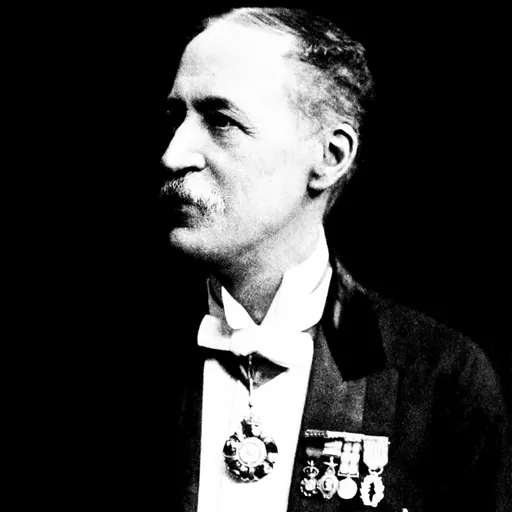
Herbert Hope Risley
British ethnographer and colonial administrator
About Herbert Hope Risley
Lived 1851 – 1911 (aged 60). Herbert Hope Risley was an anthropologist, ethnographer, indologist, tibetologist and local government officer.
Sir Herbert Hope Risley (4 January 1851 – 30 September 1911) was a British ethnographer and colonial administrator, a member of the Indian Civil Service who conducted extensive studies on the tribes and castes of the Bengal Presidency. He is notable for the formal identification of the centuries old established caste system of the entire Hindu population of British India in the 1901 census, of which he was in charge. As an exponent of scientific racism, he used anthropometric data to divide Indians into seven races.
Risley was born in Buckinghamshire, England, in 1851 and attended New College, Oxford University prior to joining the Indian Civil Service (ICS). He was initially posted to Bengal, where his professional duties engaged him in statistical and ethnographic research, and he soon developed an interest in anthropology. His decision to indulge these interests curtailed his initial rapid advancement through the ranks of the Service, although he was later appointed Census Commissioner and, shortly before his death in 1911, became Permanent Secretary at the India Office in London. In the intervening years he compiled various studies of Indian communities based on ideas that are now considered to constitute scientific racism. He emphasised the value of fieldwork and anthropometric studies, in contrast to the reliance on old texts and folklore that had historically been the methodology of Indologists and which was still a significant approach in his lifetime.
Aside from being honoured by his country, including by the award of a knighthood, Risley also became President of the Royal Anthropological Institute.
Early life Herbert Hope Risley was born at Akeley in Buckinghamshire, England, on 4 January 1851. His father was a rector and his mother the daughter of John Hope, who had served in the Bengal Medical Service at Gwalior.
During his schooldays at Winchester College, where many of his relatives had preceded him, he won a scholarship and was also awarded a gold medal for an essay in Latin. Continuing his education with a scholarship at New College, Oxford, he graduated with a second-class Bachelor of Arts degree in law and modern history in 1872. He had already passed the competitive examination for the Indian Civil Service (ICS) in 1871, entered it on 3 June 1873 and arrived in India on 24 October of that year.
India: 1873–1885
His initial posting was to Midnapur in Bengal as an Assistant Magistrate and Assistant District Collector. The area was inhabited in part by forest tribes. He soon took to studying them and retained an interest in the anthropology of such tribes for the remainder of his life. He also became involved in William Wilson Hunter's Statistical Survey of India, which began in 1869, and was to be printed in the first edition of The Imperial Gazetteer of India, published in 1881. Hunter personally conducted the survey of Bengal, and the anthropological, linguistic and sociological accomplishments of Risley were recognised in February 1875 when he was appointed as one of five Assistant Directors of Statistics for Hunter's Survey. As time went on, the ethnographic studies and their resultant categorisations were embodied in numerous official publications and became an essential part of the administrative mechanisms of the colonial government; of those categorisations it was caste that was regarded to be, in Risley's words, "the cement that holds together the myriad units of Indian society". The desire for ethnographic studies was expressed by another Raj administrator, Denzil Ibbetson, in his 1883 report on the 1881 census of Punjab:
Risley's survey task was aided when research papers of a recently deceased Indian Medical Service doctor, James Wise, were given to him by the doctor's widow. Wise had researched the people of Eastern Bengal and it was agreed that, after ascertaining the accuracy of his work, his research should be incorporated into Risley's survey results. In return, those volumes of the survey dealing with ethnographic matters would be dedicated to Wise. Further assistance came from the research of Edward Tuite Dalton into the jungle tribes of Chhotanagpur and Assam. Dalton, like Wise, had previously published his efforts but now they would be integrated as a part of a larger whole. Risley was able to deal with the remaining areas of Bengal by making use of a large staff of correspondents who came from disparate backgrounds, such as missionaries, native people and Government officials. It was a contribution to what Thomas Trautmann, a historian who has studied Indian society, describes as "the racial theory of Indian civilisation". Trautmann considers Risley, along with the philologist Max Müller, to have been leading proponents of this idea which Trautmann notes, however, that the convergence of their theories was not a deliberate collaboration.
In the same year, 1891, the four volumes of The Tribes and Castes of Bengal were published. These contained the results of the Bengal survey, with two volumes comprising an "Ethnographical Glossary", and a further two being of "Anthropometric Data". Risley took advice from William Henry Flower, Director of the Natural History Museum, and William Turner, an Edinburgh anthropologist, in compiling the anthropometric volumes. The work was well received by the public and government alike. In the same year, he was elected an officier of the Académie Française; and in the 1892 New Year Honours he was appointed a Companion of the Indian Empire (CIE). In more recent times, his use of contemporary anthropometric methods has led to his career being described by Bates as "the apotheosis of pseudo-scientific racism", an opinion that is shared by others. The theory now known as scientific racism was prevalent for a century from around the 1840s and had at its heart, says Philip D. Curtin, that "race was one of the principal determinants of attitudes, endowments, capabilities and inherent tendencies among human beings. Race thus seemed to determine the course of human history."
According to Trautmann, Risley believed that ethnologists could benefit from undertaking fieldwork. He quotes Risley saying of ethnologists in India that they had relied too much: Risley was influenced by the methodology of the French physical anthropologist Paul Topinard, from whose Éléments d'anthropologie générale he had selected several anthropometric techniques, including the nasal index. Topinard believed that this index—a ratio derived from measuring the breadth and height of the nose—could be combined with other cranial measurements to enable a Linnean classification of humans, for which purpose Trautmann said:
Despite his comments regarding the use of literature by anthropologists, Risley used the ancient Rig Veda text, which he interpreted as speaking of Aryan invaders coming into India from the northwest and meeting with existing peoples. Dalton and J. F. Hewitt had posited that the native people comprised two distinct groups, being the Dravidian and the Kolarian, and Risley's use of the nasal index was in part intended to counter those theories by showing that the two groups were racially identical even if they were linguistically varied. Crooke noted that Risley appeared to succeed in proving a physical similarity between "the so-called Dravidian and Kolarian races" and "identified the Austro-Asiatic group of languages, with Munda as one of its sub-branches." saying that generally "the social position of a caste varies inversely as its nasal index." Trautmann explains that Risley "found a direct relation between the proportion of Aryan blood and the nasal index, along a gradient from the highest castes to the lowest. This assimilation of caste to race ... proved very influential." He also saw a linkage between the nasal index and the definition of a community as either a tribe or a Hindu caste
The methods of anthropometric data collection, much of which was done by Risley, have been questioned in more recent times. Bates has said:
India: the 1901 census
After completing the Bengal survey, Risley's work consisted of heading an enquiry into policing, and following that more usual administrative tasks for both the Bengal and Imperial governments. In 1899 he was appointed Census Commissioner, tasked with preparing and reporting on the forthcoming decennial census of 1901. The detailed regulations that he formulated for that exercise were also used for the 1911 census, and the work involved in co-ordinating the various Provincial administrations was considerable and detailed. According to political scientist Lloyd Rudolph, Risley believed that varna, however ancient, could be applied to all the modern castes found in India, and "[he] meant to identify and place several hundred million Indians within it."
The outcome of the census is described by Crooke as "an exceptionally interesting report", produced in association with a colleague, Edward Albert Gait. Crooke notes that in the report "he developed his views on the origin and classification of the Indian races largely on the basis of anthropometry."
Another event that occurred in 1901 and which related to Risley was the official approval of an India-wide ethnographic survey, intended to be conducted over a period of eight years and using in part the anthropometrical methodology established for Risley's survey of Bengal. Superintendents were appointed to each Province and Presidency and grants of £5000 per annum were given for the eight-year period. Bates considers that the results of this effort, which included works by Edgar Thurston and Robert Vane Russell, were rarely "quite so thorough, even by Risley's standards."
Some of the material from the 1901 census was later republished, in amended form, in Risley's 1908 work, The People of India, which sociologist D. F. Pocock describes as "almost the last production of that great tradition of administrator scholars who had long and extensive experience in the Indian Civil Service and had not found their arduous activity incompatible with scholarship." Trautmann considers the census report and subsequent book to represent "Risley's grand syntheses of India ethnology", while the paper of 1891 had given "an exceptionally clear view of his project at the state of what we might call its early maturity." |author=|title=|source=
India: later years In 1901 Risley was appointed Director of Ethnography. Risley was appointed Permanent Secretary of the judicial department of the India Office, succeeding Charles James Lyall. In January of that same year he became President of the Royal Anthropological Institute.
According to Crooke, "the strain of [overseeing the Provincial Council reforms] on a constitution which at no time was robust doubtless laid the seeds of the fatal disease which was soon to end his life." Risley died at Wimbledon on 30 September 1911, continuing his studies to the end despite suffering what the ODNB describes as a "distressing illness". His widow was remarried to Lieutenant-General Sir Fenton Aylmer; she died in 1934.
Don’t just read it —
keep it.
Full-length biographies made to live with: read them, listen on the way to work, watch them tonight.
- E-book
- Audio
- Video
Instant download · yours to keep · every purchase keeps this site free
Important facts
People in Herbert Hope Risley's life
Named in this biography and alive at the same time



Related people
Same field, nearest in time




Contemporaries
People whose lives overlapped Herbert Hope Risley's



Frequently asked questions
Who was Herbert Hope Risley?
British ethnographer and colonial administrator
When was Herbert Hope Risley born?
Herbert Hope Risley was born on 4 January 1851.
When did Herbert Hope Risley die?
Herbert Hope Risley died on 30 September 1911.
What was Herbert Hope Risley's occupation?
Herbert Hope Risley was an anthropologist, ethnographer, indologist, tibetologist and local government officer.
Sources & further reading
· Wikipedia: Herbert Hope Risley
· DBpedia: Herbert Hope Risley
Cite this page
APA: Biography.guide. (2026). Herbert Hope Risley. https://biography.guide/herbert-hope-risley/
MLA: "Herbert Hope Risley." Biography.guide, https://biography.guide/herbert-hope-risley/.
Chicago: "Herbert Hope Risley." Biography.guide. https://biography.guide/herbert-hope-risley/.
Data last updated: 2026-09-21 · Spot an error? Report a correction.
Portrait: Wikimedia Commons · author & licence
Page generated 2026-09-27 04:59 UTC