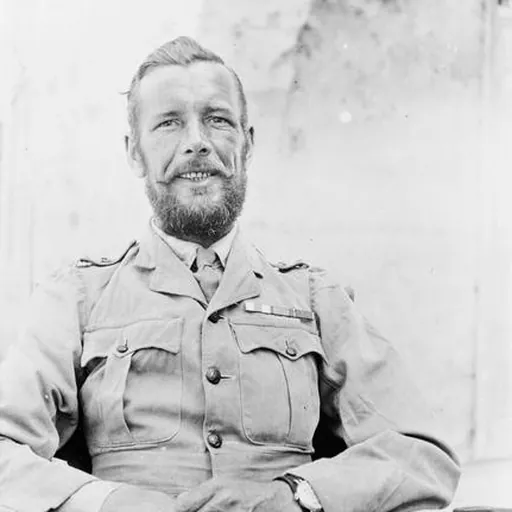
About Herbert Garland
Lived 1880 – 1921 (aged 40–41). Herbert Garland was a British engineer, metallurgist and chemist.
Major Herbert Garland OBE MC FCS M. Inst. Metals (1880 – 2 April 1921 ) was a British metallurgist and army officer. An Army Ordnance Corps member, in 1906 he was stationed on Guernsey, where he wrote a novel, Diverse Affections: a Romance of Guernsey. Garland rose to become Superintendent of Laboratories at the Cairo Citadel, Egypt by 1913 and received a grant from the Chemical Society, of which he was a fellow, to conduct research into ancient Egyptian alloys. The outbreak of war saw him commissioned as a Special List officer with the Arab Bureau. Garland developed explosives for the army, including the Garland grenade and was, in September 1916, assigned to train T. E. Lawrence and the fighters of the Arab Revolt in explosives. His mines were used against the Hejaz Railway and may have been involved in the first derailing of a moving train by explosives. Garland commanded the desperate defence of Yanbu in which he forced an attacking superior Ottoman force to withdraw with almost no bloodshed. Awarded the Military Cross and appointed an Officer of the Order of the British Empire, Garland became director of the Arab Bureau after the war and was involved in the post-war negotiations for the future of Arabia. Returning from Egypt because of poor health, Garland died within days of setting foot in England.
Early career Garland was born in Sheffield in 1880. In 1906, he published a novel, Diverse Affections: a Romance of Guernsey, written whilst stationed on the island with the Army Ordnance Corps. Garland was later transferred to Khartoum, Sudan and by the outbreak of the First World War was Superintendent of Laboratories at the Cairo Citadel, Egypt, where he had received a grant from the Chemical Society to research ancient Egyptian alloys. He was elected a fellow of the society the same year. He was one of the first to study the crystalline structures of ancient metals by polishing, etching and examination by microscope. He had three papers published in the Cairo Scientific Journal in 1913-4 entitled Ancient Egyptian Metal Tools; Outlines of Metallography and Some Physical Properties of Tin. He also developed the Garland Trench Mortar, a 65mm calibre improvised device that was trialled by Australian forces at Gallipoli. There he applied his practical knowledge of explosives to developing mines, teaching T. E. Lawrence and the Arab rebels to use them during their guerilla campaign and contributing to the British capture of Damascus and the eventual downfall of the Ottoman Empire.
He taught me how to be familiar with high explosive. Sappers handled it like a sacrament, but Garland would shove a handful of detonators into his pocket with a string of primers, fuse, and fusees and jump gaily on his camel for a week's ride to the Hejaz railway. — TE Lawrence Garland saw to it that a defensive trench was dug by the townsfolk, barbed wire entanglements were established, machine gun positions were correctly sited and the towns' 300-year-old coral walls were strengthened. The searchlights were thought by one of Garland's men to have been key to winning the battle, being used to discourage an Ottoman attack by highlighting the coverless plain that had to be crossed prior to reaching the town. In the final days of the war in Arabia Garland was sent to Medina to oversee the surrender of that town to the allies. Garland was appointed a Member of the Order of the British Empire in the King's Birthday Honours on 3 June 1918. He received permission to accept the fourth class award of the Order of the Nile on 26 November 1919 and the third class of the Order of El Nahda on 16 January 1920. Garland was also appointed an Officer of the Order of the British Empire and mentioned in dispatches several times. He relinquished his commission on 14 May that year, but received permission to retain his rank. He was later appointed major and became director of the Arab Bureau in Cairo, under the High Commissioner to Egypt Lord Allenby.
In 1921 Garland left Egypt on health grounds, returning to England on 28 March. He died suddenly on 2 April of a ruptured aortic aneurysm, and was buried in Gravesend. His notes were published posthumously in 1927, as Ancient Egyptian Metallurgy, having been written up by Charles Olden Bannister, Professor of metallurgy at Liverpool University. having been donated by his daughter, Mena.
Don’t just read it —
keep it.
Full-length biographies made to live with: read them, listen on the way to work, watch them tonight.
- E-book
- Audio
- Video
Instant download · yours to keep · every purchase keeps this site free
Important facts
People in Herbert Garland's life
Named in this biography and alive at the same time

Related people
Same field, nearest in time

Contemporaries
People whose lives overlapped Herbert Garland's




Frequently asked questions
Who was Herbert Garland?
British scientist and soldier
When was Herbert Garland born?
Herbert Garland was born in 1880 in Sheffield.
When did Herbert Garland die?
Herbert Garland died on 2 April 1921 in England.
What was Herbert Garland's occupation?
Herbert Garland was an engineer, metallurgist and chemist.
What nationality was Herbert Garland?
Herbert Garland was British.
Sources & further reading
Cite this page
APA: Biography.guide. (2026). Herbert Garland. https://biography.guide/herbert-garland/
MLA: "Herbert Garland." Biography.guide, https://biography.guide/herbert-garland/.
Chicago: "Herbert Garland." Biography.guide. https://biography.guide/herbert-garland/.
Data last updated: 2026-09-23 · Spot an error? Report a correction.
Portrait: Wikimedia Commons · author & licence
Page generated 2026-09-27 05:05 UTC