
About Herb Lubalin
Lived 1918 – 1981 (aged 63). Herb Lubalin was an American graphic designer and typographer.
Herbert F. Lubalin (; March 17, 1918 – May 24, 1981) was an American graphic designer. He collaborated with Ralph Ginzburg on three of Ginzburg's magazines: Eros, Fact, and Avant Garde.
Biography Herb Lubalin was born March 17, 1918, in New York. There he lived with his parents, older sister, and twin brother. His parents were very appreciative of the arts and were supportive of his artistic capabilities and talent. Early into his education, his parents realized that he was color blind.
Education and early career Lubalin entered Cooper Union at the age of seventeen, and quickly became interested in typography as a communicative implement. Gertrude Snyder notes that during this period Lubalin was particularly struck by the differences in interpretation one could impose by changing from one typeface to another, always “fascinated by the look and sound of words (as he) expanded their message with typographic impact.”
After graduating in 1939, Lubalin had a difficult time finding work; he was fired from his job at a display firm after requesting a raise from $8/week (around US$100 in 2006 currency) to $10.
Lubalin would briefly land at Reiss Advertising, and then (in 1945) at Sudler & Hennessey, where he worked for 19 years. Lubalin and John J. Graham created the original NBC Peacock in 1957 at Sudler. The Cooper Union web book, 100 Days of Herb Lubalin (day 46), displays a Sudler ad from the 1950s that shows Andy Warhol, Art Kane and John Pistilli were among his employees.
Pistilli Roman (1964) was Lubalin's first typeface. Google Images show it later comprised the trademarks of Lincoln Center, the Metropolitan Opera and the New York Philharmonic from 1978 to 1985.
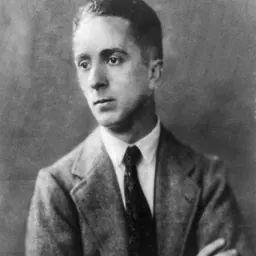
In 1961 Lubalin designed the trademark for the Saturday Evening Post, which it used for several years. His work redesigning the magazine was portrayed in a cover painting by Norman Rockwell.
Lubalin left Sudler to start his own firm, Herb Lubalin, Inc., in 1964.
Private practice
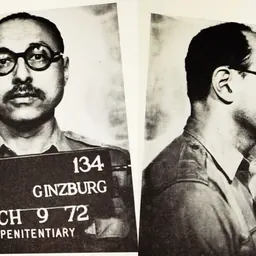
Lubalin created the trademark for the World Trade Center at its opening (1973). He designed versions of Reader's Digest, New Leader and the entire series of Eros magazine, the last of which was the subject of a U.S. Supreme Court case on obscenity, Ginzburg v. United States 383 U.S. 463 (1966).
Eros Magazine and Fact Magazine In Lubalin's private studio, he worked on a number of wide-ranging projects, from poster and magazine design to packaging and identity solutions. It was here that he became best known for his work on a series of magazines published by Ralph Ginzburg: Eros, Fact, and Avant Garde.
Eros (four issues, Spring 1962 to 1963) devoted itself to the beauty of the rising sense of sexuality and experimentation, particularly in the burgeoning counterculture. It was a quality production with no advertising, and the large format (13 by 10 inches) made it look like a book rather than a quarterly magazine. It was printed on varying papers and the editorial design has been considered as among Lubalin's greatest achievements. It quickly folded after an obscenity case brought by the U.S. Post Office.
Ginzburg and Lubalin followed with Fact, largely founded in response to the treatment Eros received. This magazine's inherent anti-establishment sentiment lent itself to outsider writers who could not be published in mainstream media; Fact managing editor Warren Boroson noted that “most American magazine, emulating the Reader's Digest, wallow in sugar and everything nice; Fact has had the spice all to itself.”
Page design Avant Garde (14 issues, January 1968 to summer 1971) also provided Lubalin with a large format of wide typographic experimentation; the page format was an almost square 11.25 by 10.75 inches bound in a cardboard cover, a physical quality that, coupled with Lubalin’s layouts, caught the attention of many in the New York design scene. The font was created by Lubalin and Tom Carnase based on their wordmark for the Avant Garde magazine. Condensed styles were drawn by Ed Benguiat in 1974.
U&lc Magazine
Lubalin spent the last ten years of his life working on a variety of projects, playing a key role in the International Typeface Corporation and its typographic journal U&lc (short for Upper and lower case). Steven Heller argues that U&lc was the first Emigre, or at least the template for its later successes, for this very combination of promotion and revolutionary change in type design. Heller further notes, “In U&lc, he tested just how far smashed and expressive lettering might be taken. Under Lubalin’s tutelage, eclectic typography was firmly entrenched.”
Don’t just read it —
keep it.
Full-length biographies made to live with: read them, listen on the way to work, watch them tonight.
- E-book
- Audio
- Video
Instant download · yours to keep · every purchase keeps this site free
Important facts
People in Herb Lubalin's life
Named in this biography and alive at the same time





Related people
Same field, nearest in time


Contemporaries
People whose lives overlapped Herb Lubalin's


Frequently asked questions
Who was Herb Lubalin?
American graphic designer (1918-1981)
When was Herb Lubalin born?
Herb Lubalin was born on 17 March 1918 in New York City.
When did Herb Lubalin die?
Herb Lubalin died on 24 May 1981 in New York City.
What was Herb Lubalin's occupation?
Herb Lubalin was a graphic designer and typographer.
What nationality was Herb Lubalin?
Herb Lubalin was American.
Sources & further reading
Cite this page
APA: Biography.guide. (2026). Herb Lubalin. https://biography.guide/herb-lubalin/
MLA: "Herb Lubalin." Biography.guide, https://biography.guide/herb-lubalin/.
Chicago: "Herb Lubalin." Biography.guide. https://biography.guide/herb-lubalin/.
Data last updated: 2026-09-22 · Spot an error? Report a correction.
Page generated 2026-09-27 05:33 UTC