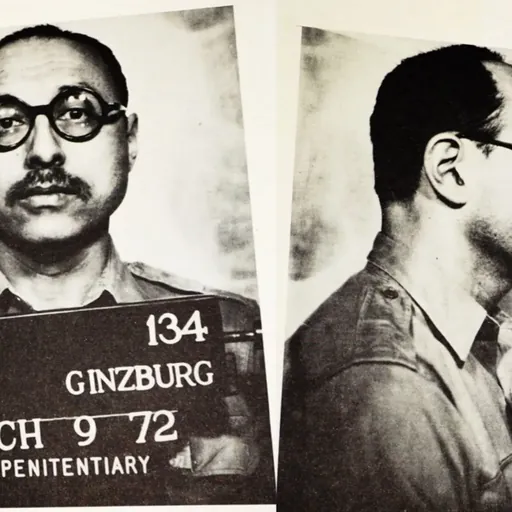
About Ralph Ginzburg
Lived 1929 – 2006 (aged 76). Ralph Ginzburg was an American journalist, known for Eros (magazine).
Ralph Ginzburg (October 28, 1929 – July 6, 2006) was an American editor, publisher, journalist, and photographer. He was best known for publishing books and magazines on erotica and art and for his conviction in 1963 for violating federal obscenity laws.
Biography Ralph Ginzburg was born in Brooklyn on October 28, 1929, to Russian-Jewish immigrant parents. He went to New Utrecht High School in Brooklyn and was president of his class. Since his parents hoped that he could be an accountant, Ginzburg later became editor-in-chief of it, which further fostered his passion for journalism. to his cathedral in 1070 through to the outright pornographic work of the 1950s, An Unhurried View examines examples of English erotic literature in an interpretive and explanatory context. The end of the book includes a bibliography of 100 titles. He convinced the notable psychoanalyst Theodor Reik to write the introduction.The book sold more than 125,000 copies in hardback and over 200,000 in print, showing Ginzburg a large potential market for this kind of publication as well as his talents in the mailing business.
In August 1961, Ginzburg managed to conduct an extensive interview of 18-year-old Bobby Fischer. Ginzburg said he got in touch with Fischer by simply giving Fischer's older sister Joan a call, and he "got along well" with Fischer. He sold the interview, entitled "Portrait of a Genius As a Young Chess Master", to Harper's Magazine, which published it in January 1962. The interview of the reclusive chess genius became one of the most famous interviews in history, especially among chess players, However, Bobby Fischer himself hated the article and denied most of it, claiming that it was not even a remotely accurate representation of his actual statements or his life, while Ralph Ginzburg destroyed all of the research materials that would have backed his interview. which ironically added to its popularity.
After he finally saved enough money to rent his own office—a fifth-floor walk-up in an old Manhattan office building, Ginzburg published his first self-published book, 100 Years of Lynchings in 1962, a collection of newspaper accounts that directly exposed the history and the status quo of American racism. The book was a sign that Ginzburg had wed his business to his interest in social activism,
From 1968 to 1971, Ginzburg published Avant Garde, an art and culture magazine with graphic and logogram designed by Herb Lubalin, and the logo font of the magazine later gave birth to a well-known typeface of the same name. Avant Garde focused on radical politics and stopped publication when Ginzburg started serving his sentence in 1972. (He wrote "Castrated: My Eight Months in a Federal Prison" to describe his time in prison.) Although he tried to revive it as a tabloid newspaper with his wife after his release from prison, his attempt failed and the new Avant Garde lasted only one issue.
Apart from publishing and editing, Ginzburg continued to be an activist. Ginzburg's interest in activism also extended to opposing circumcision. In 1986, he founded Outlaw Unnecessary Circumcision in Hospitals (O.U.C.H.), a non-profit organisation against circumcision, striving to stop health insurance companies from funding circumcision surgery and therefore lowering the rate of American baby boys being circumcised.
When Ginzburg turned 55, he retired from publishing and started a second career as a photojournalist. He became a freelance photographer for the New York Post, specialising in New York scenes. His last book, I Shot New York, consisted of images he took of life in New York City on 365 consecutive days.
Eros magazine
In 1962, Ginzburg began publication of his first major work, Eros,
According to Ginzburg, Eros was published as "the result of recent court decisions that have realistically interpreted America's obscenity law that has given this country a new breath of freedom of expression". Ginzburg made the best of such freedom and devoted the magazine to "the joys of love and sex".
Meanwhile, Eros, in fact, contained more sophisticated and critical subtexts.
Eros magazine is significant in American publishing history as it covered and helped to incite the sexual revolution, while it also contributed to the formation of counter-culture in the late 1960s. At last, the fourth final issue of Eros, with the eight pages of colour photos showing a naked muscular black man and a naked white woman embracing each other, finally convinced Kennedy to authorise prosecution. He was supported by Deputy Attorney General Nicholas Katzenbach and Solicitor General Archibald Cox, and Katzenbach believed that they would eventually prosecute Ginzburg because of his continual testing of boundaries of obscenity in his magazine, "so why wait". The Trial Judge, Ralph Body, explained the finding of the court as:
In conclusion, after a thorough reading and review of all the indicted materials, this Court finds that said materials are compilations of sordid narrations dealing with sex, in each case in a manner designed to appeal to prurient interests. They are devoid of theme or ideas. Throughout the pages of each can be found constant repetition of patently offensive words used solely to convey debasing portrayals of natural and unnatural sexual experiences. Each in its own way is a blow to sense, not merely sensibility. They are all dirt for dirt's sake and dirt for money's sake.
Ginzburg appealed, and a year later the Third Circuit easily affirmed the decision of the lower court. He appealed again and his case got to the Supreme Court in 1965. Under such consideration and borrowing principles from the Roth case, the Supreme Court carefully assumed that "standing alone, the publications (Eros, Liaison and The Housewife's Handbook on Selective Promiscuity) themselves might not be obscene. and therefore mailing advertisements for obscene material would be considered illegal, even though the material actually sent in response to orders resulting from the advertisement was not obscene itself. crimes he was in fact not charged with.
After the loss of his last plea to vacate his conviction (an appeals court earlier reduce his sentence from five to three), Ginzburg started his time in prison in 1972, and was released on parole eight months later,
Another contributing factor to Ginzburg's being indicted and found guilty was his appearance. When magazines are typically deemed as an extension of their editors, and editors would be considered as representatives of ideal readers of the magazines, the appearance of Ralph Ginzburg effectively made for a bad impression of his magazine, especially when his magazines were about sex. He looked exactly like Central Casting's idea of a pornographer: "shady, you might say shifty, with a thin, sallow face and a small mustache". To borrow from Earl Warren, Chief Justice of the Supreme Court during the period of Ginzburg's case, Ginzburg lost because he was as unattractive a First Amendment claimant as possible.
Avant Garde From January, 1968 through July, 1971, Ginzburg published Avant Garde, a handsome softbound periodical. Ginzburg's age and federal conviction had calmed him down some by this time: Avant Garde could not be termed obscene, but was filled with creative imagery often caustically critical of American society and government, as well as sexual themes and (for the time) crude language. One cover featured a naked pregnant woman; another had a parody of Willard's famous patriotic painting, "The Spirit of '76", with a white woman and a black man photographed by Carl Fischer.
Avant Garde had a modest circulation but was extremely popular in certain circles, including New York's advertising and editorial art directors. Herbert F. Lubalin (1918–1981), a post-modern design guru, was Ginzburg's collaborator on his four best-known magazines, including Avant Garde, which in turn gave birth to a well-known typeface of the same name. It was originally intended primarily for use as in logos, with the first version consisting solely of 26 capital letters. Inspired by Ginzburg and his wife, Lubalin's design was rendered by his assistants and Tom Carnase, one of Lubalin's partners. It is characterized by geometrically perfect round strokes and short, straight lines, with an extremely large number of ligatures and negative kerning. The International Typeface Corporation (ITC), of which Lubalin was a founder, subsequently released a full version in 1970.
Personal life Ginzburg was married to Shoshana Brown Ginzburg until his death on July 6, 2006. He had three children: Shepherd Ginzburg, Lark Kuhta, and Bonnie Erbe, the host of the PBS show To The Contrary.
List of publications
Books An Unhurried View of Erotica, etc. by Ralph Ginzburg; introduction by Theodor Reik; preface by George Jean Nathan (New York: Helmsman Press, 1959. ) 100 Years of Lynchings edited by Ralph Ginzburg (New York: Lancer Books, 1962); Baltimore, MD: Black Classic Press, 1988. . The Housewife's Handbook on Selective Promiscuity by Rey Anthony (real name Maxine Sanini), published by Ralph Ginzburg (New York: Documentary Books, 1962. ) Eros on Trial: "A Portfolio of The Most Beautiful Art From Eros" by Ralph Ginzburg (New York: Book Division of Fact Magazine, 1966. ) The Best of Fact edited by Ralph Ginzburg and Warren Boroson (New York: Trident Press, 1967, ) Castrated: My Eight Months in Prison (New York: Avant-Garde Books, 1973. ) I Shot New York, photographs by Ralph Ginzburg; foreword by George Plimpton; captions by Shoshana Ginzburg (New York: Harry Abrams, 1999. )
Magazines Eros published by Eros Magazine, Inc., New York (Vol. I, Nos. 1–4, 1962) Moneysworth published by Avant-Garde Media, Inc. Fact published by Fact Magazine, Inc., New York (Vol. I–IV, Jan. 1964 to Aug. 1967). Vol. I, no. 2, included the first printing of Mark Twain's "Some Thoughts on the Science of Onanism". Avant Garde published by Avant-Garde Media, Inc. Better Living published by Avant-Garde Media, Inc. American Business published by Avant-Garde Media, Inc. Uncle Sam Magazine published by Avant-Garde Media, Inc.
Don’t just read it —
keep it.
Full-length biographies made to live with: read them, listen on the way to work, watch them tonight.
- E-book
- Audio
- Video
Instant download · yours to keep · every purchase keeps this site free
Important facts
People in Ralph Ginzburg's life
Named in this biography and alive at the same time




Related people
Same field, nearest in time

Contemporaries
People whose lives overlapped Ralph Ginzburg's
Frequently asked questions
Who was Ralph Ginzburg?
American writer, publisher and photo-journalist
When was Ralph Ginzburg born?
Ralph Ginzburg was born on 28 October 1929 in New York City.
When did Ralph Ginzburg die?
Ralph Ginzburg died on 6 July 2006.
What was Ralph Ginzburg's occupation?
Ralph Ginzburg was a journalist.
What was Ralph Ginzburg known for?
Ralph Ginzburg was known for Eros (magazine).
What nationality was Ralph Ginzburg?
Ralph Ginzburg was American.
Sources & further reading
Cite this page
APA: Biography.guide. (2026). Ralph Ginzburg. https://biography.guide/ralph-ginzburg/
MLA: "Ralph Ginzburg." Biography.guide, https://biography.guide/ralph-ginzburg/.
Chicago: "Ralph Ginzburg." Biography.guide. https://biography.guide/ralph-ginzburg/.
Data last updated: 2026-09-22 · Spot an error? Report a correction.
Portrait: Wikimedia Commons · author & licence
Page generated 2026-09-27 05:04 UTC