
About Henry Van Brunt
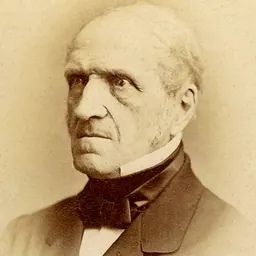
Lived 1832 – 1903 (aged 70). Henry Van Brunt was an American architect.
Henry Van Brunt FAIA (September 5, 1832 – April 8, 1903) was an American architect and architectural writer.
Life and work Van Brunt was born in Boston in 1832 to Gershom Jacques Van Brunt and Elizabeth Price Bradlee. Van Brunt attended Boston Latin School, and graduated from Harvard College in 1854.
From 1854 to 1857, he apprenticed with architect George Snell, then worked with Richard Morris Hunt, in New York City.
During the Civil War, Van Brunt served as Secretary to the Admiral of the North Atlantic Squadron, United States Navy. He resigned on February 15, 1864.
In the 1860s, Van Brunt and fellow Harvard graduate William Robert Ware established the architectural firm of Ware & Van Brunt. The firm produced designs for many buildings in the Boston area, including Harvard University's Memorial Hall, "said to be one of the greatest examples of Ruskinian Gothic architecture outside of England".
In 1869, he married Alice S. Osborn; together they had 6 children. In 1874 Van Brunt published a translation of Eugène Viollet-le-Duc's Discourses on architecture, and he remained a prolific writer through his career.
His partnership with Ware dissolved in 1881. The same year, Van Brunt and former employee Frank M. Howe established the firm of Van Brunt & Howe, and about six years after took the dramatic step of moving his office from Boston to Kansas City, partly for multiple commissions for the Union Pacific Railroad for grand stations in western cities like Ogden, Utah (1889; burned down 1923), Denver, Colorado (1895; rebuilt 1912), Cheyenne, Wyoming and Omaha, Nebraska (1899; replaced 1931). Many Kansas City civic landmarks of the time were Van Brunt's designs. Stylistically, most of his later work is comfortably consistent with Richardsonian Romanesque; in at least one case, the Hoyt Library, he adapted and finished a rejected Richardson design.
In 1884 he was elected an officer of the American Institute of Architects. In 1899 he became president of the AIA for a one-year term.
Van Brunt returned to Massachusetts around 1902, and died in Milton, Massachusetts, in 1903. 1869 - Adams Academy, now the Quincy Historical Society, Quincy, Massachusetts 1870 - Memorial Hall (Harvard University), Cambridge, Massachusetts, continuously redesigned through 1897 1870 - Addition to Harvard Hall, Harvard University, Cambridge, Massachusetts 1870 - Weld Hall, Harvard University 1872 - Charles Freeland tomb, Mount Auburn Cemetery, Cambridge 1873 - Lawrence Hall, Episcopal Divinity School, Cambridge, expanded 1880 1875 - Addition to Gore Hall, Harvard University, Cambridge, Massachusetts (demolished) 1875 - Walter Hunnewell house, Hunnewell estate, Wellesley, Massachusetts (then West Needham) 1881 - Yorktown Memorial, Yorktown, Virginia, with sculptor J.Q.A. Ward 1881 - Music Hall, Wellesley College, Massachusetts 1881-1883 - Old Library, University of Michigan (demolished)
Van Brunt & Howe
1883 - 167 Brattle Street (his residence), Cambridge, Massachusetts 1883 - Harvard Medical School, Boston, Massachusetts (demolished) 1883 - William Washington Gordon Monument, Savannah, Georgia 1884 - First National Bank, Portland, Maine 1885 - Cheyenne Union Depot, now the Wyoming Transportation Museum, 15th Street and Capitol Avenue, Cheyenne, Wyoming 1887 - Soldiers' and Sailors' Monument, Arlington, Massachusetts 1887 - Hoyt Library, Saginaw, Michigan 1888 - Cambridge Public Library, Cambridge, Massachusetts 1888 - Gibraltar Building, Kansas City, Missouri (razed) 1889 - Union Pacific Railroad Depot, North 2nd Street, Lawrence, Kansas 1904 - Pipe Organ Case of the 10,000 pipe instrument exhibited by the Los Angeles Art Organ Co., Festival Hall, Louisiana Purchase Exposition, St. Louis, Missouri (a temporary construction)
Writing Translator of: Eugène Viollet-le-Duc. Discourses on architecture. Boston : J.R. Osgood, 1875. On the Present Condition and Prospects of Architecture. Atlantic Monthly 57, no. 341 (March 1886). Henry Hobson Richardson, Architect. Atlantic Monthly 58:349 (November 1886). Architecture in the West, Atlantic Monthly 64:386 (December 1889). Greek Lines and Other Architectural Essays. Houghton, Mifflin. 1893
Gallery
Don’t just read it —
keep it.
Full-length biographies made to live with: read them, listen on the way to work, watch them tonight.
- E-book
- Audio
- Video
Instant download · yours to keep · every purchase keeps this site free
Important facts
People in Henry Van Brunt's life
Named in this biography and alive at the same time




Related people
Same field, nearest in time



Contemporaries
People whose lives overlapped Henry Van Brunt's




Frequently asked questions
Who was Henry Van Brunt?
United States architect (1832–1903)
When was Henry Van Brunt born?
Henry Van Brunt was born on 5 September 1832 in Boston.
When did Henry Van Brunt die?
Henry Van Brunt died on 8 April 1903 in Milton.
What was Henry Van Brunt's occupation?
Henry Van Brunt was an architect.
What nationality was Henry Van Brunt?
Henry Van Brunt was American.
Sources & further reading
Cite this page
APA: Biography.guide. (2026). Henry Van Brunt. https://biography.guide/henry-van-brunt/
MLA: "Henry Van Brunt." Biography.guide, https://biography.guide/henry-van-brunt/.
Chicago: "Henry Van Brunt." Biography.guide. https://biography.guide/henry-van-brunt/.
Data last updated: 2026-09-20 · Spot an error? Report a correction.
Page generated 2026-09-27 05:22 UTC