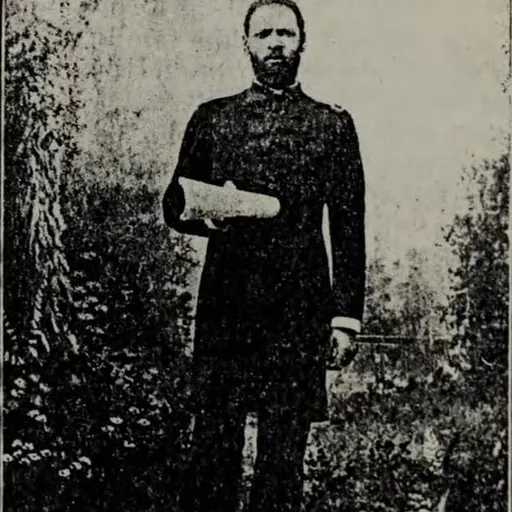
Henry V. Plummer
1844-1906 , Baptist clergyman and U.S. Army chaplain
About Henry V. Plummer
Lived 1844 – 1905 (aged 60). Henry V. Plummer was an American clergyman and baptists.
Henry Vinton Plummer (July 30, 1844 – February 10, 1905) was an American Baptist preacher and chaplain with the United States Army Buffalo Soldiers. Born a slave on a plantation near Bowie, Maryland, he escaped slavery in his early 20s and enlisted in the Union Navy during the American Civil War. He served as a pastor at several churches before being appointed chaplain of the 9th Cavalry Regiment by President Chester A. Arthur in 1884. At that time, he was the only black officer in the US Army. In 1894 he was dishonorably discharged from the Army for drunkenness and poor conduct, but his discharge was upgraded to honorable after a review in 2005.
Early life Henry Vinton Plummer was born a slave July 30, 1844, Plummer's father was Adam Francis Plummer and his mother was Emily Saunders Plummer and he had multiple sisters, including Sarah Miranda Plummer Clark and Nellie Arnold Plummer. He and his mother were sold in 1851, and in 1862, Plummer escaped from slavery and traveled to Riversdale Plantation in Prince George's County to find his father. He hid at Riversdale for a time, before he enlisted with the Union Navy during the American Civil War in 1864. He married and had multiple children, including H. Vinton Plummer.
Pre-Army career After the war, Plummer took a position as a coachman and gardener with B. F. Guy of Hyattsville. He also became involved in the politics and religious life of Washington DC's Maryland suburbs. In 1870, Plummer founded the Union Association of Bladensburg, Maryland. In 1871, he received an appointment as watchman for the US Postal Service in Washington DC. In 1882 he became the pastor of Mount Carmel Church, where he served until 1884. In 1882, he was a member of the executive committee of the Maryland Republican Association under president James S. Crawford. Plummer was a participant of the First Washington Baptist Association in the early 1880s. In 1883 he was put forward as a Republican candidate for the Maryland House of Delegates but was passed over for the nomination on account of his race. In 1883, he was vice president of the Hyattsville Maryland Republican Club along with Robert S. Whitticomb and Ferdinand Hall under president F. H. Smith.
Army In 1884, President Chester A. Arthur appointed Plummer chaplain of the 9th Cavalry Regiment. His appointment was in large part due to the advocacy by Hart B. Holton. He replaced Chaplain Pierce and was the only black officer in the Army, holding the rank of captain. By 1890, 3 more black officers were also in the army, Charles Young and John H. Alexander, both also of the 9th Cavalry, and Allen Allensworth of the 24th Infantry, all serving in black regiments.
From August 1, 1885 to March 10, 1891, he was stationed at Fort McKinney in Wyoming. He also served for a time at Fort Riley in Kansas.
His work was not without controversy. While stationed at Fort Robinson in Nebraska, he started a newspaper where, under a pseudonym, he advocated that the forts black soldiers defend themselves physically against abuse they received in nearby Crawford, Nebraska. In August 1894, Plummer proposed a scheme to the Secretary of War, Daniel S. Lamont, to explore parts of Africa. He designed this proposal with the support of Bishop Henry Turner and numerous other proponents of African Americans moving to Africa. However, his career in the army was cut short and ended in September.
On August 23, 1894, Plummer was court martialed for drinking and furnishing liquor and behaving inappropriately.
Post-Army life and death
Plummer returned to Washington DC, where he took part in Baptist leadership, being a leader of the Baptist Minister's Union in 1899. He soon moved to Kansas City, Kansas, where he continued to be a religious leader and active in the local Republican Party.
Plummer died February 10, 1905.
Don’t just read it —
keep it.
Full-length biographies made to live with: read them, listen on the way to work, watch them tonight.
- E-book
- Audio
- Video
Instant download · yours to keep · every purchase keeps this site free
Important facts
People in Henry V. Plummer's life
Named in this biography and alive at the same time



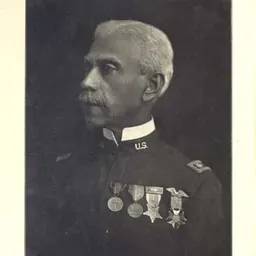


Related people
Same field, nearest in time
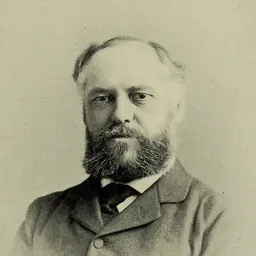

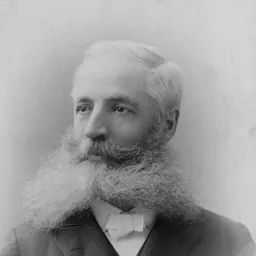
Contemporaries
People whose lives overlapped Henry V. Plummer's

Frequently asked questions
Who was Henry V. Plummer?
1844-1906 , Baptist clergyman and U.S. Army chaplain
When was Henry V. Plummer born?
Henry V. Plummer was born on 30 July 1844 in Bowie.
When did Henry V. Plummer die?
Henry V. Plummer died on 19 February 1905 in Kansas City.
What was Henry V. Plummer's occupation?
Henry V. Plummer was a clergyman and baptists.
What nationality was Henry V. Plummer?
Henry V. Plummer was American.
Sources & further reading
Cite this page
APA: Biography.guide. (2026). Henry V. Plummer. https://biography.guide/henry-v-plummer/
MLA: "Henry V. Plummer." Biography.guide, https://biography.guide/henry-v-plummer/.
Chicago: "Henry V. Plummer." Biography.guide. https://biography.guide/henry-v-plummer/.
Data last updated: 2026-09-22 · Spot an error? Report a correction.
Portrait: Wikimedia Commons · author & licence
Page generated 2026-09-27 04:59 UTC