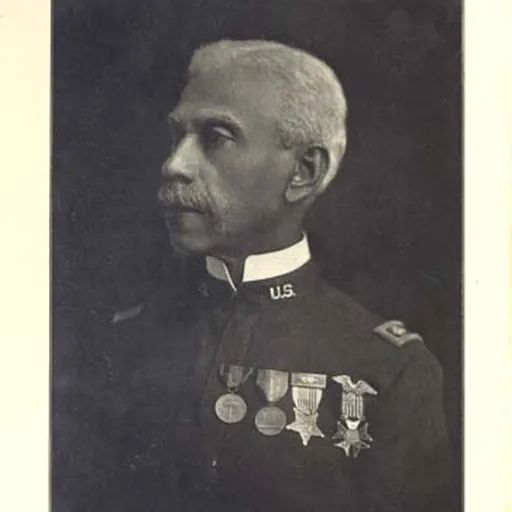
Allen Allensworth
American enslaved person, Buffalo Soldier and religious leader
About Allen Allensworth
Lived 1842 – 1914 (aged 72). Allen Allensworth was an American military personnel, allensworth and california.
Allen Allensworth (April 7, 1842 – September 14, 1914) was an American chaplain, colonel, city founder, and theologian. Born into slavery in Kentucky, he escaped during the American Civil War by joining the 44th Illinois Volunteers as a Union soldier. After being ordained as a Baptist minister by the Fifth Street Baptist Church, April 9, 1871, he worked as a teacher, led several churches, and was appointed as a chaplain in the United States Army. In 1886, he gained appointment as a military chaplain to a unit of Buffalo Soldiers in the West, becoming the first African American to reach the rank of lieutenant colonel in the United States Army. He served in the Army for 20 years, retiring in 1906.
Allensworth was a prolific public speaker, embarking on a speaking tour with the goal of inspiring Black youth. His lectures included Five Manly Virtues Exemplified, The Battle of Life and How to Fight It, and Character and How to Read It. While on tour in Pasadena, he met William Alexander Payne, a professor. In 1908, Allensworth, Payne, and a small committee founded Allensworth, California, the first community established, financed, and governed entirely by African Americans. It continues to be restored and maintained as the Colonel Allensworth State Historic Park.
Early life and education Born into slavery in Louisville, Kentucky in 1842, (The National Park Service's Sailor record for Allensworth states that he was born in New York, New York.)
His mother was enslaved by A.P. and Bett Starbird. The mistress assigned Allen as a young slave to her son Thomas. When the Starbird boy started school, Allen began to learn from him, although it was illegal. After his father died when Allen was young, his mother chose to be sold as a cook to a neighbor, the attorney Nat Wolfe. When the Starbirds found Allen was learning to read, they separated him from their son and placed him with another family, the Talbots. Mrs. Talbot, a Quaker, was kind to Allen and continued to teach him to read and write; she also took him to a Sunday school for slave children. When Bett Starbird discovered this, she took Allen back. In 1854 she made arrangements with her husband's partner John Smith to send the boy downriver to a plantation owned by John's brother Pat, in Henderson, Kentucky, to put an end to his learning. On the steamboat, the boy was placed in the care of a slave steward rather than being chained with other slaves below deck, who were being transported for sale to downriver markets. He was ordained as a preacher by the Baptists in 1871. In the 1870s, Allensworth went to Tennessee to study theology. During this time he also served as a preacher in Franklin, Tennessee, south of Nashville.
Post-Reconstruction era
Allensworth was called to the State Street Church in Bowling Green, Kentucky. He also gave public lectures. That fall, he went to Boston to give a series of lectures, after studying public speaking in Philadelphia.
On his return, he met people from the American Baptist Publication Society in Philadelphia, who appointed him as Sunday School Missionary for the state of Kentucky. He had always worked to build up the Sunday Schools at his churches, and this gave him the chance to continue to work on education around the state. The Colored Baptist State Sunday School Convention of Kentucky appointed him to the position of State Sunday School Superintendent. He was assigned to the 24th Infantry Regiment, known as the Buffalo Soldiers.
His family accompanied him on assignments in the West, ranging from Fort Bayard, New Mexico Territory to Fort Supply, Indian Territory, and Fort Harrison, near Helena, Montana.
Josephine Leavell, his wife, played organ in the fort chapels.
In 1887, Allensworth was featured in Men of Mark: Eminent, Progressive and Rising, an anthology of African-American biographies by William J. Simmons.
His assignment to Fort Douglas in Utah (1886–1888) was initially marked by a disparaging column in the local newspaper; near the end of his time there it published a retraction and lauded his work at the fort.
In 1889, while at Fort Bayard, Allensworth published the pamphlet Outline of Course of Study, and The Rules Governing Post Schools of Ft. Bayard, N.M., which became a military education standard.
By the time of his retirement in 1906, Allensworth had been promoted to the rank of lieutenant colonel, the second African American to have become a commanding officer
By 1908, he had founded Allensworth in Tulare County, about thirty miles north of Bakersfield, in the heart of the San Joaquin Valley. The black settlers of Allensworth built homes, laid out streets, and put up public buildings. They established a church, and organized an orchestra, a glee club, and a brass band. Allensworth is the only California community to be founded, financed and governed by African Americans.
The Allensworth colony became a member of the county school district and the regional library system and a voting precinct. Residents elected the first African-American Justice of the Peace in post-Mexican California. In 1914, the California Eagle reported that the Allensworth community consisted of of deeded land worth more than US$112,500.
Allensworth soon developed as a town, not just a colony. Among the social and educational organizations that flourished during its golden age were the Campfire Girls, the Owl Club, the Girls' Glee Club, and the Children's Savings Association, for the town's younger residents, while adults participated in the Sewing Circle, the Whist Club, the Debating Society, and the Theater Club. Col. Allensworth was an admirer of the African-American educator Booker T. Washington, the founding president and longtime leader of the Tuskegee Institute in Alabama. Allensworth dreamed that his new community could be self-sufficient and become known as the "Tuskegee of the West."
The Girls' Glee Club was modeled after the Jubilee Singers of Fisk University, who had toured internationally. They were the community's pride and joy. All the streets in the town were named after notable African Americans and/or white abolitionists, such as Sojourner Truth, Frederick Douglass, poet Paul Laurence Dunbar, and Harriet Beecher Stowe, abolitionist and author of Uncle Tom's Cabin. The 1915 voting registration showed "farmers, storekeepers, carpenters, nurses and more, all suggesting that the colony’s business and industrial output was prodigious."
Several events led to the town's decline. Allen, who was the leader of the town, died in an accident in 1914. Over time, the town experienced a shortage of water. The Great Depression and World War II drew people to places with greater opportunities. More people left when three of the town's wells were found to have arsenic in 1965, About 240 acres from Allensworth was used to create the California State Historic Park, Colonel Allensworth State Historic Park, which became part of the state park system in 1973. It was updated in 1985 from funding attained from historic development section of the California Parks and Recreation Facilities Act of 1984. Colonel Allensworth was buried at Angelus-Rosedale Cemetery in Los Angeles, California.
Legacy and honors
In 1914, Charles Alexander wrote Allensworth's biography, Battles and Victories of Allen Allensworth, A.M., Ph.D., Lieutenant-Colonel, Retired, U.S. Army.
The state has preserved the Allensworth site and is gradually restoring its buildings. The most important building is the school house, which the community prized as representing the future of its children. In use until 1972, it is furnished as it would have been on a school day in 1915. The park arranges events to celebrate the former community's history, and the park's visitor center features a film about the site. An annual re-dedication ceremony reaffirms the vision of the original pioneers.
Don’t just read it —
keep it.
Full-length biographies made to live with: read them, listen on the way to work, watch them tonight.
- E-book
- Audio
- Video
Instant download · yours to keep · every purchase keeps this site free
Important facts
People in Allen Allensworth's life
Named in this biography and alive at the same time





Related people
Same field, nearest in time

Contemporaries
People whose lives overlapped Allen Allensworth's

Frequently asked questions
Who was Allen Allensworth?
American enslaved person, Buffalo Soldier and religious leader
When was Allen Allensworth born?
Allen Allensworth was born on 7 April 1842 in Louisville.
When did Allen Allensworth die?
Allen Allensworth died on 14 September 1914 in Monrovia.
What was Allen Allensworth's occupation?
Allen Allensworth was a military personnel, allensworth and california.
What nationality was Allen Allensworth?
Allen Allensworth was American.
Sources & further reading
· Wikipedia: Allen Allensworth
Cite this page
APA: Biography.guide. (2026). Allen Allensworth. https://biography.guide/allen-allensworth/
MLA: "Allen Allensworth." Biography.guide, https://biography.guide/allen-allensworth/.
Chicago: "Allen Allensworth." Biography.guide. https://biography.guide/allen-allensworth/.
Data last updated: 2026-09-21 · Spot an error? Report a correction.
Portrait: Wikimedia Commons · author & licence
Page generated 2026-09-27 04:59 UTC