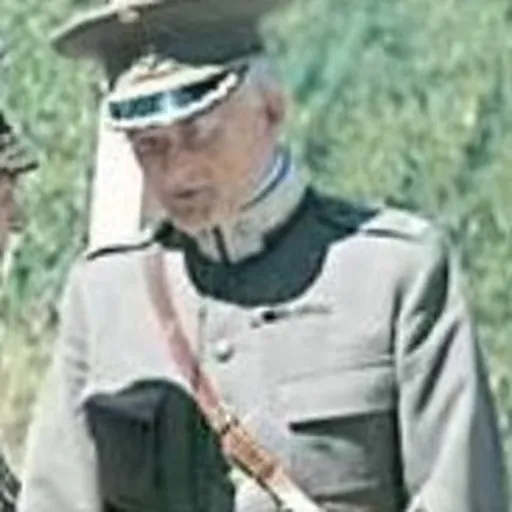
About Henry Kellgren
Lived 1886 – 1954 (aged 68). Henry Kellgren was a Swedish military personnel.
Lieutenant General Per Henry Theodor Kellgren (23 August 1886 – 19 November 1954) was a senior Swedish Army officer whose career spanned nearly five decades and brought him to some of the highest levels of Sweden's military establishment. Commissioned in 1908, he served in both regimental and staff positions and steadily rose through the ranks. After attending the Royal Swedish Army Staff College, he held several important appointments, including Chief of Staff of the Northern Division and the Infantry Inspectorate. In 1936, he became commanding officer of the North Scanian Infantry Regiment, and in 1938 he was appointed Chief of the Military Office of the Land Defence.
As Chief of the Military Office, Kellgren was responsible for maintaining Sweden's extensive contacts with foreign military attachés, particularly those from Germany, Britain, and the United States. Promoted to major general in 1942, he became increasingly influential within the defence establishment. When the command offices of the Army, Navy, and Air Force were merged in 1945, Kellgren was appointed their head and became the minister of defence's principal military adviser, exercising considerable influence over military appointments and promotions.
Kellgren's wartime contacts with the German military attaché, , later became the subject of considerable controversy. In 1945, Supreme Commander General Helge Jung sought to have him dismissed, regarding Kellgren as unfit for office and as part of an older, pro-German-oriented generation of Swedish officers. Kellgren defended his contacts with von Uthmann by stating that they had been conducted in accordance with instructions from the Swedish Ministries of Foreign Affairs and Defence. The government ultimately supported Kellgren, and an official 1946 publication, known as the Kellgren White Paper, was issued to document and defend his conduct.
After retiring from active military service, Kellgren remained active in public life. He served for three years as chairman of the Stockholm Trotting Association, where he played an important role in promoting international trotting events, including the Russian Gala meetings, an intercity match against Hamburg, and Solvalla's International Elite Race.
Early life Kellgren was born on 23 August 1886 at manor in , Jönköping County, Sweden the son of Patrik Anton Teodor Kellgren and his wife Emma Christina Eriksson. He was the nephew of the physiotherapist (1837–1916). He passed mogenhetsexamen from in Skara in 1906.
Career
Military career Kellgren was commissioned as a underlöjtnant in the 2nd Life Grenadier Regiment in 1908 and promoted to lieutenant in 1913. From 1917 to 1919, he attended the Royal Swedish Army Staff College, after which he served as an aspirant with the General Staff from 1919 to 1921.
The affair became a key element of Jung's personal campaign against older officers whom he believed to be pro-German. Neither the Prime Minister nor the Minister of Defence supported his demands, prompting Jung to approach Foreign Minister Östen Undén. He warned that the government could face accusations of passivity if it failed to act against Swedes who had served—or had been willing to serve—Hitler's interests. Undén took the warning seriously and demanded an explanation from Kellgren. In response, Kellgren produced a lengthy written defence, arguing that his contacts with von Uthmann had been conducted under instructions from the Ministries of Foreign Affairs and Defence, and that the German military attaché was an unreliable source of information. The government reviewed Kellgren's defence and gave it strong backing. In response, the Swedish government decided to publish an official documentary report based largely on Kellgren's written defence. Foreign Minister Östen Undén personally supervised the preparation of what he referred to as the Kellgren White Paper, working closely with the Prime Minister and the Minister of Defence. The publication, Relations Between the Chief of the Military Office of the Land Defence and the German Military Attaché in Stockholm, 1939–1945, was released in early July 1946 and generated extensive editorial commentary throughout the Swedish press.
Personal life On 22 October 1912 in Norrköping, Kellgren married Adéle Alice Södergren (born 25 January 1888 in Stockholm), the daughter of factory manager Johan Fredrik Södergren and adopted daughter to his wife Emma Alma Augusta Lindquister. They divorced in 1923.
His funeral service was held on 26 November 1954 at the Northern Crematorium in Stockholm, officiated by the Court Chaplain . Among those in attendance were Foreign Minister Östen Undén and numerous senior military officers, including the Chief of the Army, Lieutenant General Carl August Ehrensvärd; the Chief of the Military Office of the Ministry of Defence, Major General Carl Årmann; the commander of the East Coast Naval District, Rear Admiral Erik Anderberg; as well as General Olof Thörnell, Major General Pehr Janse, Major General , and Lieutenant General Hjalmar Åström.
General Ehrensvärd delivered the Army's tribute, Major General Årmann spoke on behalf of the Military Office of the Ministry of Defence, and Professor represented the Swedish trotting community.
Dates of rank 31 December 1908 – Underlöjtnant 20 June 1913 – Lieutenant 2nd Class 26 September 1917 – Lieutenant 1st Class 28 April 1922 – Captain 17 October 1931 – Major 1 June 1934 – Lieutenant colonel 16 November 1936 – Colonel 1 July 1942 – Major general 20 September 1951 – Lieutenant general
Awards and decorations
Swedish
Lingiad Anniversary Medal (Lingiadens jubileumsmedalj) Swedish Military Sports Association's Gold Medal (Sveriges militära idrottsförbunds guldmedalj) Landstormen Silver Medal (Landstormens silvermedalj) Gold Badge of Honour of the National Association of Swedish Militia Officers' Societies (Landstormsofficerssällskapens i Sverige Riksförbund hederstecken i guld)
Foreign
Grand Officer of the Order of Merit of the Kingdom of Hungary
Honours Member of the Royal Swedish Academy of War Sciences (1938)
Don’t just read it —
keep it.
Full-length biographies made to live with: read them, listen on the way to work, watch them tonight.
- E-book
- Audio
- Video
Instant download · yours to keep · every purchase keeps this site free
Important facts
People in Henry Kellgren's life
Named in this biography and alive at the same time




Related people
Same field, nearest in time




Contemporaries
People whose lives overlapped Henry Kellgren's
Frequently asked questions
Who was Henry Kellgren?
Swedish military personnel
When was Henry Kellgren born?
Henry Kellgren was born on 23 August 1886 in Ljungarum.
When did Henry Kellgren die?
Henry Kellgren died on 19 November 1954 in Engelbrekt church parish.
What was Henry Kellgren's occupation?
Henry Kellgren was a military personnel.
What nationality was Henry Kellgren?
Henry Kellgren was Swedish.
Sources & further reading
Cite this page
APA: Biography.guide. (2026). Henry Kellgren. https://biography.guide/henry-kellgren/
MLA: "Henry Kellgren." Biography.guide, https://biography.guide/henry-kellgren/.
Chicago: "Henry Kellgren." Biography.guide. https://biography.guide/henry-kellgren/.
Data last updated: 2026-09-20 · Spot an error? Report a correction.
Page generated 2026-09-27 05:09 UTC