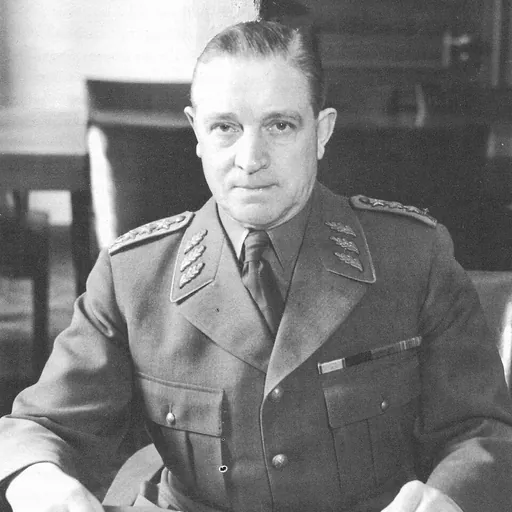
About Helge Jung
Lived 1886 – 1978 (aged 91). Helge Jung was a Swedish military officer and soldier.
General Helge Victor Jung (23 March 1886 – 3 January 1978) was a Swedish Army officer. Helge Jung had a distinguished military career in the Swedish Army. He began as a volunteer in 1904, graduated from the Military Academy Karlberg in 1906, and rose through the ranks, becoming a lieutenant in 1909 and later a captain in 1921. Jung served in various roles, including as an instructor and company commander, and attended military courses.
His contributions extended to the realm of war history and defence debate. Jung led the work on a comprehensive book about Sweden's war history, conducted extensive archival research, and played a key role in defence policy discussions. He founded the New Military Journal and had a significant influence on the Defence Act of 1936, which included a ten-year rearmament plan.
Jung's career continued to advance, and he became Chief of the Army Staff and the General Staff Corps in 1937. He advocated for active action in the event of war with the Soviet Union. However, disagreements within his circle of officers arose in the years leading up to World War II.
Jung was promoted to general in 1944 and appointed Supreme Commander of the Swedish Armed Forces. He held this position until 1951 and played a crucial role in shaping the future organization of the Swedish defence post-World War II. Despite facing challenges and opposition, Jung's determination and strategic leadership left a lasting impact on the Swedish military, modernizing its defence and anchoring it among the people. Historians describe Jung as a complex figure with both tactical cunning and a commitment to strengthening Sweden's defence.
Early life Jung was born on 23 March 1886 in Malmö, Sweden, the son of the headmaster Victor Jung and his wife Maria (née Levan). Jung passed mogenhetsexamen in Malmö in 1903 and then studied history at Lund University for a couple of semesters from 1903 to 1904.
Career
Early military career He was accepted as a volunteer at the South Scanian Infantry Regiment (I 7) in 1904 and graduated from the Military Academy Karlberg in 1906 and was commissioned into the Swedish Army the same year as an underlöjtnant in the same regiment where he was promoted to lieutenant in 1909. From 1912 to 1916, Jung served as a regimental adjutant in the South Scanian Infantry Regiment, whereupon he attended the Royal Swedish Army Staff College from 1916 to 1918. He was a cadet officer at the Military Academy Karlberg from 1919 to 1922: first at the reserve officer courses during 1919 and then at the officer courses from 1919 to 1922. He was an assistant teacher in martial law and service regulations on the officer course at the Military Academy Karlberg from 1921 to 1922.
During this time, Jung took an instructor course at the Royal Central Gymnastics Institute from 1907 to 1908,
As head of the War History Department, he led the work on Sveriges krig 1611–1632 ("Sweden's war 1611–1632"), a book in eight volumes published 1936–1939. and eventually founded Ny militär tidskrift ("New Military Journal") in 1927, whose editor he was 1927–1930. Even before he had time to take office, however, he was appointed on 30 June to be Acting Chief of Military Office of the Land Defence from 1 August, a post he held until 30 June 1937. On 13 November 1936, he was relieved of command of the North Scanian Infantry Regiment and was appointed executive commander of the Life Regiment Grenadiers (I 3) from 16 November, but was given continued leave to serve as Chief of the Military Office of the Land Defence.
As part of the Defence Act of 1936, the General Staff was divided into the Defence Staff and the Army Staff. This was entirely in line with Jung's junta's argument for a unified leadership of the armed forces in a more efficient organization. As a reward for his persistent work in the 1930 Defence Commission, Jung was appointed Chief of the Army Staff and the General Staff Corps and took office on 1 July 1937. He was promoted to major general in 1938 Thereafter, from 1 October 1940 until 30 September 1942, he was commander of the II Army Division (II. arméfördelningen), from 1 October 1942 to 30 September 1943, military commander of the II Military District and from 1 October 1943 to 31 March 1944, military commander of the IV Military District as well as Commandant General in Stockholm. In November 1949, he received an extended appointment as Supreme Commander until 31 March 1951, when he resigned.
During this time he was against the Swedish extradition of Baltic soldiers in 1945 and a friend of NATO, as his speech to students at Lund University in November 1949 shows. About his other activities as Supreme Commander, an obituary read: "Jung's work became very important in order to present a plan for the Swedish Armed Forces's future organization after World War II. He had to overcome many anti-defence forces, the war fatigue, the atomic bomb threat and the peace optimism. Jung worked in the same way as in the 1920s and 1930s. He gathered around him a group of skilled and useful officers and invested in a well-organized defence information. With indomitable energy, Jung succeeded in gaining the attention of the Swedish government for his proposals and in preventing the ruling organization from collapsing. He thus laid the foundation for the future development of the Swedish defence for many years. It has been said by the former Supreme Commander, General Stig Synnergren that ’the modernization and anchoring of the defence among the Swedish people is Jung's lasting effort’." Historian Kent Zetterberg has stated that “Helge Jung was to a large extent a complex nature. His personality had features of cunning and tactical calculation, yes cynicism, but at the same time there were also clear elements of the ideality and selfless work for strengthening the Swedish defence.”
Personal life In 1913, he married Ruth Wehtje (1893–1951), the daughter of the deputy district judge Ernst Wehtje and Mimmi Ahnfelt. In 1952, he married Dagmar Bager (1897–1955), the daughter of vice consul John Jeansson and Sigrid Maijström. He was the father of Stig (born 1915), Karin (born 1917) and Elisabet (born 1919–1994).
Dates of rank 1906 – Underlöjtnant 1909 – Lieutenant 1921 – Captain 1929 – Major 1933 – Lieutenant colonel 12 June 1936 – Colonel 1938 – Major general 1 January 1944 – Lieutenant general 1 April 1944 – General
Awards and decorations
Swedish
50px Grand Cross of the Order of St. Olav (between 1945 and 1947)
Badge of Honor of the Danish Shooting, Gymnastics and Sports Associations (Danska Skytte-, gymnastik-och idrottsföreningars hederstecken)
Honours Member of the Royal Society for the Publication of Manuscripts concerning Scandinavian History (1929) Member of the Royal Swedish Academy of War Sciences (1931) Honorary member of the Royal Swedish Society of Naval Sciences (1946)
Don’t just read it —
keep it.
Full-length biographies made to live with: read them, listen on the way to work, watch them tonight.
- E-book
- Audio
- Video
Instant download · yours to keep · every purchase keeps this site free
Important facts
People in Helge Jung's life
Named in this biography and alive at the same time



Related people
Same field, nearest in time



Contemporaries
People whose lives overlapped Helge Jung's





Frequently asked questions
Who was Helge Jung?
Swedish general and supreme commander (1886–1978)
When was Helge Jung born?
Helge Jung was born on 23 March 1886 in Malmö.
When did Helge Jung die?
Helge Jung died on 3 January 1978 in Stockholm.
What was Helge Jung's occupation?
Helge Jung was a military officer and soldier.
What nationality was Helge Jung?
Helge Jung was Swedish.
Sources & further reading
Cite this page
APA: Biography.guide. (2026). Helge Jung. https://biography.guide/helge-jung/
MLA: "Helge Jung." Biography.guide, https://biography.guide/helge-jung/.
Chicago: "Helge Jung." Biography.guide. https://biography.guide/helge-jung/.
Data last updated: 2026-09-20 · Spot an error? Report a correction.
Portrait: Wikimedia Commons · author & licence
Page generated 2026-09-27 04:57 UTC