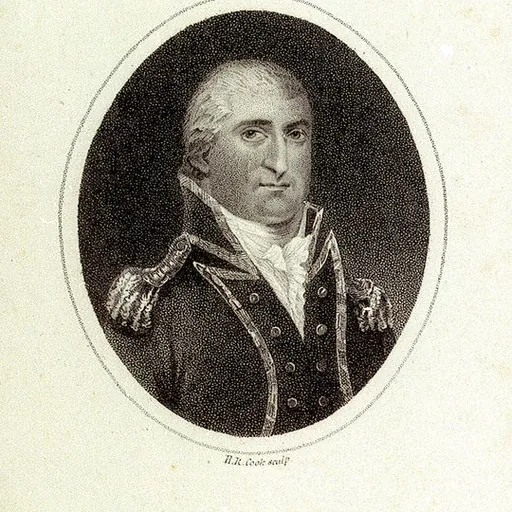
Henry Inman
British Royal Navy officer during the late eighteenth and early nineteenth centuries, serving in the American Revolutionary War, the French Revolutionary Wars and the Napoleonic Wars
About Henry Inman
Lived 1762 – 1809 (aged 46–47). Henry Inman was a British military personnel.
Captain Henry Inman (1762 – 15 July 1809) was a Royal Navy officer during the late eighteenth and early nineteenth centuries, serving in the American War of Independence, the French Revolutionary Wars and the Napoleonic Wars. Inman's service in the American war was punctuated by three shipwrecks: the burning of HMS Lark off Rhode Island in the face of a superior French squadron, the grounding of HMS Santa Monica on Tortola and the foundering of Hector following an engagement with two French ships in the Mid-Atlantic. After the war he was placed in reserve until the Spanish Armament of 1790, when he was given command of the 14-gun cutter HMS Pygmy stationed off the Isle of Man.
Inman's subsequent service career was principally in frigates: he was engaged at the Siege of Toulon in HMS Aurore, in a raid at Dunkirk in HMS Andromeda and participated in the Battle of Copenhagen as captain of HMS Désirée. He later served on the ship of the line HMS Triumph at the Battle of Cape Finisterre and was subsequently called to give evidence at the court martial of Sir Robert Calder. After the battle off Finisterre, Inman suffered from ill-health and remained on shore duty until 1809 when he was appointed as Admiralty commissioner for Madras. The lengthy sea journey to India exacerbated his existing health problems and he died just ten days after his arrival.
Early life
Henry Inman was born in 1762, the son of the vicar of the Somerset village of Burrington, Reverend George Inman. Educated by his father until the age of 14, Inman was sent to join the Royal Navy in 1776, posted aboard the 90-gun second rate HMS Barfleur. Barfleur s captain was Sir Samuel Hood, later to become Viscount Hood, who formed a close personal and professional attachment to his subordinate that continued throughout Inman's military service. After two years on Barfleur, Inman was transferred to the frigate in 1778 for service off New England. The American Revolutionary War had broken out three years earlier, but Barfleur had been based in Britain and so there had been no opportunity for action aboard Hood's ship. His career in Lark was cut short on 5 August 1778, when Captain John Brisbane, the senior officer off Rhode Island, ordered the frigate beached and burnt with four other ships when a French fleet under Vice-Admiral Comte d'Estaing appeared off the harbour. Inman and the rest of the crew were transferred to shore duties and over the following week engaged D'Estaing's ships from fixed gun batteries as they bombarded the British positions. Remaining on shore service in the West Indies for the next two years, Inman was again employed in the aftermath of the Battle of the Saintes, appointed to the prize crew of the captured French vessel Hector for the journey to Britain. Hectors masts and hull had been seriously damaged in the battle, requiring lighter spars to be fitted and 22 of her 74 guns removed to make her more seaworthy. As the fleet could not spare men to man her, the 223-strong prize crew was made up of men pressed in the Caribbean, principally invalids unfit for frontline service. Within a short period, Inman was the only officer remaining on deck, but he was able to successfully drive the French away following a failed attempt to board, although Hector was left in a severely damaged state with 75 men killed or wounded. A hurricane that followed the battle inflicted further damage and the ship was badly flooded, seawater ruining the food supplies and threatening to sink the ship completely. Some of the crew were so ill and exhausted that they collapsed and died while manning the pumps. Inman only managed to prevent the remaining sailors from fleeing below decks by carrying loaded pistols and threatening men who refused his orders. Once the storm had abated it was clear that Hector was foundering; her rudder and masts had been torn away and the pumps were unable to keep pace with the water leaking through the battered hull.
French Revolutionary Wars With the Peace of Versailles in 1783, the war ended and Inman was placed on half-pay in reserve, suffering from poor health caused by his ordeal on Hector. Retiring to his father's house in Somerset, Inman was not employed again until 1790, when the Spanish Armament provoked a rapid expansion of the Navy. He was initially commissioned into the frigate under Captain Albemarle Bertie, but in the aftermath of the emergency Inman was given command of the 14-gun cutter HMS Pigmy, stationed on the Isle of Man. He also married the daughter of Commander Thomas Dalby in 1791; the couple had a son and a daughter. He was reinstated in 1797 as temporary commander of the ship of the line in the immediate aftermath of the Nore Mutiny. Belliqueux had been heavily involved in the uprising: three members of the crew were under sentence of death and six others facing severe punishment for their part in the revolt. Inman was consequently afraid for his life and for the next six months slept with three loaded pistols beside him. He was subsequently posted to the frigate in early 1799. In November 1799, Andromeda was attached to the force that evacuated the Duke of York's army following the failure of the Anglo-Russian invasion of Holland and he remained in the region, observing movements off the Elbe. Andromeda also participated in the Raid on Dunkirk on 7 July 1800, when four French frigates were attacked by a squadron of British ships in Dunkirk harbour. Although an assault with fireships failed, captured the French frigate Désirée, with Inman following in the cutter Vigilant, crewed by thirty volunteers from Andromeda. Under fire from all sides, Inman successfully boarded the French ship following her surrender and brought her out of the harbour, sending the crew ashore on parole to avoid having to assign men to guard them. Désirée was brought back to Britain and commissioned into the Royal Navy, Inman taking command of the new frigate.
In 1801, Désirée was attached to the fleet gathering at Yarmouth under Sir Hyde Parker and Lord Nelson for service in the Baltic Sea against the League of Armed Neutrality. Sailing for Denmark in March, the fleet anchored off Copenhagen and on 1 April a squadron under Nelson closed with the Danish fleet, which was anchored in a line of battle protecting the harbour. Désirée was ordered to operate at the Southern end of the Danish line, engaging shore batteries and nearby ships while their attention was focused on the main British battle-line. When the battle began at 10:00 on 2 April, Inman engaged the Provesteen, which was firing on the 50-gun . Désirée succeeded in inflicting considerable damage on the Danish ship and drew some fire away from the battered Isis. Once Provesteen had been abandoned by her Danish crew Désirée was engaged with a number of Danish shore batteries, but due to poor aim of the Danish gunners, who fired over the frigate throughout the engagement, she was not badly damaged and suffered only four men wounded in the battle. In 1804 he moved from Utrecht to the 74-gun HMS Triumph and in February 1805 was attached to the fleet under Sir Robert Calder stationed off Cape Finisterre during the Trafalgar campaign. At 11:00 on 22 July, Calder sighted the French and Spanish fleet under Vice-Admiral Pierre-Charles Villeneuve emerging from the fog off Ferrol and attacked, Triumph third in line behind HMS Hero and HMS Ajax. The battle lines tacked and closed with one another, beginning a general action at 18:00, eventually separating at 21:30. Triumph was heavily engaged in the melee, in which two Spanish ships were captured, and suffered severe damage although light casualties of five killed and six wounded. On 26 July, Inman was briefly detached from the fleet to chase away the French frigate Didon before returning to her station in the battle line, but the action was not resumed, Calder ordering the fleet to return to Britain. In the aftermath of the battle, Calder faced a court martial for his failure to resume the engagement and Inman was called to give evidence: when questioned as to why he had not informed Calder about the damage to his ship, Inman replied "I did not think that a proper time to trouble the admiral with my complaints". Returning to his family ashore, Inman was initially given command of the sea fencibles at King's Lynn before he was made Admiralty commissioner at Madras by Lord Mulgrave in 1809. The journey to India broke his health completely and he died on 15 July 1809, just ten days after arriving in Madras.
Don’t just read it —
keep it.
Full-length biographies made to live with: read them, listen on the way to work, watch them tonight.
- E-book
- Audio
- Video
Instant download · yours to keep · every purchase keeps this site free
Important facts
People in Henry Inman's life
Named in this biography and alive at the same time


Related people
Same field, nearest in time
Contemporaries
People whose lives overlapped Henry Inman's





Frequently asked questions
Who was Henry Inman?
British Royal Navy officer during the late eighteenth and early nineteenth centuries, serving in the American Revolutionary War, the French Revolutionary Wars and the Napoleonic Wars
When was Henry Inman born?
Henry Inman was born in 1762 in Burrington.
When did Henry Inman die?
Henry Inman died on 15 July 1809 in Chennai.
What was Henry Inman's occupation?
Henry Inman was a military personnel.
What nationality was Henry Inman?
Henry Inman was British.
Sources & further reading
· DBpedia: Henry Inman (Royal Navy officer)
Cite this page
APA: Biography.guide. (2026). Henry Inman. https://biography.guide/henry-inman-military-personnel/
MLA: "Henry Inman." Biography.guide, https://biography.guide/henry-inman-military-personnel/.
Chicago: "Henry Inman." Biography.guide. https://biography.guide/henry-inman-military-personnel/.
Data last updated: 2026-09-29 · Spot an error? Report a correction.
Portrait: Wikimedia Commons · author & licence
Page generated 2026-10-04 14:12 UTC