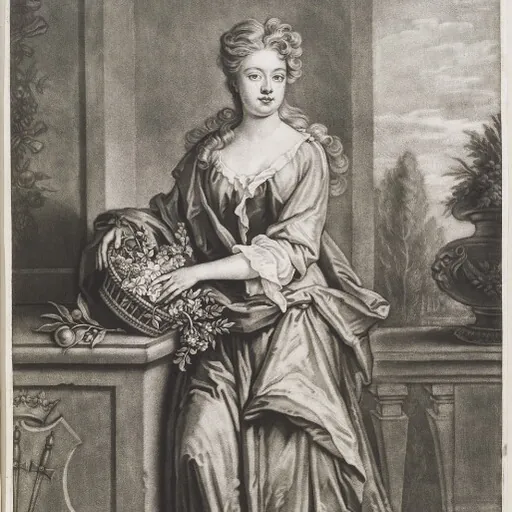
Henrietta Paulet, Duchess of Bolton
(c.1682 - 1729/1730)
About Henrietta Paulet, Duchess of Bolton
Lived 1680 – 1730 (aged 49–50).
Henrietta Paulet, Duchess of Bolton ( Crofts; – 27 February 1730), was the third wife of Charles Paulet, 2nd Duke of Bolton. She was the elder daughter of James Scott, 1st Duke of Monmouth by one of his mistresses, and the niece of Jane Myddelton. Henrietta served as a Lady of the Bedchamber to Caroline of Ansbach in the 1710s. She was one of several aristocratic female signatories who petitioned King George II for the creation of a Foundling Hospital in the 1720s and 1730s, but she did not live long enough to see its creation. She spend part of her life in Dublin, and the city's Henrietta Street is reputedly named after her.
Early life The elder daughter of James Scott, 1st Duke of Monmouth, by his mistress Eleanor Needham, Henrietta took the surname of "Crofts" that had been assumed by her father when he was in the care of the Crofts baronets. Her mother's sister, Jane Myddelton, was one of the celebrated Windsor Beauties.
Personal life Henrietta married the Duke of Bolton in Dublin in about 1697, some years after the death of his second wife, Frances. She was around twenty years his junior, and he was known in society as ‘a most lewd, vicious man, a great dissembler and a very hard drinker’.
Court life From 1714 to 1718, the duchess was a Lady of the Bedchamber to the Princess of Wales, Caroline of Ansbach.
In 1716, following the Jacobite Rebellion of 1715, Henrietta unsuccessfully interceded, with King George I on behalf of her friend Anna Radclyffe, Countess of Derwentwater, whose husband, James, 3rd Earl of Derwentwater, was condemned to death for his role in the rebellion.
She was one of the aristocratic female signatories to Thomas Coram's 1730 petition to establish the Foundling Hospital, which was presented to King George II in 1735. She signed the petition on 25 April 1729, and Gillian Wagner suggests that the Bolton family members may have signed as a result of their 'personal experience of illegitimacy in the family'. Wagner also suggests that the Dowager Duchess signed with the encouragement of her step-daughter-in-law Anne, who had signed Coram's petition three days earlier, on 22 April 1729.
Her portrait, by Sir Godfrey Kneller, is held by the Art Gallery of South Australia; the Royal Collection has a mezzotint copy and a watercolour miniature.
Don’t just read it —
keep it.
Full-length biographies made to live with: read them, listen on the way to work, watch them tonight.
- E-book
- Audio
- Video
Instant download · yours to keep · every purchase keeps this site free
Important facts
Family & relationships
People in Henrietta Paulet, Duchess of Bolton's life
Named in this biography and alive at the same time



Contemporaries
People whose lives overlapped Henrietta Paulet, Duchess of Bolton's



Frequently asked questions
Who was Henrietta Paulet, Duchess of Bolton?
(c.1682 - 1729/1730)
When was Henrietta Paulet, Duchess of Bolton born?
Henrietta Paulet, Duchess of Bolton was born in 1680.
When did Henrietta Paulet, Duchess of Bolton die?
Henrietta Paulet, Duchess of Bolton died on 27 February 1730.
Sources & further reading
· Wikipedia: Henrietta Paulet, Duchess of Bolton
· DBpedia: Henrietta Paulet, Duchess of Bolton
Cite this page
APA: Biography.guide. (2026). Henrietta Paulet, Duchess of Bolton. https://biography.guide/henrietta-paulet-duchess-of-bolton/
MLA: "Henrietta Paulet, Duchess of Bolton." Biography.guide, https://biography.guide/henrietta-paulet-duchess-of-bolton/.
Chicago: "Henrietta Paulet, Duchess of Bolton." Biography.guide. https://biography.guide/henrietta-paulet-duchess-of-bolton/.
Data last updated: 2026-09-22 · Spot an error? Report a correction.
Portrait: Wikimedia Commons · author & licence
Page generated 2026-09-27 05:03 UTC