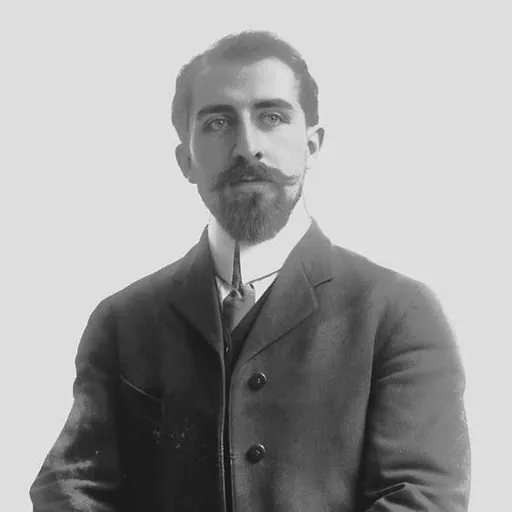
About Henri de Miffonis
Lived 1882 – 1955 (aged 72–73). Henri de Miffonis was a French and Canadian engineer and civil engineer, known for Fisheries and Oceans Canada.
Henri de Miffonis (born Louis Fernand Henri de Miffonis; May 24, 1882 – 1955) was a French-Canadian civil engineer. He specialized in the construction of lighthouses, and studied civil engineering at the University of Paris. In 1905, after obtaining his diploma, he accepted an offer of employment with the Department of Fisheries and Oceans in Canada for work with the Commission des phares (Commission of Lighthouses), newly created. Miffonis' work was supervised by the Chief Engineer of the commission, William Patrick Anderson, a fervent promoter of reinforced concrete in the construction of lighthouses.
The recruitment of Miffonis, for his competence in the use of concrete, corresponded with an intense period of maritime infrastructure construction in Canada, and in particular, the construction of lighthouses. During the first three years of the commission, Miffonis developed and patented in 1908 plans for the design of tapered reinforced concrete lighthouses with flying buttresses.
The importance of Miffonis' role in the construction of Canadian lighthouses between 1908 and 1913 was underestimated until the rediscovery of his correspondence with Anderson. In 1913, Miffonis published a work presenting calculations showing the use of reinforced concrete and its advantages in the construction of lighthouses.
At the end of World War I, there was little construction of new lighthouses and Miffonis ended his career with Fisheries and Oceans Canada.
Biography Education and arrival in Canada Miffonis was born in Boulogne-Billancourt, on 24 May 1882. He received his education at the University of Paris during a time when reinforced concrete was revolutionizing the building industry in France and was considered the leading edge in its use as a new material. The Chief Engineer of the commission, William Patrick Anderson, was persuaded that reinforced concrete was the best choice for construction of future lighthouses in terms of solidity and costs.
The construction of the new lighthouses using reinforced concrete begins after the recruitment of Miffonis. The Assistant Chief Engineer, B. H. Fraser, mentioned that Miffonis was an educated man, possessing a grand culture and a great knowledge of mathematics and mechanics and one of the best theorists of the department.
The five reinforced concrete lighthouses constructed by the Steel Concrete Co. used plans from the Chief Engineer of the company, Emil Andrew Wallberg. There was also a description of the advantages of his model, i.e., a great solidity of the tower and a great resistance to lateral wind forces due to the flying buttresses as well as a reduction of the quantity of concrete needed for construction. The expertise of Miffonis in the use of reinforced concrete was not limited to lighthouses. He also participated in the construction of a quay with this material at Pointe-du-Lac in 1909–1910, which is mentioned in an annual report of Anderson's in 1911. Between 1921 and 1922, Miffonis, who then worked in the physics laboratories of Queen's University, carried out research on the optical qualities of various sources of lighting as well as on the reflective properties of certain materials likely to be used in lighthouses.
During this period, he published some scientific articles on his research in optics. In 1923, he published an article in the journal of the Franklin Institute titled The sense of verticality and its application to lighthouse work that dealt with construction of tall structures, their resistance to wind, as well as the level of visibility of such buildings for those who look for them, especially according to distance. The next year, he published an article in The Astrophysical Journal about the construction of a device called a periodoscope, which is used to measure the period of a repetition of an event in astronomy when there is a limited number of observations.
In 1925, he was assigned to the Dominion Lighthouse Depot, an organization responsible for the maintenance of lighthouses and marine infrastructure in Canada. The confusion regarding the authorship of these plans may be attributed to the publication in 1913 of a work by Frederick A. Talbot, Lightships and Lighthouses, which was written with information provided by William Patrick Anderson and to whom was attributed the building of the reinforced concrete lighthouses. and questions the authorship of Anderson concerning the reinforced concrete tower plans. The quadrangular structure is framed by four concrete pillars connected by wooden walls bent at the top by steel beams. The plaster which was originally intended to cover the walls was instead covered with a facing of clapboard.
+ Canadian lighthouses constructed with reinforced concrete and flying buttresses Location Year of Construction Shape and buttress Height (meters) Condition and status Point northwest of Belle Isle in Newfoundland 1908 Hexagonal with 6 flying buttresses 12 Still existing. Recognized by the Federal Heritage Buildings Review Office (FHBRO) in 1989. Cape Anguille in Newfoundland 1907-10 Hexagonal with 6 flying buttresses 28.5 Demolished in 1980. Pointe-au-Père in Québec 1909 Octagonal with 8 flying buttresses 31.8 Still existing. Classified by the FHBRO in 1990. Recognized national historic site of Canada in 1974. Estevan Point in British Columbia 1909 Octagonal with 8 flying buttresses 29.3 Still existing. Classified by the FHBRO in 1991. Cape Norman in Newfoundland 1910 Hexagonal with 6 flying buttresses 16 Demolished in 1963. Cape Bauld in Newfoundland 1910 Hexagonal with 6 flying buttresses 24.4 Demolished near 1960. Île Caribou, Lake Superior in Ontario 1910 Hexagonal with 6 flying buttresses 30.5 Still existing. Classified by the FHBRO in 1990. Michipicoten Island, Lake Superior in Ontario 1911 Hexagonal with 6 flying buttresses 20.8 Still existing. Classified by the FHBRO in 1990. Escarpement Bagot, Anticosti Island in Québec 1912 Hexagonal with 6 flying buttresses 23.5 Still existing. Classified by the FHBRO in 1990.
Publications Béton et béton armé, aide-mémoire pratique à l'usage des ingénieurs, architectes, entrepreneurs et surveillants de travaux published in Paris by H. Ferreyrol, 1913
Don’t just read it —
keep it.
Full-length biographies made to live with: read them, listen on the way to work, watch them tonight.
- E-book
- Audio
- Video
Instant download · yours to keep · every purchase keeps this site free
Important facts
People in Henri de Miffonis's life
Named in this biography and alive at the same time


Related people
Same field, nearest in time



Contemporaries
People whose lives overlapped Henri de Miffonis's



Frequently asked questions
Who was Henri de Miffonis?
French engineer
When was Henri de Miffonis born?
Henri de Miffonis was born on 24 May 1882 in France.
When did Henri de Miffonis die?
Henri de Miffonis died in 1955 in Canada.
What was Henri de Miffonis's occupation?
Henri de Miffonis was an engineer and civil engineer.
What was Henri de Miffonis known for?
Henri de Miffonis was known for Fisheries and Oceans Canada.
What nationality was Henri de Miffonis?
Henri de Miffonis was French and Canadian.
Sources & further reading
· Wikipedia: Henri de Miffonis
Cite this page
APA: Biography.guide. (2026). Henri de Miffonis. https://biography.guide/henri-de-miffonis/
MLA: "Henri de Miffonis." Biography.guide, https://biography.guide/henri-de-miffonis/.
Chicago: "Henri de Miffonis." Biography.guide. https://biography.guide/henri-de-miffonis/.
Data last updated: 2026-09-22 · Spot an error? Report a correction.
Portrait: Wikimedia Commons · author & licence
Page generated 2026-09-27 05:02 UTC