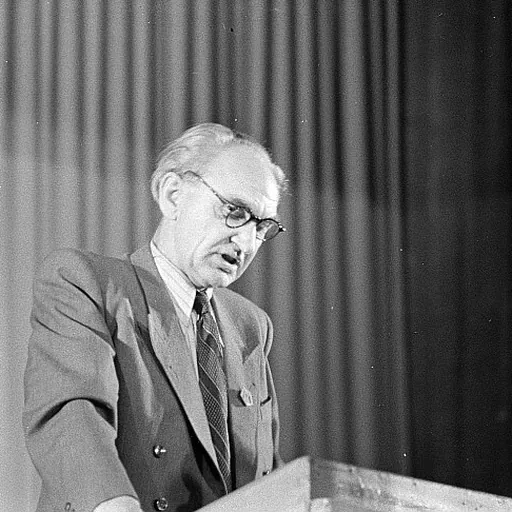
About Heinrich Rau
Lived 1899 – 1961 (aged 61). Heinrich Rau was a German politician, resistance fighter, communist and minister, known for German Economic Commission and XI International Brigade.
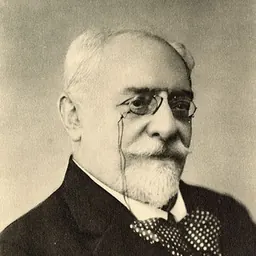
Heinrich Gottlob "Heiner" Rau (2 April 1899 – 23 March 1961) was a German communist politician during the Weimar Era, a commander in the International Brigades during the Spanish Civil War, and a leading East German statesman after World War II.
Rau grew up in a suburb of Stuttgart, where early on he became active in socialist youth organizations. After military service in World War I, he participated in the German revolution of 1918–1919. From 1920 onward, he was a leading agricultural policy maker of the Communist Party of Germany (KPD). This ended in 1933, when Adolf Hitler came to power. Shortly afterward Rau was thrown in jail for two years. As an enemy of the Nazi regime in Germany he was imprisoned, in total, for more than half of the time of Hitler's rule. After his first imprisonment he emigrated in 1935 to the Soviet Union (USSR). From there, in 1937, he went on to Spain, where he participated in the Spanish Civil War as a leader of one of the International Brigades. In 1939, he was arrested in France, and was delivered by the Vichy regime back to Nazi Germany in 1942. After a few months in a Gestapo prison, he was transferred to the Mauthausen concentration camp in March 1943. While in the concentration camp he participated in conspiratorial prisoner activities, which led to a camp uprising in the final days before the end of World War II in Europe.
After the war he played an important role in the political scene of East Germany. Before the establishment of an East German state he was the chairman of the German Economic Commission, the precursor to the East German government. Subsequently, he became chairman of the National Planning Commission of East Germany and a deputy chairman of the East German Council of Ministers. He was a leading economic politician and diplomat of East Germany and led various ministries at different times. Within East Germany's ruling Socialist Unity Party of Germany (SED) he was a member of the party's Central Committee Politburo.
Origins and early political career
Stuttgart
Early years until World War I Stuttgart's New Castle 1916. The upper parts of the then-adjacent Wilhelm Palais can be seen behind the right wing of the castle. Rau was born in Feuerbach, now a part of Stuttgart, in the German Kingdom of Württemberg, the son of a peasant who later became a factory worker. He grew up in the adjacent city of Zuffenhausen, now also a part of Stuttgart. After finishing school in spring 1913, he started work as a press operator in a shoe factory. In November 1913 he changed his employer and moved to the Bosch factory works in Feuerbach. There he completed his training as metal presser and remained until autumn 1920, with interruptions due to war service during 1917-1918 and the subsequent German Revolution of 1918–1919.
From 1913 Rau also was active in the labour movement. In that year he joined the metal workers' union (Deutscher Metallarbeiterverband) and a social democratic youth group in Zuffenhausen. During the following years, which saw the beginning of World War I, Rau's youth group, whose leader he became in 1916, was significantly influenced by the left wing of the Social Democratic Party of Germany (SPD). The leftists considered the war a conflict between "imperialist powers". A few local members of a far left SPD group, among them Edwin Hoernle and Albert Schreiner, who later became well-known members of the Spartacus League (Spartakusbund), visited the youth group in Zuffenhausen and gave lectures. In 1916, Rau joined the Spartacists as well and became a co-founder of their youth organisation. In September 1918 a shell splinter penetrated his lungs. In the following weeks, he was treated in military hospitals in Weimar and in Stuttgart's neighbouring town Ludwigsburg. While in Ludwigsburg, Rau managed to get leave at short notice on 8 November 1918 and joined the in those days developing revolution in Stuttgart.
Revolution The revolution in November 1918 led in Württemberg, like everywhere in Germany, to the end of the monarchy. King William II left Stuttgart on 9 November, shortly after a revolutionary crowd had stormed his residence, the Wilhelm Palais and flown a red flag above the building. On the very same day the demonstrators were also able to seize some of Stuttgart's barracks, where parts of the garrisons openly joined them. During the following days and weeks more spontaneously elected worker and soldier councils were formed, and took over a large part of Württemberg.
As early as 9 November, about 150 councillors gathered for a two-day meeting in Stuttgart. A majority of the councillors entrusted the leaders of the SPD and USPD political parties, who had been invited to the meeting, with the establishment of a provisional government in Württemberg. The Spartacist Albert Schreiner, then chairman of a soldier council, initially assumed the key position of Minister of War in this quickly established first government, which for the time being shared power with the councils. However, he resigned already a few days later, after disputes about the future course of the government. |group=note They seized public buildings and print offices. During one such an attempt - at the beginning of April 1919 when the Bavarian Soviet Republic was formally proclaimed in Munich - a general strike took place in the Stuttgart area. The government in Stuttgart imposed a state of emergency and 16 people died in street fights. At the time of these events, Rau used his position as chief of the military police in Zuffenhausen to shut down companies that remained operational while the strike was ongoing. However, when the strike collapsed, Rau was removed from office by the government.
Rau resumed his employment at Bosch in Feuerbach. During another general strike in several Württemberg cities, from 28 August to 4 September 1920, he led the strike committee in his firm, which resulted in his dismissal.
Influences From 1919 until 1920 Rau was head of the local KPD group in Zuffenhausen, and chaired the KPD organisation in Stuttgart. The party leader in Württemberg at this time was Edwin Hoernle. Hoernle had visited Rau's youth group in Zuffenhausen and had become a long-standing friend; he was an influential teacher for Rau and made his voluminous library available to Rau to use.
The most outstanding ideological authority of the movement in Stuttgart, during the time of Rau's political involvement there, was however Clara Zetkin. She was a founding member of the Second International, about whom Friedrich Engels once had written, that he liked her very much, while emperor Wilhelm II is said to have referred to her as the "worst witch in Germany". She had been living in a Stuttgart suburb since 1891 and, since then, been gathering a circle of Württemberg Marxists around her, among them Rau's friend Hoernle, who had been editing with her the magazine Die Gleichheit. Her house, built in 1903 in Sillenbuch (now a part of Stuttgart), had become a meeting place of leading national and local left-wing and communist activists. It was also visited by international communist leaders like Vladimir Lenin, who stayed there overnight in 1907. Although the brigade achieved some temporary successes during these months, Francisco Franco's troops were already on the road to victory. Rau's brigade saw combat in the battles of Brunete, Belchite, Teruel and the Aragon Offensive, where Rau was wounded.
When Rau took charge of the XI Brigade, he might have been at odds with his predecessor, Richard Staimer, the future son-in-law of KPD leader Wilhelm Pieck. This was the time of the Great Purge which had its echos in Spain, and it could be perilous to have powerful enemies. André Marty, the chief commissar of the International Brigades based at Albacete, was also an executor of the Great Purge in Spain. Following Rau's injury, Marty managed to imprison him under a pretext for a brief time. A report, written in Moscow in 1940, described Rau as a "political criminal", who had had contact with the Spanish anarchists and members of the Workers' Party of Marxist Unification (POUM), which was demonized as "Trotskyist". These were serious allegations in this time, when accusations of Trotskyism frequently led to a death sentence if the accused was within reach of the authorities.
It seems, however, that Rau also had influential friends. He was released from prison and expelled from Spain. He moved to France in May 1938. There, he was in charge of the emergency committee of the German and Austrian Spain fighters and member of the KPD country leadership in Paris until 1939. At the beginning of 1939 Rau crossed the border to Spain again and subsequently led, together with Ludwig Renn, the remainders of the XI Brigade. Together with other remaining international units – now combined in the "Agrupación Internacional" – they fought on Spain's northern border after the fall of Barcelona, protecting the stream of refugees escaping to France. Thus the Agrupación enabled the escape of perhaps some 470,000 civilians and soldiers.
Rau was arrested by the French authorities in September 1939 and sent to Camp Vernet, an internment centre in France, and in November 1941 to a secret prison in Castres. In June 1942, he was handed over to the Gestapo by the Vichy regime and was held until March 1943 in the Gestapo prison in the Prince Albrecht Street. Afterwards he was sent to the Mauthausen Concentration Camp, where he remained until May 1945, when he participated in a camp rebellion as one of the organisers of a secret military camp organisation.
East Germany
1945–1949
New start in Brandenburg
When the war was over, Rau went to Vienna for some weeks and helped the KPD representatives in the city gather liberated political prisoners from Germany. He left Vienna in July 1945, when he led a car convoy with 120 former Mauthausen inmates to the Soviet occupied part of Berlin.
In September 1945, the Soviets appointed Rau a member of the provisional chairmanship of the province of Brandenburg with the title of a vice-president and responsibility for food, agriculture and forests. Rau succeeded Edwin Hoernle, who had held this position since the end of June and became chairman of the central administration for agriculture and forests in the Soviet Occupation Zone (SBZ). In his new position, Rau was a member of the commission for the execution of the land reform in the province. In spring 1946 he assumed responsibility for economy and transport in Brandenburg. In this capacity, he was, from June 1946 onwards, chairman of the newly established sequester commission in the province. 1946 was also the year of the forced merger of eastern KPD and eastern SPD into the Socialist Unity Party of Germany (SED), resulting in Rau's membership in the SED. Important 1946 events in Brandenburg were in November elections, which preceded an official status change from a province to a federal state in the following year. Afterwards, from 1946 until 1948, Rau was state parliament delegate and Minister for Economic Planning of Brandenburg. Finally the Berlin Blockade was lifted on 12 May 1949.
The DWK's increasingly centralised administration resulted in a substantial increase in its staffing level, which grew from about 5000 employees in mid-1948 to 10,000 by the beginning of 1949. In March 1949, Rau, like the representative of a state, signed a first treaty with a foreign state, a trade agreement with Poland.
1949–1953
Establishment and difficult first years of a new state The time of Rau's German Economic Commission ended in October 1949 with the establishment of the East German state, the German Democratic Republic (GDR). The GDR was proclaimed on 7 October 1949, at a ceremony in the former Air Ministry Building in Berlin, until then the seat of Rau's organisation. Five days later, the DWK was formally abolished on 12 October 1949. Rau thereupon became a delegate of the People's Chamber representing East Berlin, the newly established parliament of the GDR and joined the new government. Beside Ulbricht and Rau there were three other deputy prime ministers, among them two representatives of the other parties in the National Front, who, according to Grotewohl in a talk with Joseph Stalin, were of no relevance. ("Comrade Grotewohl says that two of the five deputies are representatives of bourgeois parties, and we are glad that they do not do anything.")|group=note
Between 1949 and 1950, Rau was Minister for Planning of the GDR and in 1950–1952 chairman of the National Planning Commission. In this position, as the key figure of the economic development, Rau came into conflict with SED General Secretary Walter Ulbricht. In the face of an imminent economic collapse, Rau blamed the "Bureau Ulbricht" for the wrong policy. In response East Germany's old president Wilhelm Pieck renewed the old accusation of Trotskyism against Rau. In a later letter to Pieck of 28 November 1951, Rau protested at the manner in which the Secretariat usurped the Politburo by censoring his speech on economic affairs.
In 1952–1953, Rau led the newly established Coordination Centre for Industry and Traffic at the East German Council of Ministers. (Three years later, in 1956, Dahlem was rehabilitated and shortly afterward among the first recipients of the new established Hans Beimler Medal, which he received during a ceremony supervised by Rau. Ironically Richard Staimer, a quite prominent person in the GDR and also a target of some speculations which claimed him to be Beimler's murderer, received the same medal on this occasion as well out of necessity – and had to accept it.) |group=note Suggested were first Rudolf Herrnstadt and then Heinrich Rau, but both were hesitant, thus a decision was postponed. The very next day after the meeting Ulbricht went by plane to Moscow and the Soviet leadership, who in part also feared that deposing Ulbricht might be construed as a sign of weakness, now secured Ulbricht's position. Subsequently, five members and candidate members of the Politburo lost their positions.
1953–1961
Competition in the Politburo and economic reform
Unlike some other rebels in the leadership, Rau kept most of his positions. He remained a member of the Politburo and deputy chairman of the Council of Ministers. In the Politburo he continued to be responsible for the industry of the GDR. However, his position had been weakened. Bruno Leuschner, a follower of Ulbricht and Rau's successor as chairman of the National Planning Commission, now became a new candidate member of the Politburo. During the ensuing period, Leuschner, often supported by Ulbricht, gradually superseded Rau as the senior leader for the economy as a whole. The official GDR press never mentioned the dissension between Rau and Leuschner and always described their cooperation as a success story.
Concentrating on his tasks in the SED leadership and as a minister, Rau – despite occasional internal criticism – avoided giving the impression of any disagreement with Ulbricht, at least in public. In 1954, Rau received in the Order of Merit for the Fatherland (Vaterländischer Verdienstorden) in gold. Later, Ulbricht stated in a 1964 interview about the "introduction of socialism" in the GDR, that only three people were heavily involved in the economic development during that time, "namely Heinrich Rau, Bruno Leuschner and me. Others were not consulted!"
In 1953–1955 Rau led the new established Ministry for Machine Construction, which combined the responsibilities of three existing ministries. #tag:ref|The three ministries, which merged into the Ministry for Machine Construction were the Ministries for Heavy Machine Construction, for General Machine Construction, and for Transport and Agricultural Machine Construction.
Rau, in poor health during his final years, died of a heart attack in East Berlin, in March 1961. He was cremated and honoured with burial at the Memorial to the Socialists in the Friedrichsfelde Central Cemetery, Berlin.
Aftermath and legacy After his death, firms, schools, recreation homes, numerous streets, and a fighter squadron were named after him. The GDR issued a stamp with his picture three times.
Rau was married twice and had three sons and a daughter. Like the other members of the Politburo, he lived until 1960 in a secured area of East Berlin's district Pankow and moved in 1960 to the Waldsiedlung near Wandlitz. In Pankow he had lived in Majakowskiring no. 50. In 1963, Rau's widow Elisabeth moved to this street again.
When the prominent West German SPD politician and future President of Germany Johannes Rau visited an SPD rally in the East German city of Erfurt during the time of German reunification, he was introduced as "Prime Minister 'Heinrich Rau. Thereupon Johannes Rau ironically commented on this lapse by observing that Heinrich Rau was a "Minister of Trade, a Swabian and a communist" and he was none of the three.
Awards and honors 1954: Patriotic Order of Merit in Gold 1955: 1955: 1956: Hans Beimler Medal 1958: Banner of Labor 1958: Medal for Fighters Against Fascism 1958: 1958: Order of the National Flag, 1st Class 1959: Hero of Labor 1961: Order of the Nile, Grand Cordon
Don’t just read it —
keep it.
Full-length biographies made to live with: read them, listen on the way to work, watch them tonight.
- E-book
- Audio
- Video
Instant download · yours to keep · every purchase keeps this site free
Important facts
People in Heinrich Rau's life
Named in this biography and alive at the same time





Related people
Same field, nearest in time



Contemporaries
People whose lives overlapped Heinrich Rau's



Frequently asked questions
Who was Heinrich Rau?
German Communist politician (1899–1961)
When was Heinrich Rau born?
Heinrich Rau was born on 2 April 1899 in Feuerbach, Germany.
When did Heinrich Rau die?
Heinrich Rau died on 23 March 1961 in East Berlin.
What was Heinrich Rau's occupation?
Heinrich Rau was a politician, resistance fighter, communist and minister.
What was Heinrich Rau known for?
Heinrich Rau was known for German Economic Commission and XI International Brigade.
What nationality was Heinrich Rau?
Heinrich Rau was German.
Sources & further reading
Cite this page
APA: Biography.guide. (2026). Heinrich Rau. https://biography.guide/heinrich-rau/
MLA: "Heinrich Rau." Biography.guide, https://biography.guide/heinrich-rau/.
Chicago: "Heinrich Rau." Biography.guide. https://biography.guide/heinrich-rau/.
Data last updated: 2026-09-22 · Spot an error? Report a correction.
Portrait: Wikimedia Commons · author & licence
Page generated 2026-09-27 05:04 UTC