
About Harue Koga
Lived 1895 – 1933 (aged 38). Harue Koga was a Japanese artist and painter.
was a Japanese avant-garde painter active from the 1910s to the early 1930s. He is considered to be one of the first and one of the most representative Japanese surrealist painters.
Early life Harue Koga was born Yoshio Koga in 1895 to parents Seijun and Ishi Koga in the town of Kurume in Fukuoka Prefecture on the island of Kyushu, Japan. His father Seijun was the head priest of a local Buddhist temple belonging to the Jōdo-shū sect of Buddhism. Koga began attending Hiroshi Jinjo Elementary School at age seven, and shortly after his father, Seijun, gave his position of head priest to his son-in-law to focus his time on his son's education, hoping that Koga would also follow in the family tradition by becoming a Buddhist priest. In 1913, Koga enrolled in the Institute of the Japanese Watercolor Society, Exhibitions hosted by Raimoku would be one of the first venues where Koga could formally exhibit his art.
In 1915, he was deeply affected by the suicide of his best friend so his father, concerned about his behavior, made him return home. After a brief stay in Nagasaki, and a thwarted affair with a distant relative of his father, he entered the Buddhist priesthood and was given the name Harue ("spring bough," usually a feminine name). Shortly after, he fell in love with Oka Yoshie, a local poet. His family opposed the marriage until he agreed to succeed his father as the local priest.
Shortly after, his father died and he began auditing classes in theology at what is now Taishō University while continuing to paint in his spare time. In 1917, he was hospitalized for pleurisy. On his way home to recuperate, he became ill with the flu, which turned into pneumonia. Although in critical condition, he recovered but had missed so much time at the university, he decided to quit school and concentrate on painting, after which his family withdrew financial support.
Koga's interest in the arts was not limited to painting. He was also an avid fan of poetry, and for a time considered a career in naniwabushi, a traditional Japanese style of musical theater. Koga also developed a deep appreciation for Asakusa Opera, an extremely popular form of light opera staged in the Asakusa district of Tokyo, and would frequent shows in the late 1910s and early 1920s. Koga's love of Asakusa Opera was generally disapproved of by his colleagues in the Japanese Watercolor Society, as it was as considered a low-class art.
Avant-garde artist
Koga's formal debut as an artist occurred in 1922 when two of his paintings were chosen for the Nika Exhibition, an exhibition dedicated to showcasing younger Japanese artists and artists utilizing experimental and modern styles in their works. Of these two paintings, especially notable is Burial, a "Cubistic" painting which art historian Chinghsin Wu argues was partially inspired by Spanish classical painter El Greco's painting The Burial of the Count of Orgaz (1586) and was painted in response to the stillbirth of Koga's daughter the year before. Thereafter, Koga continued to have his paintings accepted into the Nika Exhibition every year until his death. In 1926 he became an associate member of Nika and later a full member in 1929.
Having experimented with Cubism in his pieces from 1922 to 1924, Koga thereafter began to paint more fantastical pieces inspired by Swiss-German expressionist painter Paul Klee, such as Fireworks (1927) and Innocent Moonlit Night (1929). Koga continued to paint a majority of his paintings in this style until 1929. He exhibited paintings in this style at the Nika Exhibition over the course of his career, as well as the Prince Shotoku Fine Art Exhibition in 1926. Koga had a severe nervous breakdown in November 1927 and briefly returned to Fukuoka before moving to Nagasaki in May 1928. He recovered from his neurasthenia and returned to Tokyo in October 1928. Over this time, he continued to develop his artistic style and developed more pieces influenced by Paul Klee and exhibiting a fantasy style. Around this time, Koga became deeply interested in emerging schools of thought and was introduced to painters Seiji Tōgō and Kongō Abe, who had just returned from studying art in Europe. In 1929, Koga began painting cover designs and illustrations for various magazines and novels, and in June of 1930 he was given the opportunity to work on set design of the play Ruru due to his connection to Tōgō and Abe. In 1931, Koga and Abe became affiliated with an avant-garde poetry workshop in Shinjuku.
In 1929, Koga's painting style shifted, and he began exhibiting large-scale paintings in a photomontage style, which are considered some of the first Surrealist paintings in Japan. Recent scholarship has uncovered how Koga appropriated a wide variety of images and motifs from contemporary mass-media sources such as photo magazines, newspapers, film stills, and postcards. Other notable works in this style include Makeup through the Window (1930), and Intellectual Expression Crossing the Reality Line (1931), which included an image of the mechanical robot Eric, which had been exhibited in London in 1928. Koga continued to develop artworks in this style until his death in 1933.
Illness and death
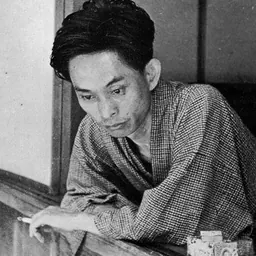
In 1929, Koga became ill and blamed it on the strain caused by participating in a major exhibition. More periods of illness followed and his condition was later diagnosed as syphilis. This, together with being a heavy smoker, eventually caused a tremor that affected his work. During this period, he also became friends with Yasunari Kawabata, who lived nearby, as they apparently shared an interest in dogs. As his disease progressed, he began to suffer from severe neuralgia and started behaving strangely. By early 1933, he required hospitalization and, despite various intense treatments (including malaria therapy), died later that year.
Koga was described by friends and family throughout his lifetime as a sickly individual. Following his death, Koga's acquaintance Nakano Kaichi, who was a doctor, chronicled his symptoms and conducted a psychiatric evaluation. Nakano felt that Koga's symptoms were characteristic of a schizoid personality, particularly given his preference for solitude and occasional episodes of paranoia.
Selected paintings
Don’t just read it —
keep it.
Full-length biographies made to live with: read them, listen on the way to work, watch them tonight.
- E-book
- Audio
- Video
Instant download · yours to keep · every purchase keeps this site free
Important facts
People in Harue Koga's life
Named in this biography and alive at the same time
Related people
Same field, nearest in time




Contemporaries
People whose lives overlapped Harue Koga's

Frequently asked questions
Who was Harue Koga?
Japanese artist (1895-1933)
When was Harue Koga born?
Harue Koga was born on 18 June 1895 in Kurume.
When did Harue Koga die?
Harue Koga died on 10 September 1933 in Tokyo.
What was Harue Koga's occupation?
Harue Koga was an artist and painter.
What nationality was Harue Koga?
Harue Koga was Japanese.
Sources & further reading
Cite this page
APA: Biography.guide. (2026). Harue Koga. https://biography.guide/harue-koga/
MLA: "Harue Koga." Biography.guide, https://biography.guide/harue-koga/.
Chicago: "Harue Koga." Biography.guide. https://biography.guide/harue-koga/.
Data last updated: 2026-09-20 · Spot an error? Report a correction.
Page generated 2026-09-27 05:31 UTC