
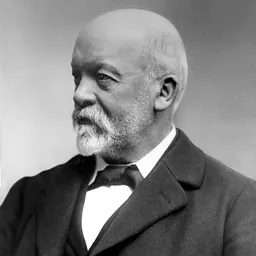
Hartley Burr Alexander
American philosopher, writer, educator, scholar, poet and iconographer
About Hartley Burr Alexander
Lived 1873 – 1939 (aged 66). Hartley Burr Alexander was an American philosopher, writer and university teacher.
Hartley Burr Alexander, PhD (1873–1939), was an American philosopher, writer, educator, scholar, poet, and iconographer.
Family and early years Alexander was born in Syracuse, Nebraska, on April 9, 1873. His father, the Rev. George Sherman Alexander (1823–1894), was a Methodist minister and pioneer newspaper editor in Nebraska. These twin sources were to implant in young Hartley a delight in the written word and a distrust of Christianity. His mother, Abigail Smith Alexander (1835–1876), died when he was three and in 1877 his father remarried Susan Godding (1829–1893). Ms. Godding had been a teacher and chairperson in the Methodist School in East Greenwich and at Friends College in Providence, Rhode Island, and brought with her to the harsh Nebraska frontier a love of art, music and language that was to stay with Alexander for the remainder of his long and productive life. Living on the frontier exposed Alexander to the ways of the First Peoples and was to instill in him an interest in Native religion and spirituality that was to form one of the paths of life that he was to follow. In 1890, while still in high school he wrote a poem, To a Child's Moccasin, (Found at Wounded Knee) that bucked the current philosophy that "the only good Indian was a dead Indian." This was not to be the only time that Alexander's conscience was to lead him to take an unpopular stand that would put him in opposition to the current American standards.
Education After graduating from high school in Syracuse, Nebraska in 1892 Alexander attended the University of Nebraska in nearby Lincoln. Following that he attended graduate school at the University of Pennsylvania and obtained his doctorate at Columbia University in 1901.
He received the Knight of the Legion of Honor award from the government of France in 1936 and was awarded an Honorary Membership in the American Institute of Architects for his collaboration with many of its architect members.
Career and accomplishments He was on the staff of Webster's Dictionary from 1903 to 1908, then became professor of philosophy at the University of Nebraska.
Writings
His published writings include: The Problem of Metaphysics (1902) Poetry and the Individual (1906) The Mid-Earth Life (1907) Odes on the Generations of Man (1910) The Religious Spirit of the American Indian (1910) The Mystery of Life (1913) The Mythology of All Races, volume x: North American (1916); volume xi: Latin American (1920) Liberty and Democracy (1918) Letters to Teachers (1919) God's Drum - and Other Cycles from Indian Lore (1927) Truth and the Faith (1929) God and Man's Destiny: Inquiries into the Metaphysical Foundations of Faith (1936) The World's Rim - Great Mysteries of the North American Indians (1953) (Posthumous) He wrote a volume of poetry, Odes and Lyrics (1921). In 1919 he served as president of the American Philosophical Society.
Iconographer
Burr is believed to have coined the term iconographer to describe the work that he did developing iconographic schemes, decorative themes and inscriptions for a large number and variety of public buildings in the United States. These include:
Alexander family burial plot marker, Lee Lawrie, sculptor, c.1924, Syracuse, NE California Institute of Technology Century of Progress Exhibition, Chicago, Illinois, 1933 Kansas City City Hall, Wight & Wight, architects, 1936, Kansas City, Missouri. In this commission each of the three sculptors involved, C. Paul Jennewein, Walker Hancock and Ulrik Ellerhusen were required to each pay Alexander $100 from their fee for his input Fidelity Mutual Insurance Building, Zantzinger, Borie and Medary, architects, Lee Lawrie, sculptor, 1926, Philadelphia, Pennsylvania Goodhue Memorial Fountain
Joslyn Art Museum, John and Alan McDonald, architects, 1931, Omaha Nebraska Justice Department Building, Zantzinger, Borie and Medary, architects, 1931–1934, Washington D.C. Los Angeles Public Library, Bertram G. Goodhue, architect, Lee Lawrie, sculptor, Los Angeles, California Memorial Stadium, Lincoln, Nebraska Metropolitan Life Insurance Company Home Office Building, Ottawa, Canada Myron Taylor Hall, Cornell University, Ithaca, New York Nebraska State Capitol, Bertram G. Goodhue, architect, Lee Lawrie, sculptor, Lincoln Nebraska Oregon State Capitol, Salem, Oregon Leo Friedlander, sculptor Rockefeller Center, Lee Lawrie, Paul Manship, Rene Paul Chambellan et al., sculptors NYC Ellen Phillips Samuel Memorial, Paul Cret architect, Einar Jónsson, Heinz Warneke, John Flannagan, Jacques Lipchitz et al., sculptors, 1932 Philadelphia Pennsylvania State Finance Building, Harrisburg, Pennsylvania Title and Trust Building, Los Angeles, California
Legacy Bust of Alexander created by Tom Palmerton in 1990 for the Nebraska Hall of Fame.
The Ryons-Alexander House, which he purchased, later was listed on the National Register of Historic Places on July 8, 1982.
He was inducted into the Nebraska Hall of Fame in 1988.
Don’t just read it —
keep it.
Full-length biographies made to live with: read them, listen on the way to work, watch them tonight.
- E-book
- Audio
- Video
Instant download · yours to keep · every purchase keeps this site free
Important facts
People in Hartley Burr Alexander's life
Named in this biography and alive at the same time



Related people
Same field, nearest in time




Contemporaries
People whose lives overlapped Hartley Burr Alexander's

Frequently asked questions
Who was Hartley Burr Alexander?
American philosopher, writer, educator, scholar, poet and iconographer (1873-1939)
When was Hartley Burr Alexander born?
Hartley Burr Alexander was born on 9 April 1873 in Lincoln.
When did Hartley Burr Alexander die?
Hartley Burr Alexander died on 27 July 1939 in Claremont.
What was Hartley Burr Alexander's occupation?
Hartley Burr Alexander was a philosopher, writer and university teacher.
What nationality was Hartley Burr Alexander?
Hartley Burr Alexander was American.
Sources & further reading
· Wikipedia: Hartley Burr Alexander
· DBpedia: Hartley Burr Alexander
Cite this page
APA: Biography.guide. (2026). Hartley Burr Alexander. https://biography.guide/hartley-burr-alexander/
MLA: "Hartley Burr Alexander." Biography.guide, https://biography.guide/hartley-burr-alexander/.
Chicago: "Hartley Burr Alexander." Biography.guide. https://biography.guide/hartley-burr-alexander/.
Data last updated: 2026-09-20 · Spot an error? Report a correction.
Page generated 2026-09-27 05:34 UTC