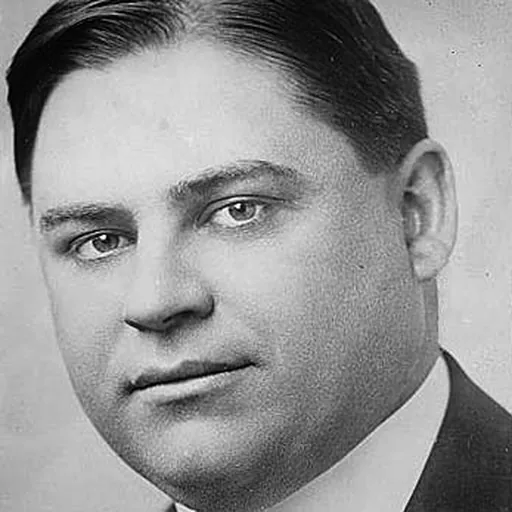
About Harry Frazee
Lived 1880 – 1929 (aged 48). Harry Frazee was an American theatre director, known for Babe Ruth, Boston Red Sox and Musical theatre.
Harry Herbert Frazee (June 29, 1880 – June 4, 1929) was an American theatrical agent, producer, and director, and owner of Major League Baseball's Boston Red Sox from 1916 to 1923. He is well known for selling Babe Ruth to the New York Yankees, which started the alleged Curse of the Bambino.
Early life Harry Frazee was born June 29, 1880, in Peoria, Illinois, son of William and Margaret Frazee. He attended Peoria High School, where he was a baseball teammate of Harry Bay, who later played for Major League Baseball teams in Cincinnati and Cleveland. At 16, Frazee became assistant manager of the Peoria Theater. Within a year, he was player-coach of the Peoria Distillers semi-pro baseball club. As his theatrical endeavors continued, Frazee moved to Chicago, where he built the Cort Theater in 1907.
After several successful shows, Frazee went to New York City, where in 1913 he built the Longacre Theatre on West 48th Street and staged hit plays such as Fine Feathers by Eugene Walter and the musical Adele. He also promoted a boxing match between Jess Willard and Jack Johnson on April 5, 1915 in Havana, Cuba and was reported by then to be a millionaire.
Frazee was a Freemason.
Owner of the Red Sox
Frazee bought the Boston Red Sox baseball team from Joseph Lannin for a reported $675,000 after their victory in the 1916 World Series. The Sox won another World Series title in 1918. The team finished sixth in 1919, and after that season Frazee started selling players to the New York Yankees, most notoriously Babe Ruth. He then left the Red Sox in bankruptcy while continuing to produce theatre shows. After the sale of Ruth, the team crashed into the American League cellar and did not finish above .500 until 1934. The Red Sox did not win another pennant until 1946, and did not win another World Series until 2004. The 86-year World Series drought is the third-longest in MLB history, trailing only the Chicago Cubs (108 years from 1908 to 2016) and Chicago White Sox (88 years from 1917 to 2005).
Frazee backed a number of New York theatrical productions (before and after Ruth's sale), the best-known of which is probably No, No, Nanette, which was once claimed, and later debunked, as the specific play that Ruth's sale financed (it was actually what paid off the Fenway Park mortgage that the Ruth sale included). He was the subject of an unflattering portrait in Fred Lieb's account of the Red Sox, which further insinuated that he had sold Ruth to finance a Broadway musical. This became a central element in the Curse of the Bambino.
The truth is more nuanced and has as much to do with a long-running dispute between Frazee and American League founder and president Ban Johnson as it does with Frazee's finances. Frazee was the first American League owner who Johnson had not essentially hand-picked, and was unwilling to simply do Johnson's bidding. Although they seemed to settle their differences when Frazee hired Ed Barrow, a friend of Johnson's, as manager, their relationship worsened again when Frazee loudly criticized Johnson's handling of the issues brought about by the United States entering World War I. For his part, Johnson was angered by the open presence of gamblers and bookies at Fenway Park. These factors led Johnson to actively seek to push Frazee out.
Additionally, Frazee's theater ventures didn't generate even a fraction of the capital needed to meet the Red Sox' expenses. He often found himself having to borrow from the Red Sox to meet his other commitments. Over the next three years, Frazee sold virtually all of the Red Sox' top players to the Yankees, netting him a total of $305,000.
Bullet Joe Bush—December 1921. Pitched in two pennant seasons for the Yankees. Traded for Rip Collins (pitcher), Roger Peckinpaugh, Bill Piercy, Jack Quinn. Joe Dugan—July 1922. Played for five Yankee pennant teams. Traded for Chick Fewster, Elmer Miller, Johnny Mitchell, Lefty O'Doul. Harvey Hendrick—January 1923. Never played for Red Sox; was in 1923 World Series with Yankees. Traded for Al DeVormer, who batted .254 after trade (Hendrick's lifetime average was .308). Waite Hoyt—December 1920. Traded (with Harry Harper, Wally Schang, and Mike McNally) for Del Pratt, Muddy Ruel, Hank Thormahlen, and Sammy Vick. Hoyt pitched for the Yankees in ten seasons, and was in seven World Series (including the 1931 Series, with the Philadelphia A's). Sad Sam Jones—December 1921. Traded with Joe Bush (q. v.). Pitched five seasons with Yankees. Carl Mays—July 1919. Traded to Yankees for players Bob McGraw and Allan Russell. Herb Pennock—January 1923. Traded to Yankees for Camp Skinner, Norm McMillan, and George Murray. Pennock stayed with the Yankees until 1933, pitching in five Series. George Pipgras—January 1923. Traded to the Yankees for Al DeVormer (supra). Pipgras never played for Boston; his eleven-year career included three Yankee pennant seasons. Wally Schang—December 1920. Traded to the Yankees for Pratt, Ruel, Thormahlen, and Vick. Caught for three Yankee pennant teams. Everett Scott—traded along with Joe Bush (q.v.). Scott set the consecutive-game playing record it took Lou Gehrig to break. Elmer Smith—July 1922. Traded to Yankees with Joe Dugan (q. v.). Was famous as first player (with Indians in 1920) to hit grand slam homer in World Series.
The above only includes the trades Frazee made to the Yankees from 1918 to 1923, when he was owner of the Red Sox. The Encyclopedia lists about 40 trades in all made by the Red Sox in those years, including to teams other than the Yankees.
It has been argued that the deals with the Yankees made a modicum of sense at the time, and only a stroke of bad luck turned them into Yankee heists. Notably, the players sent to Boston suffered a rash of injuries However, this is belied by the fact that Barrow became general manager of the Yankees in 1921. He'd managed nearly all of the players who came to New York in these deals, and was almost certainly aware of who he was getting. When the Yankees won their first World Series in 1923, they did so with a roster dominated by players acquired via their trades with Frazee. Half of their starting position players, as well as four-fifths of the rotation, came from the Red Sox.
Sale of Red Sox In 1921, an article in the Dearborn Independent claimed that Frazee was one of many Jews who had ruined baseball. Although Frazee was not Jewish, the article played up longstanding stereotypes about Broadway impresarios. Frazee was unable to respond, since at the time it was published he was not only dealing with a divorce, but the death of his father. The article wrecked any chance Frazee had of rehabilitating himself. Although he was forced to sell to a syndicate of Midwestern businessmen fronted by Johnson crony Bob Quinn, he held out for $1.2 million—nearly double what he paid for the team in 1916. The Red Sox had some of their worst seasons ever under Quinn's ownership after one of his principal investors died.
Death Harry Frazee's grave in Kensico Cemetery In 1929, Harry Frazee died of kidney failure in his Park Avenue home with his wife and son at his side. He is interred at Kensico Cemetery. Lou Gehrig and Ed Barrow are also interred at Kensico.
The Top 5 Reasons You Can't Blame... In 2005, ESPN Classic aired an episode in The Top 5 Reasons You Can't Blame... series in which it examined the sale, and explained why Frazee cannot be held as the scapegoat: 5. World War I: With rosters depleted because of the war, Ruth saw action as both a pitcher and outfielder; the latter made him the home run hitter he would become. After the players returned, Ruth became bigger than the team because his home runs were the talk of baseball and he no longer wanted to pitch. 4. Ban Johnson: The president of the American League since its debut in 1901 effectively limited Frazee to the Yankees and White Sox as the only teams with whom Frazee could make a deal by pressuring the other five teams (the Cleveland Indians, Detroit Tigers, Philadelphia Athletics, St. Louis Browns and Washington Senators) not to make any trades at all with Frazee. 3. Babe Ruth's antics: He often spent evenings out in bars and was often drunk only hours before games. He also jumped the team several times, the final straw being in the final game of the 1919 season.
2. Ed Barrow: Frazee's right-hand man, Barrow served as general manager and field manager. Like Frazee, Barrow also knew how much of a troublemaker Ruth was. When Frazee wanted to send Ruth to the Yankees, Barrow, for reasons unknown, said the Yankees didn't have any players he wanted. In a bizarre twist of fate, Barrow left the Red Sox after the 1920 season to become general manager of none other than the Yankees and built the team to World Champions by 1923 by acquiring as many as seven players from the Red Sox (four of whom had won the World Series in Boston in 1918). 1. Babe Ruth's holdout: Ruth forced Frazee's hand by holding out after the 1919 season, demanding $20,000 per year—twice as much as he had been making during the season. During the holdout, he planned other ventures, such as becoming a boxer and going into acting. Frazee was upset over the holdout because he had given Ruth bonuses after both the 1918 and 1919 seasons. Finally, with Ruth's demands so high and after several occasions in which Ruth had already jumped the team, Frazee felt he had no choice but to ship Ruth out.
An "honorable mention" was Shoeless Joe Jackson. Frazee wanted to trade Ruth to the White Sox for Jackson, but the Black Sox Scandal scuttled those plans.
Don’t just read it —
keep it.
Full-length biographies made to live with: read them, listen on the way to work, watch them tonight.
- E-book
- Audio
- Video
Instant download · yours to keep · every purchase keeps this site free
Important facts
People in Harry Frazee's life
Named in this biography and alive at the same time




Related people
Same field, nearest in time

Contemporaries
People whose lives overlapped Harry Frazee's





Frequently asked questions
Who was Harry Frazee?
American businessman
When was Harry Frazee born?
Harry Frazee was born on 29 June 1880 in Peoria.
When did Harry Frazee die?
Harry Frazee died on 4 June 1929 in Manhattan.
What was Harry Frazee's occupation?
Harry Frazee was a theatre director.
What was Harry Frazee known for?
Harry Frazee was known for Babe Ruth, Boston Red Sox and Musical theatre.
What nationality was Harry Frazee?
Harry Frazee was American.
Sources & further reading
Cite this page
APA: Biography.guide. (2026). Harry Frazee. https://biography.guide/harry-frazee/
MLA: "Harry Frazee." Biography.guide, https://biography.guide/harry-frazee/.
Chicago: "Harry Frazee." Biography.guide. https://biography.guide/harry-frazee/.
Data last updated: 2026-09-22 · Spot an error? Report a correction.
Portrait: Wikimedia Commons · author & licence
Page generated 2026-09-27 05:01 UTC