
About Harrison Begay
Lived 1917 – 2012 (aged 94). Harrison Begay was an American painter.
Harrison Begay, also known as Haashké yah Níyá (meaning "Warrior Who Walked Up to His Enemy" or "Wandering Boy") (November 15, 1914 or 1917 – August 18, 2012) was a renowned Diné (Navajo) painter, printmaker, and illustrator. Begay specialized in watercolors, gouache, and silkscreen prints. At the time of his death in 2012, he was the last living, former student of Dorothy Dunn and Geronima C. Montoya at the Santa Fe Indian School. His work has won multiple awards and is exhibited in museums and private collections worldwide and he was among the most famous Diné artists of his generation.
Early life and education Harrison Begay was born circa 15 November 1917, in Whitecone, Arizona. Begay's birth year has also been recorded as 1914. His parents were Black Rock and Zonnie/Ah-Hin Nil-bah and he had eight siblings. His classmates included Gerald Nailor, Quincy Tahoma, and Andrew Tsihnahjinnie. Begay learned Dunn's characteristic "Studio Style" painting, a type of "Flatstyle". In her book American Indian Painting of the Southwest and Plains Areas, Dunn described Begay's work as "at once decorative and lifelike, his color clear in hue and even in value, his figures placid yet inwardly animated.... e seemed to be inexhaustibly resourceful in a quiet reticent way." Begay was one of the Studio School's star students.
During his career, Begay worked in gouache, watercolor, sandpainting, silkscreen painting, and commercial illustration. Most of his works represent genre scenes of Diné (Navajo) life and of natural imagery.
He was married in 1940 to Ramona Espinosa. From 1940 to 1941, Begay attended Black Mountain College in Black Mountain, North Carolina under a scholarship from the Indian Commission. After he continued studies at Phoenix Junior College.
In 1951, Begay expanded his artistic horizons by co-founding the Tewa Enterprises in Santa Fe with fellow artist Charles Barrows. This printing company provided another avenue for Begay and Native American artists to disperse their art to a wide audience. Begay took an active role in cutting the screens for his serigraph reproductions. His artwork was easily adapted to the new medium due to his flat forms, delicate lines, and strict fields of color. The low cost of his prints led to the popularization of Begay's paintings to a wide American and European audience.
Begay was close friends with fellow Studio School artist Quincy Tahoma. Following Tahoma's death in 1956, Begay was overcome with grief. In 1959, Begay decided to relocate to the Navajo Nation Reservation to be closer to his family and community.
In the 1960s and 1970s, Begay spent the majority of his time at the Navajo Nation Reservation continuing to make and sell paintings and prints. His work in the 1960s and 1970s represents genre scenes, animals, geographical locations, and natural elements. Begay placed particular emphasis on horses, colts, deer, and fawn. Others praise the soft tone and peaceful style of his art as inventive, original, refined, delicate, and detailed. He was buried in the Fort Defiance Veterans Cemetery in Arizona. National Museum of the American Indian, the Museum of Modern Art, the Museum of Northern Arizona, the Heard Museum, the Museum of Indian Arts and Culture, the Wheelwright Museum, the Southwest Museum of the American Indian, the Philbrook Museum, the Gilcrease Museum, the De Young Museum of San Francisco, and many more.
Publications Books that were illustrated by Begay: – The story follows a young Papago girl as she learns traditional basketry from her grandmother.
Books and publications that feature Begay's work: Enduring Tradition: Art of the Navajos, by Lois and Jerry Jacka Southwest Indian Painting, by Clara Lee Tanner When the Rainbow Touches Down, by Tryntje Van Ness Seymour Visions and Voices: Native American Painting from the Philbrook Museum of Art, by Lydia Wyckoff
Exhibitions 2009–2010 – "Through Their Eyes: Paintings from the Santa Fe Indian School," Wheelwright Museum 2005 – "Beautiful Resistance: Works on Paper from the Heard Museum Collection", Heard Museum 2004 – "Beneath A Turquoise Sky: Navajo Painters and Their World," National Cowboy & Western Heritage Museum,
Awards 1954 –Officier d'Academie, Ordre des Palmes Académiques, presented by the French government. 1967, 1969, and 1971 – three grand awards at the Gallup Intertribal Ceremonial, Gallup, New Mexico 1969 – first prize at the Gallup Intertribal Ceremonial, Gallup, New Mexico 1970 – Begay received another honorable mention at the Philbrook Museum annual show. 1995 – Native American Masters Award by the Heard Museum. 2003 – Lifetime Achievement Award from the Southwestern Association for Indian Arts (SAIA)
Don’t just read it —
keep it.
Full-length biographies made to live with: read them, listen on the way to work, watch them tonight.
- E-book
- Audio
- Video
Instant download · yours to keep · every purchase keeps this site free
Important facts
People in Harrison Begay's life
Named in this biography and alive at the same time



Related people
Same field, nearest in time

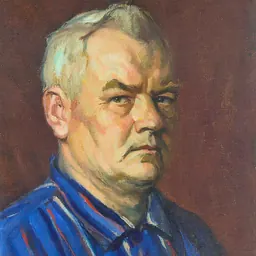
Contemporaries
People whose lives overlapped Harrison Begay's

Frequently asked questions
Who was Harrison Begay?
Navajo painter in the Studio-Style (1917-2012)
When was Harrison Begay born?
Harrison Begay was born on 15 November 1917 in Whitecone.
When did Harrison Begay die?
Harrison Begay died on 18 August 2012 in Gilbert, Arizona.
What was Harrison Begay's occupation?
Harrison Begay was a painter.
What nationality was Harrison Begay?
Harrison Begay was American.
Sources & further reading
Cite this page
APA: Biography.guide. (2026). Harrison Begay. https://biography.guide/harrison-begay/
MLA: "Harrison Begay." Biography.guide, https://biography.guide/harrison-begay/.
Chicago: "Harrison Begay." Biography.guide. https://biography.guide/harrison-begay/.
Data last updated: 2026-09-20 · Spot an error? Report a correction.
Page generated 2026-09-27 05:16 UTC