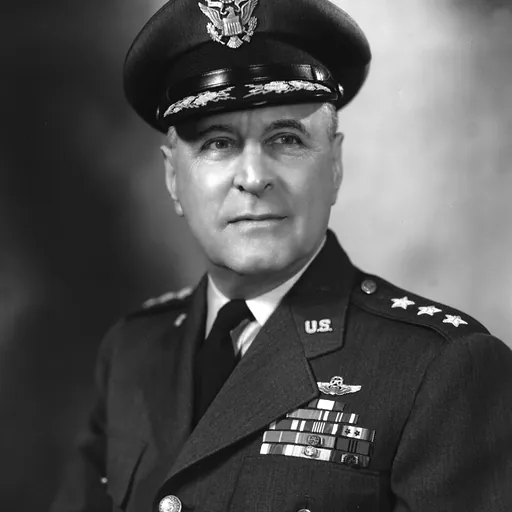
About Harold L. George
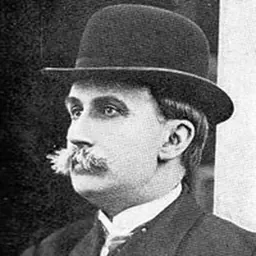
Lived 1893 – 1986 (aged 92). Harold L. George was an American military officer and politician.
Harold Lee George (July 19, 1893 – February 24, 1986) was an American aviation pioneer who helped shape and promote the concept of daylight precision bombing.
During World War II, George led the Air Transport Command, taking it from 130 obsolescent aircraft to 3,000 modern transports, operated by 300,000 airmen. Following the war, he helped Hughes Aircraft become a very profitable company, and was twice elected mayor of Beverly Hills, California.
Early career George was born July 19, 1893, in Somerville, Massachusetts, to Horace and Susan E. George. He attended George Washington University, but decided to interrupt his studies when the United States became directly involved in World War I. George observed that massed bombers, flying in formation, swamped enemy defenses and so reduced the attacker's casualties.
In 1919, George clerked part time for U.S. Supreme Court Justice James McReynolds, and graduated in 1920 from the National University School of Law with an LL.B. degree.
Bombing advocate In France, George met William "Billy" Mitchell and became convinced that Mitchell's vision of an independent Air Force was the best future direction for the American military.
After the war, George was assigned to the 49th Bombardment Squadron at Kelly Field, Texas. On July 1, 1920, when the Air Service became a combat arm of the line, he transferred to it in the permanent grade of 1st lieutenant. He next served with the 14th Bombardment Squadron at Langley Field, Virginia, and with the Aberdeen Proving Ground, Maryland, from 1921 to 1925. There George assisted Mitchell in his bombing demonstration against old battleships, and helped develop air-to-ship tactics.
In July 1929, George was ordered to Hawaii for two years with the 5th Composite Group at Luke Field. In September, 1931, he went to Maxwell Field, Alabama, to study at the Air Corps Tactical School (ACTS) where he helped refine the precision daylight bomber doctrine taught there. He was promoted to captain during the assignment, on December 1, 1931. Following graduation, George became an instructor at ACTS, teaching air tactics and precision bombing doctrine, In 1934, George was made director of the Department of Air Tactics and Strategy, and vigorously promoted the doctrine of precision bombing in which massed air fleets of heavy bombers would be commanded independently of naval or ground warfare needs. reaching $100M in sales in 1948. George expanded the company beyond the manufacture of aircraft to focus on the new field of military electronics, primarily by bringing together expert electronics designer Dean Wooldridge and engineer-businessman Simon Ramo, both hired by George in 1946. In August 1953, Ramo and Wooldridge resigned. George followed a few months later to help form the Ramo-Wooldridge Corporation, competing directly with Hughes by developing ballistic missile defenses. In 1958, Ramo-Wooldridge would merge with Thompson Products, to become Thompson Ramo Wooldridge, which was shortened to TRW in 1965.
After moving there in 1948, George was elected to the City Council of Beverly Hills, California, in 1952, and in 1954 he was elected mayor, a one-year term. He served a second term in 1959. During his second term, George established an annual award to honor outstanding Beverly Hills police officers, given in the name of Clinton H. Anderson, the city's police chief.
In 1955, George was recalled to active duty in the United States Air Force for eight months as a special consultant to the Air Force Chief of Staff. George was relieved from active duty November 4, 1955. On February 24, 1986, George died in Laguna Hills. He was survived by his wife Violette; three daughters and one son.
Legacy Walter J. Boyne highlight's George's involvement in pushing toward the concept of daylight precision bombing as a strategic, war-winning doctrine. Though he played a fundamental role in the development of U.S. air power strategy, he is perhaps better known as the first commander of Air Transport Command—the man who guided and expanded that organization throughout World War II.
The Order of Daedalians has, since 1956, awarded the "Lieutenant General Harold L. George Civilian Airmanship Award", a trophy "presented annually to the pilot, copilot and/or crew of a United States certified commercial airline selected by a Federal Aviation committee to have demonstrated ability, judgment and/or heroism above and beyond normal operational requirements." The Air Force Aid Society bestows the "Lieutenant General Harold Lee George Educational Grant Award."
In 1991 he was inducted into the Airlift/Tanker Association Hall of Fame.
Recognition George was awarded:
Don’t just read it —
keep it.
Full-length biographies made to live with: read them, listen on the way to work, watch them tonight.
- E-book
- Audio
- Video
Instant download · yours to keep · every purchase keeps this site free
Important facts
People in Harold L. George's life
Named in this biography and alive at the same time





Related people
Same field, nearest in time


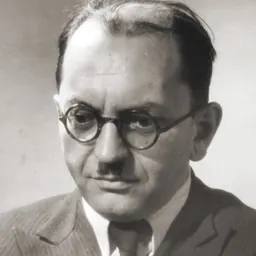
Contemporaries
People whose lives overlapped Harold L. George's
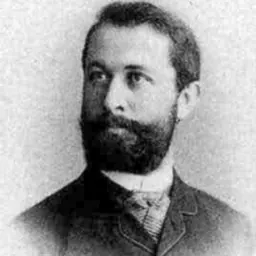
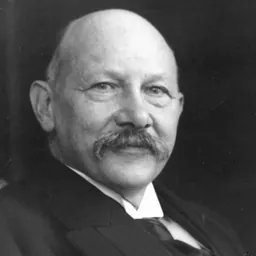
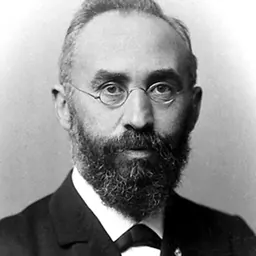

Frequently asked questions
Who was Harold L. George?
United States Air Force general (1893-1986)
When was Harold L. George born?
Harold L. George was born on 19 July 1893 in Somerville.
When did Harold L. George die?
Harold L. George died on 24 February 1986 in Laguna Hills.
What was Harold L. George's occupation?
Harold L. George was a military officer and politician.
What nationality was Harold L. George?
Harold L. George was American.
Sources & further reading
Cite this page
APA: Biography.guide. (2026). Harold L. George. https://biography.guide/harold-l-george/
MLA: "Harold L. George." Biography.guide, https://biography.guide/harold-l-george/.
Chicago: "Harold L. George." Biography.guide. https://biography.guide/harold-l-george/.
Data last updated: 2026-09-21 · Spot an error? Report a correction.
Portrait: Wikimedia Commons · author & licence
Page generated 2026-09-27 05:00 UTC