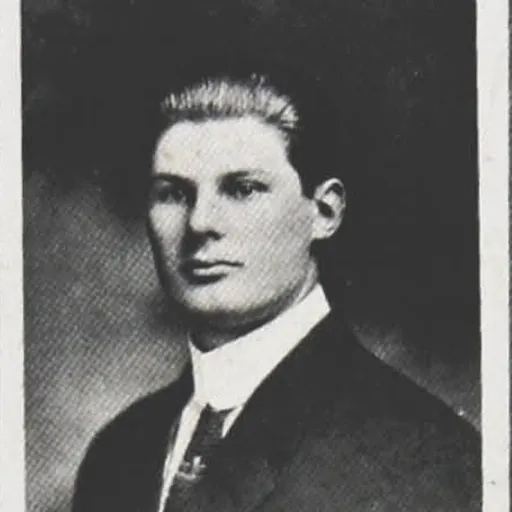
About Harold Beverage
Lived 1893 – 1993 (aged 99). Harold Beverage was an American inventor, amateur radio operator, electrical engineer and executive.
Harold Henry "Bev" Beverage (October 14, 1893 – January 27, 1993) was an American inventor and researcher in electrical engineering. He is known for his invention and development of the wave antenna, which came to be known as the Beverage antenna. Less widely known (outside of the community of science history researchers) is that Bev was a pioneer of radio engineering and his engineering research paralleled the development of radio transmission technology throughout his professional career with significant contributions not only in the field of radio frequency antennas but also radio frequency propagation and systems engineering.
Biography
Harold Beverage was born on October 14, 1893, in North Haven, Maine, to Fremont Beverage and his wife, Lottie Smith. He received a B.S. in electrical engineering from the University of Maine in 1915, and went to work for General Electric Company the following year as a radio-laboratory assistant to Dr. Ernst Alexanderson. In 1920, he was placed in charge of developing receivers for transoceanic communications at the Radio Corporation of America in Riverhead, New York. Three years later, at the age of 30, he received the IRE Morris N. Liebmann Memorial Prize "for his work on directional antennas."
RCA named Beverage chief research engineer of communications in 1929, a position he held until 1940. At that time, he was promoted to vice president in charge of research and development at RCA Communications Inc., a subsidiary of the Radio Corporation of America. Beverage retired in 1958 from that position and as director of radio research, but continued to work in communications as a consultant.
In 1938, the Radio Club of America presented him with its Armstrong Medal for his work in the development of antenna systems. The Beverage antenna, the citation said, was "the precursor of wave antennas of all types." Beverage was awarded the IRE Medal of Honor in 1945, "In recognition of his achievements in radio research and invention, of his practical applications of engineering developments that greatly extended and increased the efficiency of domestic and world-wide radio communications and of his devotion to the affairs of the Institute of Radio Engineers." In awarding him its AIEE Lamme Medal in 1956 the American Institute of Electrical Engineers cited him "for his pioneering and outstanding engineering achievements in the conception and application of principles basic to progress in national and worldwide radio communications."
Beverage died on January 27, 1993, at the John T. Mather Hospital in Port Jefferson, L.I. He was 99, and lived in Stony Brook, New York.
Patents Jun 7, 1921 Radio Receiving System - the Beverage antenna Nov 7, 1922 Radio Receiving System - the bidirectional Beverage antenna Nov 7, 1922 Radio Receiving System - using a Beverage antenna with multiple receivers Nov 7, 1922 Radio Receiving System - a Beverage antenna with selective circuits to eliminate interference from adjacent wavelengths Mar 18, 1924 Radio Receiving System - improvements to the directivity of the Beverage Antenna Jan 8, 1929 Artificial transmission lines for phasing multiple antennas Aug. 5, 1931 Means for testing recorded sound—automatic check film Aug. 18, 1931 H.H.B. % H.O. Peterson—Means for eliminating fading on high frequencies (filed1/2/26) Mar. 15, 1932 Frequency modulate or mark/space for AGC (automatic gain control) Aug. 30, 1932 Acoustic combining system - mix reflections Aug. 30, 1932 Method for eliminating fading—basic rectifier telegraph Nov. 15, 1932 Differential volume control for diversity artificial line Jul. 11, 1933 H.H.B. & H.O. Peterson—Rotating switch, diversity Jul. 11, 1933 H.H.B. & H.O. Peterson—Artificial line pickup delay, diversity Jun 12, 1934 Device for reducing the effects of static or fading Jul 24, 1934 Aerial System - to be used adjacent to local noise sources Jan. 15, 1935 H.H.B. & H.O. Peterson—Means for elimination of fading on short wavelengths Feb 5, 1935 Method of testing recorded sound Sept. 17, 1935 Remote control system for relay stations Dec. 10, 1935 Aerial system—balanced bridge to reduce engine ignition noise of aircraft Dec. 24, 1935 Multiplex signaling—commutator and frequency change for multiplex Jan. 28, 1936 Receiving system-rectifier high frequency for C.W. Hansell electrolytic recorder Mar. 24, 1936 Radio telegraph repeater—electronic, no relays Jan. 12, 1937 Radio communication—frequency diversity Feb. 9, 1937 H.H.B. & H.O. Peterson—Fading eliminator—different beat notes Feb. 6, 1937 Multiplex cable code with diversity receivers Apr. 6, 1937 Crystal oscillator monitor for centralized control May 25, 1937 Television system—AGC based on density of film June 22, 1937 System for radio spectrography, horizontal sync on oscillograph Oct, 5, 1937 Signaling-space between carrier and sidebands, phone Feb 1, 1938 Relay system - Ultra short radio waves Aug. 5, 1938 Centralized control relay stations Nov 29, 1938 Phasing and spacing antennas to eliminate undesired reflected rays Jan, 17, 1939 Electrical energy measuring system frequency modulation Feb 7, 1939 Warren Knotts & H.H.B. -- Frequency assignments for relay stations Sept. 191 1939 Amplitude modulation reception—change to phase modulation Jul 1, 1941 Broadband Uni-directional Shortwave Antenna Sept 9, 1941 System for noise reduction - noise random, signal in phase Feb. 3, 1942 Ultra short wave noise elimination—balance local noise vertical suppressor Aug 20, 1946 Secrecy system for multiplex telegraphy Mar 4, 1947 Radio receiver system for UHF frequencies that removes unintentional frequency modulation from a received signal Nov 8, 1949 Radio Relaying System - frequency selection for a chain of relay stations
Don’t just read it —
keep it.
Full-length biographies made to live with: read them, listen on the way to work, watch them tonight.
- E-book
- Audio
- Video
Instant download · yours to keep · every purchase keeps this site free
Important facts
People in Harold Beverage's life
Named in this biography and alive at the same time



Related people
Same field, nearest in time


Contemporaries
People whose lives overlapped Harold Beverage's


Frequently asked questions
Who was Harold Beverage?
American inventor (1893–1993)
When was Harold Beverage born?
Harold Beverage was born on 14 October 1893 in North Haven.
When did Harold Beverage die?
Harold Beverage died on 27 January 1993 in Port Jefferson.
What was Harold Beverage's occupation?
Harold Beverage was an inventor, amateur radio operator, electrical engineer and executive.
What nationality was Harold Beverage?
Harold Beverage was American.
Sources & further reading
Cite this page
APA: Biography.guide. (2026). Harold Beverage. https://biography.guide/harold-beverage/
MLA: "Harold Beverage." Biography.guide, https://biography.guide/harold-beverage/.
Chicago: "Harold Beverage." Biography.guide. https://biography.guide/harold-beverage/.
Data last updated: 2026-09-22 · Spot an error? Report a correction.
Portrait: Wikimedia Commons · author & licence
Page generated 2026-09-27 05:02 UTC