
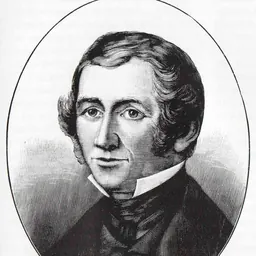
Harichand Thakur
Founder of the Matua sect
About Harichand Thakur
Lived 1812 – 1877 (aged 64–65). Harichand Thakur was a social reformer, known for Dalit.
Harichand Thakur (11 March 1812 – 5 March 1878), was a social reformer who worked among the untouchable people of the Bengal Presidency. He founded the Matua sect of Hinduism.
Life Harichand Thakur was born into a Vaishnavite Namashudra peasant family in 1811 in Safaladanga, a village in Gopalgunj, then part of the Bengal Presidency (now a part of Bangladesh). He was the son of Jashomanta Thakur (father) and Annapurna Devi (mother). His family, for generations, had belonged to the Gaudiya Vaishnavism sect; according to the book "Sri Sri Hari Lilamrita", his ancestors came from Rarhdesh. His grandfather, Manchanram Biswas, was a devout Vaishnavite known as 'Thakur Manchanram' in the locality. After that he started preaching his own religious realization which is only based on Bhakti. According to his doctrine, all traditional rituals, except devotion to God, faith in mankind, and love for living beings, are meaningless and distortions from the real aim of attaining God. These downtrodden people did not have any right in anything. His simple doctrine attracted many adherents from his own marginalized community. However, higher caste Hindus and Vaishnavs distanced themselves from his religion. In one sense, he gave the religionless Namashudras a new religion, his own Matua religion and helped them to establish their own right. They started considering him as God (Param Brahma) Harichand and as an avatar (incarnation) of Vishnu or Krishna. Thus, he became known as Sri Sri Harichand Thakur. Although he initially attracted followers only from his community, later his religion attracted followers from other caste communities that were marginalised by the upper castes, including the Chamars, Malis, and Telis.
His newly founded Matua religion is based on only three basic principles - Truth, Love, and Sanity. There is no need for leaving home to lead a saintly life. He insisted that one can achieve salvation only through simple love and devotion to God. There is no need for initiation by a guru (Diksha) or pilgrimage. One can attain God by chanting Haribol and praying the God. All other mantras except the name of God and Harinam (Haribol) are just meaningless and distortions. He formulated his new Matua religion by combining the work with religion. He said haate kam mukhe nam (work in the hand and name of the God Hari in mouth).
He gave twelve instructions to his followers. These twelve instructions are: (I) Always speak the truth (II) Treat the woman as your mother-being; Respect the woman (III) Always respect your parents (IV) Treat your neighbors and all earthly living beings with love, pity, and kindness (V) Never discriminate on racial grounds (VI) Bring all the six passions of the mind under your control. These six passions of mind are - Lust, Anger, Greed, Infatuation, Pride, and Jealousy. (VII) Remain liberal to all other religions and creeds (VIII) Become honest in mind and activities and avoid saintly dress to adorn yourself with (IX) Perform your duties devotedly and utter the sacred Haribol and pray to God simultaneously (X) Build a temple of pure thoughts in your heart and soul and a temple of Shree Hariparameshwar at your dwelling place (XI) Pray daily to God with devotion and sanctity (XII) Sacrifice yourself to the cause of God. According to Sekhar Bandyopadhyay, it was under the leadership of Guruchand that the Matua sect "achieved its doctrinal cohesion and organisational push, as it came to be associated with the Namasudra social protest movement started in 1872".
A considerable body of Dalit literature that mixes religious and secular themes has emerged around Thakur and Matua. This includes biographies, promotions of the teachings and interpretations of the relationship to later events, such as the thoughts of B. R. Ambedkar and comparisons with the situation of black people in the US.
Don’t just read it —
keep it.
Full-length biographies made to live with: read them, listen on the way to work, watch them tonight.
- E-book
- Audio
- Video
Instant download · yours to keep · every purchase keeps this site free
Important facts
Family & relationships
Related people
Same field, nearest in time




Contemporaries
People whose lives overlapped Harichand Thakur's






Frequently asked questions
Who was Harichand Thakur?
Founder of the Matua sect (1812–1877)
When was Harichand Thakur born?
Harichand Thakur was born on 11 March 1812 in Faridpur District.
When did Harichand Thakur die?
Harichand Thakur died in 1877 in Faridpur, Bangladesh.
What was Harichand Thakur's occupation?
Harichand Thakur was a social reformer.
What was Harichand Thakur known for?
Harichand Thakur was known for Dalit.
Sources & further reading
Cite this page
APA: Biography.guide. (2026). Harichand Thakur. https://biography.guide/harichand-thakur/
MLA: "Harichand Thakur." Biography.guide, https://biography.guide/harichand-thakur/.
Chicago: "Harichand Thakur." Biography.guide. https://biography.guide/harichand-thakur/.
Data last updated: 2026-09-22 · Spot an error? Report a correction.
Page generated 2026-09-27 05:11 UTC