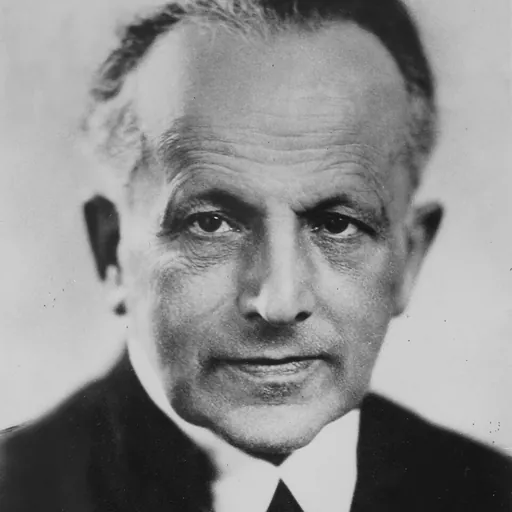
About Hans Ehrenberg
Lived 1883 – 1958 (aged 74). Hans Ehrenberg was a German resistance fighter, economist, political economist, anglican theologian, philosopher and protestant theologian.
Hans Philipp Ehrenberg (; 4 June 1883 – 21 March 1958) was a German Jewish philosopher and theologian. One of the co-founders of the Confessing Church, he was forced to emigrate to England because of his Jewish ancestry and his opposition to Nazism.
Life
1883–1914 Hans Ehrenberg was born into a liberal Jewish family, the eldest of three children. His parents were Emilie (née Fischel) and Otto Ehrenberg, brother of Victor Ehrenberg, a German jurist, and Richard Ehrenberg, a German economist. His younger brothers were Paul Ehrenberg and the historian Victor Ehrenberg, father of British historian Sir Geoffrey Elton and physicist Lewis Elton. After his graduation exam at the Wilhelm Gymnasium in Hamburg in 1902, and then studied economics, law and political studies (Rechtswissenschaften und Staatswissenschaften) in Göttingen, Berlin, Heidelberg and Munich. His attitude towards workers was already clear by 1906, when he wrote his Ph.D. dissertation on the situation of steel workers (Hüttenarbeiter) in the Ruhr Valley. Around this time, he developed a close friendship with his cousin Franz Rosenzweig, Viktor von Weizsäcker, and Martin Buber. Rosenzweig later claimed that "Ehrenberg was my real teacher in philosophy". In 1913, he married Else Anna Zimmermann (1890–1970), a linguist, teacher and descendant of Martin Luther. One of his uncles was Victor Mordechai Goldschmidt. One of his cousins, Hedwig Ehrenberg, studied physics and mathematics at the University of Goettingen, where she met and later married Max Born. Hans Ehrenberg, with Franz Rosenzweig and Eugen Rosenstock, was in regular correspondence with Louis D Brandeis through the friendship of their maternal families. In view of Hans Ehrenberg's father's and uncles' relatives, friends and acquaintances, and their travels over the lands and voyages across the seas and oceans, the reach of his communications extended to a world-wide network in many countries in all continents.
1914–1933 Ehrenberg volunteered for the First World War He joined the Social Democratic Party (SPD) in 1918, and for 18 months, was a city councilman in Heidelberg, as well as a member of workers' and soldiers' committees. He began making Christian pacifist statements in 1919. In the same year, he received an associate professorship in Heidelberg. At this time, working with Christian socialists, he began to think about becoming a Protestant minister.
Hans Ehrenberg's marriage to Else Zimmerman, 1913. The wedding party included Franz Rosenzweig and Victor Ehrenberg. Ehrenberg began his theological studies in Münster, in 1922, completing his second theological exam in 1924. He attended the World Conference of Life and Work in Stockholm, in 1925, and became friends with Nathan Soderblom and the English ecumenist George Bell. With Eugen Rosenstock-Huessy he was a co-founder, and also a prolific member of the philosophical discussion group and journal, "Die Kreatur", during the time 1925 to 1930.
Abandoning a promising academic career, in 1925, he became the minister of Pauluskirche in Bochum, in a heavily working-class area. He got involved in the Kampfbund christlicher Arbeiter (The Fighting Christian Workers), though he left the SPD, feeling that parish work was incompatible with political party activism. In 1927, he made speeches on church and antisemitism in opposition to riots organised by Nazi brownshirts. One lecture he gave in Hattingen, entitled "The Church and Anti-semitism" prompted a letter of complaint against him to the consistory in Münster:
1933–1945 Pauluskirche (St. Paul's Church), where Ehrenberg began preaching in 1925, was completely destroyed in the war and was rebuilt in 1950. After the Nazis seized power in 1933, more attacks followed and Ehrenberg's moral and pedagogical integrity were put in question.
Ehrenberg became one of the founders of the Confessing Church. He and four other Westphalian ministers had already formulated the "Bochum Confession" in May 1933. The first of its kind, it contained a denial of Nazi ideology and a confession of Christianity's Jewish origins. In July 1933, he published 72 Leitsätze zur judenchristlichen Frage (Seventy-Two Theses to the Jewish-Christian Question), clearly stating his own opposition to antisemitism and calling on the Protestant church to do the same. After he was the target of attacks in Der Stürmer, and facing pressure from the German Christian church authorities, Ehrenberg asked for early retirement in 1937. He had had a correspondence with Bell and was perhaps more significant than Franz Hildebrandt or Bonhoeffer in convincing Bell of the growing crisis in German churches under the Nazi state. His family joined him shortly afterward. in the Sachsenhausen concentration camp.
Ehrenberg spoke openly about the German confessional church in England in an effort to prevent the growing disaster in Germany. George Bell also spoke out about Nazi interference in the church. Ehrenberg and George Bell were of the same view that civilians and civilian infrastructure should not be affected by the ongoing war in central Europe.
His close friends included Pastor Dr. Werner Koch, a surviving member of the German resistance and the youngest brother of Hans Koch.
1945–1958 Ehrenberg returned to Germany in 1947, after the war, working as a minister at the Bethel Institution in Bielefeld. In 1953, he returned to Heidelberg, where he died in 1958.
Hans Ehrenberg Prize The Protestant Church Parish of Bochum and the Hans Ehrenberg Society award a prize of €5000 every two years in Ehrenberg's honor. The Hans Ehrenberg Prize is awarded at the Protestant Christuskirche (Christ Church) in Bochum, where Ehrenberg had been pastor. Previous winners are: 2000: Prof. Günter Brakelmann, theologian, Ruhr University Bochum (retired) 2002: Praeses Manfred Kock and Cardinal Karl Lehmann 2004: Prof. Dr. hc. Robert Leicht, University of Erfurt 2006: Action Reconciliation Service for Peace 2009: Dr. Edna Brocke, teacher of Jewish studies, Ruhr University Bochum 2011: Antje Vollmer, former vice president of the Bundestag (Green Party) 2013: Manfred Sorg and Eduard Wörmann, leaders in the Evangelical Church of Westphalia 2015: Heinrich Bedford-Strohm 2017: Wim Wenders 2019: Norbert Lammert
Don’t just read it —
keep it.
Full-length biographies made to live with: read them, listen on the way to work, watch them tonight.
- E-book
- Audio
- Video
Instant download · yours to keep · every purchase keeps this site free
Important facts
People in Hans Ehrenberg's life
Named in this biography and alive at the same time





Related people
Same field, nearest in time

Contemporaries
People whose lives overlapped Hans Ehrenberg's


Frequently asked questions
Who was Hans Ehrenberg?
German theologian (1883-1958)
When was Hans Ehrenberg born?
Hans Ehrenberg was born on 4 June 1883 in Altona.
When did Hans Ehrenberg die?
Hans Ehrenberg died on 21 March 1958 in Heidelberg.
What was Hans Ehrenberg's occupation?
Hans Ehrenberg was a resistance fighter, economist, political economist, anglican theologian, philosopher and protestant theologian.
What nationality was Hans Ehrenberg?
Hans Ehrenberg was German.
Sources & further reading
Cite this page
APA: Biography.guide. (2026). Hans Ehrenberg. https://biography.guide/hans-ehrenberg/
MLA: "Hans Ehrenberg." Biography.guide, https://biography.guide/hans-ehrenberg/.
Chicago: "Hans Ehrenberg." Biography.guide. https://biography.guide/hans-ehrenberg/.
Data last updated: 2026-09-23 · Spot an error? Report a correction.
Portrait: Wikimedia Commons · author & licence
Page generated 2026-09-27 05:05 UTC