
About H. R. Gross
Lived 1899 – 1987 (aged 88). H. R. Gross was an American politician, radio personality, newspaper editor and reporter.
Harold Royce Gross (June 30, 1899 – September 22, 1987) was a Republican United States representative from Iowa's 3rd congressional district for thirteen terms. The role he played on the House floor, objecting to spending measures and projects that he considered wasteful, prompted Time magazine to label him "the useful pest."
Personal background Gross was born on his parents' farm near Arispe, in Union County, Iowa. He was educated in the rural schools. In 1916, after completing his sophomore year in high school in Creston, Iowa, he concealed his youth in order to enlist in the military service, where he first served with the First Iowa Field Artillery in the Pancho Villa Expedition. During World War I he served in France with the United States Army from 1917–1919. He lost the primary by only 15,781 votes out of over 330,000 cast, in the closest primary race in Iowa in nearly thirteen years. His campaign was haunted by a statement he had made seven years earlier, while writing and speaking for the Farmers' Holiday Association, that appeared to approve of an episode of mob violence against a judge to stop a foreclosure.
Following his defeat, Gross joined an Ohio radio station and later moved to Indiana. the funeral of President John F. Kennedy (including the appropriation for fuel for the eternal flame),
Gross also refused to go on taxpayer-funded congressional junkets. As Ed Rollins recalled, "When he retired, his fellow members chipped in and bought him and his wife Hazel, who managed his office for no pay, a round-the-world trip. With tears in his eyes he took one last shot at his pals. 'Wherever we go, I am sure I'll see you all on your taxpayers' junkets!
In the early 1960s he took an early stand against the practice of retired service personnel getting a military pension and another federal paycheck. He opposed restoring former President Dwight D. Eisenhower to his generalship unless Congress stipulated that he would only receive his Presidential pension and not a general's salary also.
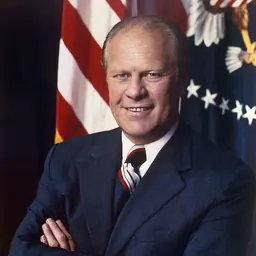
Gross was also known for his independence, so much so that then-House Minority Leader Gerald Ford remarked that "there are three parties in the House: Democrats, Republicans, and H.R. Gross."
Gross's personal lifestyle reflected his fiscally conservative views. He lived frugally and rarely attended any parties or social functions common to the life of a congressman. Gross was remembered as an outsider who preferred to sit in his townhouse and watch professional wrestling on TV.
He was also among the few who opposed the Uniform Monday Holiday Act in 1968, moving all federal holidays (other than Independence Day, Veterans Day, Christmas Day, and New Year's Day) to the nearest Monday. He argued that it would rob retail workers of their holidays because retail stores would remain open.
However, even his targets could speak warmly of Gross. Longtime House Armed Services Committee Chairman Carl Vinson, whose defense spending bills often incurred Gross's criticisms, said of Gross that "there is really no good debate unless the gentleman from Iowa is in it." as well as the 24th Amendment to the U.S. Constitution, but voted against the Civil Rights Acts of 1957 and 1964, as well as the Voting Rights Act of 1965. Despite his staunch fiscal conservatism, Gross was supportive of amendments for Social Security, the Celler-Kefauver Act, public housing, the Railroad Retirement Act, the Equal Rights Amendment of 1971 and the Oil Pollution Act of 1973.
H.R. 144 When Gross was in Congress, a special exception was made to the practice that bills offered in the House were numbered consecutively. The number H.R. 144 was reserved each session for one of Representative Gross's bills (because 144 equals one gross, making its title the arithmetical equivalent to his name).
Death Gross married Hazel E. Webster. They had two sons. He was a resident of Arlington, Virginia, until his death in a Washington, D.C. Veterans Hospital on September 22, 1987, due to complications from Alzheimer's disease.
Don’t just read it —
keep it.
Full-length biographies made to live with: read them, listen on the way to work, watch them tonight.
- E-book
- Audio
- Video
Instant download · yours to keep · every purchase keeps this site free
Important facts
People in H. R. Gross's life
Named in this biography and alive at the same time





Related people
Same field, nearest in time





Contemporaries
People whose lives overlapped H. R. Gross's

Frequently asked questions
Who was H. R. Gross?
American politician (1899-1987)
When was H. R. Gross born?
H. R. Gross was born on 30 June 1899 in Arispe.
When did H. R. Gross die?
H. R. Gross died on 22 September 1987 in Washington, D.C..
What was H. R. Gross's occupation?
H. R. Gross was a politician, radio personality, newspaper editor and reporter.
What nationality was H. R. Gross?
H. R. Gross was American.
Sources & further reading
Cite this page
APA: Biography.guide. (2026). H. R. Gross. https://biography.guide/h-r-gross/
MLA: "H. R. Gross." Biography.guide, https://biography.guide/h-r-gross/.
Chicago: "H. R. Gross." Biography.guide. https://biography.guide/h-r-gross/.
Data last updated: 2026-09-20 · Spot an error? Report a correction.
Page generated 2026-09-27 05:27 UTC