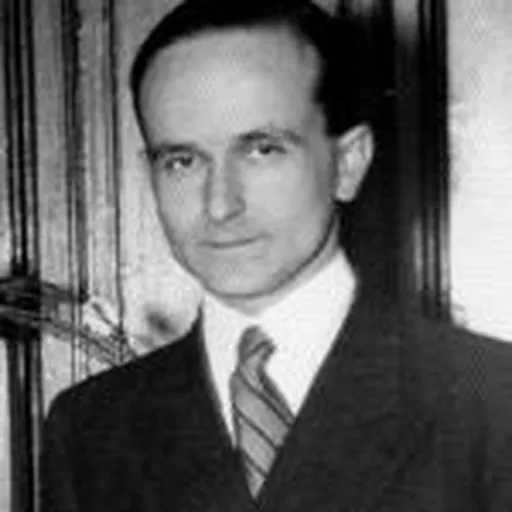
György Hajós
Hungarian mathematician who worked in group theory, graph theory, and geometry
About György Hajós
Lived 1912 – 1972 (aged 60). György Hajós was a Hungarian mathematician and university teacher.
György Hajós (February 21, 1912, Budapest – March 17, 1972, Budapest) was a Hungarian mathematician who worked in group theory, graph theory, and geometry.
Biography Hajós was born February 21, 1912, in Budapest; his great-grandfather, Adam Clark, was the famous Scottish engineer who built the Chain Bridge in Budapest. He earned a teaching degree from the University of Budapest in 1935. He then took a position at the Technical University of Budapest, where he stayed from 1935 to 1949. While at the Technical University of Budapest, he earned a doctorate in 1938. He became a professor at the Eötvös Loránd University in 1949 and remained there until his death in 1972. Additionally he was president of the János Bolyai Mathematical Society from 1963 to 1972. This result in group theory has consequences also in geometry: Hajós used it to prove a conjecture of Hermann Minkowski that, if a Euclidean space of any dimension is tiled by hypercubes whose positions form a lattice, then some pair of hypercubes must meet face-to-face. Hajós used similar group-theoretic methods to attack Keller's conjecture on whether cube tilings (without the lattice constraint) must have pairs of cubes that meet face to face; his work formed an important step in the eventual disproof of this conjecture.
Hajós's conjecture is a conjecture made by Hajós that every graph with chromatic number contains a subdivision of a complete graph . However, it is now known to be false: in 1979, Paul A. Catlin found a counterexample for , and Paul Erdős and Siemion Fajtlowicz later observed that it fails badly for random graphs. The Hajós construction is a general method for constructing graphs with a given chromatic number, also due to Hajós.
Awards and honors Hajós was a member of the Hungarian Academy of Sciences, first as a corresponding member beginning in 1948 and then as a full member in 1958. In 1965 he was elected to the Romanian Academy of Sciences, and in 1967 to the German Academy of Sciences Leopoldina. He won the Gyula König Prize in 1942, and the Kossuth Prize in 1951 and again in 1962.
Don’t just read it —
keep it.
Full-length biographies made to live with: read them, listen on the way to work, watch them tonight.
- E-book
- Audio
- Video
Instant download · yours to keep · every purchase keeps this site free
Important facts
People in György Hajós's life
Named in this biography and alive at the same time

Related people
Same field, nearest in time


Contemporaries
People whose lives overlapped György Hajós's






Frequently asked questions
Who was György Hajós?
Hungarian mathematician who worked in group theory, graph theory, and geometry (1912–1972)
When was György Hajós born?
György Hajós was born on 21 February 1912 in Budapest.
When did György Hajós die?
György Hajós died on 17 March 1972 in Budapest.
What was György Hajós's occupation?
György Hajós was a mathematician and university teacher.
What nationality was György Hajós?
György Hajós was Hungarian.
Sources & further reading
Cite this page
APA: Biography.guide. (2026). György Hajós. https://biography.guide/gyorgy-hajos/
MLA: "György Hajós." Biography.guide, https://biography.guide/gyorgy-hajos/.
Chicago: "György Hajós." Biography.guide. https://biography.guide/gyorgy-hajos/.
Data last updated: 2026-09-20 · Spot an error? Report a correction.
Portrait: Wikimedia Commons · author & licence
Page generated 2026-09-27 04:58 UTC