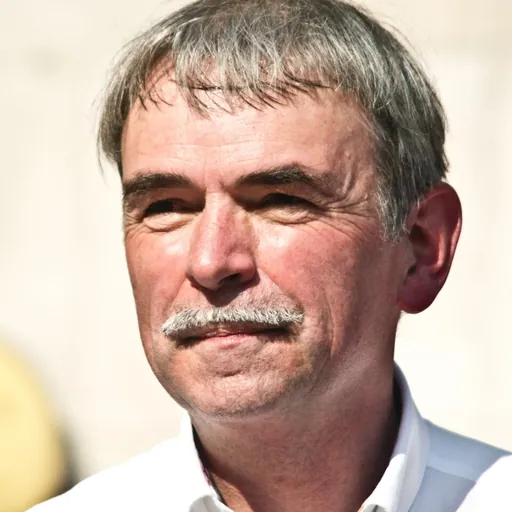
About Gustl Mollath
Born 1956. Gustl Mollath is a German entrepreneur and automobile salesperson.
Gustl Ferdinand Mollath (born 7 November 1956) is a German man who was acquitted during a criminal trial in 2006 on the basis of diminished criminal responsibility. He was subsequently committed to a high-security psychiatric hospital, as the court deemed him a danger to the public and declared him insane based on expert diagnoses of paranoid personality disorder. The judgment became the basis of controversy when elements of his supposed delusions regarding money-laundering activities at a major bank were found to be true. Mollath had consistently claimed there was a conspiracy to have him locked up in a psychiatric care ward because of his incriminating knowledge; evidence discovered in 2012 made his claims appear plausible.
In 2006, after being accused of assaulting his former wife, Petra Mollath, Gustl Mollath has denied the allegations levied against him and has said that he was being persecuted for blowing the whistle on tax evasion at HypoVereinsbank.
On 6 August 2013, the Higher Regional Court of Nuremberg ordered a retrial and Mollath's immediate release, overturning a verdict of the Regional Court of Regensburg that had blocked a retrial.
Early life Gustl Mollath was born 7 November 1956 in Nuremberg. He attended a Waldorf school and obtained an entrance qualification for universities of applied sciences in 1976. He then began to study mechanical engineering, which he subsequently abandoned. Mollath lost his father in 1960 and his mother in 1980, both due to cancer.
In 1978 he met his future wife Petra Mollath, who worked from 1990 as a financial adviser at HypoVereinsbank. They married in 1991.
Court case and detainment According to Petra Mollath, a violent confrontation and assault happened in August 2001 in their apartment. In 2002, she moved out.
From February 2006, Mollath was deemed to be a public danger and was held in three different institutions including, from April 2006, the Straubing District Hospital.
The District Court Nuernberg-Fuerth eventually acquitted Mollath in August 2006, because of his attested state of mind, yet considered the accusation proven. The court ordered his hospitalization in a psychiatric hospital because he was considered dangerous. The judgment was based, among other things, on the opinion of expert Klaus Leipziger from Bayreuth, who attested to Mollath's paranoid delusions of a "black money complex".
Since mid-2009, Mollath was hospitalized in the District Hospital of Bayreuth.
Political and media discussion Numerous media outlets, in particular the Süddeutsche Zeitung (major German newspaper) and Report Mainz (investigative TV magazine), reported critically for years about the Mollath case, for example about the trial management. They complain about mistakes in the court hearings and the selective consideration of evidence. For their series of articles in the Süddeutsche Zeitung about the Mollath case, Olaf Przybilla and Uwe Ritzer were awarded with the 3rd prize of the Guardian Prize of the German daily press (Wächterpreis der deutschen Tagespresse)
First report from Report Mainz The case was first presented on TV by Report Mainz on 13 December 2011. Mollath's former wife was employed by the HypoVereinsbank and Gustl Mollath accused her and other employees of facilitating customers tax evasion. The HypoVereinsbank then performed an internal investigation and subsequently terminated her employment in 2003, along with other employees.
Urgency motion in the Bavarian Parliament After an urgency motion of the Bavarian SPD party in the Bavarian Parliament, the Minister of Justice Beate Merk (CSU party) defended herself in a speech in front of the Parliament on 15 December 2011 against the impression Mollath had been hospitalized due to his criminal complaint. The following day she was explaining through a spokesman, that the accommodation Mollaths in psychiatry was a consequence of his crimes and had nothing to do with his wife or his lawsuit against the bank. She said, Mollath harmed his wife with strangulation marks on the neck, large hematoma and a bleeding bite wound. He also stabbed dozens of car tires, including those on vehicles of the wife's lawyers. His accommodation was confirmed by the Federal court and is observed regularly. She defended herself against the allegations that the state prosecution had failed to act because of instructions from leading politicians.
Report Mainz confronted Minister Merk in an interview with a quote from the audit report, which states that "all verifiable allegations were proven to be true". The magazine put that statement in contrast to her testimony before the Parliament Committee on Legal Affairs on 30 October 2012, where she said Mollath's allegations weren't true. Minister Merk thereupon declared in the interview that no pursuable statements had been proved to be true. The next day she explained in more detail, that the relevant audit report allegations had affected employment law issues and were not pursuable. As far as criminal matters were concerned, the statutes of limitations had already occurred. It was not a question of whether Mollath is telling the truth, but whether he is dangerous or not.
On 4 December 2012 Report Mainz broached the issue for a third time, this time particularly with regards to the allegation of Judge Brixner's bias in the case. He arranged a call at the tax authorities, that Mollath's allegations were not being pursued.
Public reactions The second report evoked a number of public reactions. The opposition in the Bavarian parliament demanded that Merk resign her office. Maria E. Fick, Commissioner for Human Rights of the Bavarian State Chamber of Physicians, professor of penal law Henning Ernst Müller (University of Regensburg) as well as the Süddeutsche Zeitung criticised the medical assessment's quality and the verdict's viability.
The first medical specialist statement on Mollath's mental health was created solely from information provided by his wife; the doctor in question, Gabriele Krach, consultant psychiatrist at the Klinikum am Europakanal, had not seen Mollath even once. Leipziger created a first medical assessment in 2005, based on court documents sent to him, which diagnosed a "paranoid system of thought". It was a direct reaction to Simmerl's statement, initiated by the responsible "court for the execution of prison sentences" (Strafvollstreckungskammer). Like Müller, the newspaper furthermore contradicted Merk's claim that Mollath's classification as a danger to the public and his black money allegations had nothing to do with each other.
Due to said coverage, Merk was under public and political pressure and on 30 November 2012 vowed to have Mollath's case re-opened.
Defending the lawsuit In December 2012 Beate Lakotta, journalist for the German weekly magazine Der Spiegel covered the lawsuit and stated that there were plausible explanations for most of the claims laid out by Mollath and his defenders. Contrary to the argument by German daily newspaper Süddeutsche Zeitung,
Debate on the judicial panel On 28 February and 7 March 2013 the judicial panel of the Bavarian parliament debated the causa Mollath. This particularly emphasised the question whether judge Otto Brixner had influenced tax fraud investigations. Roland Jüptner, president of the Bavarian state office for taxes (Bayerisches Landesamt für Steuern), denied this. During the first session, he based this opinion on the fact that if this actually was the case, there would be a remark in the files. German newspaper "Süddeutsche Zeitung" subsequently reported that such a remark in fact existed.
A statement by Beate Merk in front of the Bavarian parliament in March 2012 posed a similar situation, stating that the "Duraplus file" was an "abstruse conglomeration". It was said to have led, together with the audit report and account movements in Swiss number accounts, to the initiation of several tax crime investigations in December 2012. While at first Jüptner claimed that only a handwritten note - in itself not constituting a "note for the file" - existed. The parliamentary opposition pointed out that Jüptner himself had written about a "handwritten note for the file". During a session on 7 March, Jüptner apologised and stated that fiscal secrecy regulations had forbidden him from releasing the note, while still assuring that the closing of the proceedings would also have occurred without the phone conversation with Brixner. The parliamentary opposition remained unconvinced.
Another argument during the 7 March session regarded comments by Nuremberg state attorneys, who, according to the German newspaper "Die Zeit", had stated during phone conversations that the court ruling was the result of a certain "sloppiness". Regardless of such apparent careless mistakes the ruling was said to be "essentially correct". Releasing Mollath as a result of political pressure was said to correspond to a catastrophe for the community, because he was still regarded as a dangerous person. Parliamentary opposition demanded to withdraw the case from the Office of the Chief Public Prosecutor Nuremberg due to bias. This demand was also based on the fact that the chief public prosecutor Hasso Nerlich had also been responsible for two failed petitions by Mollath in 2004, but the Bavarian ministry for justice and the parliament refused, in part to secure the separation of legislative and judiciary. On 4 January 2013, Mollath's attorney Strate filed charges against the judge and psychiatrist who performed the interning, for wrongful deprivation of personal liberty, but these charges were dismissed in February.
Further events since February 2013 On 19 February 2013, Strate applied for a trial de novo based on evidence that the presiding judge had committed numerous instances of perversion of justice against Mollath in the case. According to Strate, the judge was responsible for Mollath's detention for almost three weeks without disclosure of the charges or presentation to a judge, failure to respond to Mollath's complaints or forward them to the higher court that should have decided them, manipulation of the court's composition, obvious misrepresentations in the reasons for the judgment, and unconscionable refusal to discharge Mollath's assigned counsel in spite of many petitions to do so, followed by use of said counsel as a witness against his own client. To prevent duplication of effort with the prosecution, which was preparing a similar application of its own, the application was based exclusively on material that was, or should have been, available to the original court at the time of the original verdict.
On 18 March 2013, in a very unusual move, the prosecution also applied for a trial de novo, based on exculpating evidence that had surfaced only after the original trial.
In April 2013 a parliamentary inquiry commission was established by the Landtag of Bavaria following a motion by Alliance '90/The Greens and the Free Voters, joined by the Social Democratic Party. Judge Otto Brixner had to admit before the committee that he hadn't read Mollath's written defense which he claimed to be irrelevant in his judgment. In June 2013 Mollath testified before the committee, repeating his claim that he wasn't allowed to give evidence during his trial.
Twitter incident Ursula Gresser, a member of the CSU party and professor for internal medicine working at LMU Munich was visited by two plainclothes police officers at noon 10 June 2013 for a Twitter message that instigated to ask the Bavarian Minister of Justice for Mollath's release during a public event on online safety with minister. According to Gresser, the police told her that there were concerns over the safety of an event with the Minister of Justice in connection with a Twitter tweet. She previously had written: "When will Mollath come free? You can ask Merk this question on Monday, 10 June 2013, 19 o'clock at the Landgasthof Hofolding (Hofolding Country Inn)". She felt that the visit of the police was an attempt to intimidate and discourage her from visiting the event. Later, the Ministry of Justice and the police denied this. They claimed to receive note over earlier tweets about Gresser's family disputes and a related, planned disruption of the event.
Release On 6 August 2013, the Oberlandesgericht Nuremberg (higher regional court) ordered the reopening of Mollath's case. He was released from mental hospital immediately. The court found that the medical certificate documenting the alleged abuse of his wife was a "fictitious document", because it appeared to be written and signed by Dr. Madeleine Reichel, who never had examined Mollath's wife. Instead the author of the report was her son, then a doctor in training.
Action for damages Mollath's 2018 action for damages by the unlawful custody has been concluded in November 2019 by an ex gratia payment of €600,000 by the defendant Free State of Bavaria.
Don’t just read it —
keep it.
Full-length biographies made to live with: read them, listen on the way to work, watch them tonight.
- E-book
- Audio
- Video
Instant download · yours to keep · every purchase keeps this site free
Important facts
People in Gustl Mollath's life
Named in this biography and alive at the same time



Related people
Same field, nearest in time





Contemporaries
People whose lives overlapped Gustl Mollath's

Frequently asked questions
Who is Gustl Mollath?
German victim of a miscarriage of justice
When was Gustl Mollath born?
Gustl Mollath was born on 7 November 1956 in Nuremberg.
What is Gustl Mollath's occupation?
Gustl Mollath is an entrepreneur and automobile salesperson.
What nationality is Gustl Mollath?
Gustl Mollath is German.
Sources & further reading
Cite this page
APA: Biography.guide. (2026). Gustl Mollath. https://biography.guide/gustl-mollath/
MLA: "Gustl Mollath." Biography.guide, https://biography.guide/gustl-mollath/.
Chicago: "Gustl Mollath." Biography.guide. https://biography.guide/gustl-mollath/.
Data last updated: 2026-09-21 · Spot an error? Report a correction.
Portrait: Wikimedia Commons · author & licence
Page generated 2026-09-27 05:01 UTC