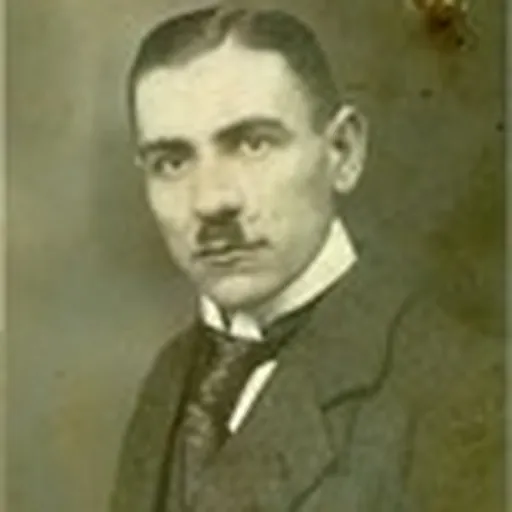
About Gustav Adolf Wohlgemuth
Lived 1868 – 1942 (aged 73). Gustav Adolf Wohlgemuth was a psychologist, known for Motion aftereffect and Psychoanalysis.
Gustav Adolf Wohlgemuth (1 November 1868 – 2 March 1942), known as A. Wohlgemuth in his publications, was a German/British businessman who lived in England and made significant contributions to psychology, conducting research into visual perception, memory, and imagery.
Biography Wolgemuth was born on 1 November 1868, in Berlin, North German Confederation, the son of Eduard Albert Maximilian Wohlgemuth and Louise Berend. According to Wade, Thompson and Morgan (2014), he travelled to London some time before 1891. Although little is known of Wohlgemuth's early life, once in London he became a British citizen in 1897 and by 1903 had established a business importing and exporting sausage casings. it proved impossible for the bullet to be removed. After Wohlgemuth had recovered from his wounds, Morrelet was tried in September 1918, was convicted for unlawful wounding, and was sentenced to six months imprisonment.
Contributions to psychology During studies for his DSc, Wohlgemuth was described as "a brilliant research student" (p. 233). based on his thesis, has been described as "the most comprehensive single article on the phenomenon [of the motion aftereffect]" Wohlgemuth, A. (1913). On memory and the direction of associations. British Journal of Psychology, 5, 447–465. Wohlgemuth, A. (1915). Simultaneous and successive association. British Journal of Psychology, 7, 434–452. Wohlgemuth, A. (1916). On the feelings and their neural correlate, with an examination of the nature of pain. British Journal of Psychology, 8, 423–476. Wohlgemuth, A. (1919). Pleasure–unpleasure. An experimental investigation of the feeling-elements. British Journal of Psychology, Monograph Supplement, 2, 1–252. Wohlgemuth, A. (1923). A critical examination of psycho-analysis. London: Allen & Unwin.
Don’t just read it —
keep it.
Full-length biographies made to live with: read them, listen on the way to work, watch them tonight.
- E-book
- Audio
- Video
Instant download · yours to keep · every purchase keeps this site free
Important facts
People in Gustav Adolf Wohlgemuth's life
Named in this biography and alive at the same time

Related people
Same field, nearest in time



Contemporaries
People whose lives overlapped Gustav Adolf Wohlgemuth's



Frequently asked questions
Who was Gustav Adolf Wohlgemuth?
British psychologist (1868–1942)
When was Gustav Adolf Wohlgemuth born?
Gustav Adolf Wohlgemuth was born on 1 November 1868 in Berlin.
When did Gustav Adolf Wohlgemuth die?
Gustav Adolf Wohlgemuth died on 2 March 1942.
What was Gustav Adolf Wohlgemuth's occupation?
Gustav Adolf Wohlgemuth was a psychologist.
What was Gustav Adolf Wohlgemuth known for?
Gustav Adolf Wohlgemuth was known for Motion aftereffect and Psychoanalysis.
Sources & further reading
· Wikipedia: Gustav Adolf Wohlgemuth
· DBpedia: Gustav Adolf Wohlgemuth
Cite this page
APA: Biography.guide. (2026). Gustav Adolf Wohlgemuth. https://biography.guide/gustav-adolf-wohlgemuth/
MLA: "Gustav Adolf Wohlgemuth." Biography.guide, https://biography.guide/gustav-adolf-wohlgemuth/.
Chicago: "Gustav Adolf Wohlgemuth." Biography.guide. https://biography.guide/gustav-adolf-wohlgemuth/.
Data last updated: 2026-09-23 · Spot an error? Report a correction.
Portrait: Wikimedia Commons · author & licence
Page generated 2026-09-27 05:06 UTC