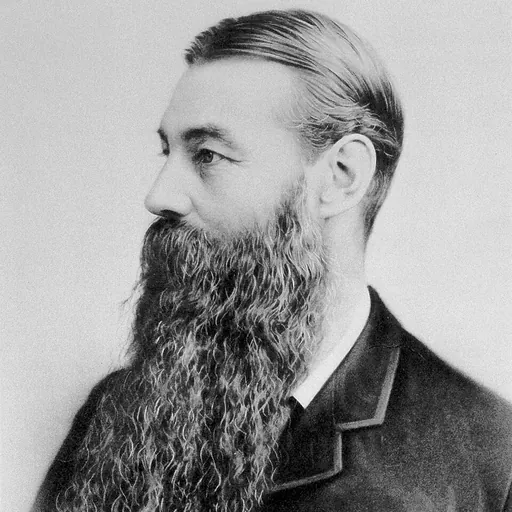
C. Lloyd Morgan
British psychologist, originator of Morgan's canon
About C. Lloyd Morgan
Lived 1852 – 1936 (aged 84). C. Lloyd Morgan was a British psychologist, zoologist, university teacher, philosopher and ethologist.
Conwy Lloyd Morgan, FRS (6 February 1852 – 6 March 1936) was a British ethologist and psychologist. He is remembered for his theory of emergent evolution, and for the experimental approach to animal psychology now known as Morgan's Canon, a principle that played a major role in behaviourism, insisting that higher mental faculties should only be considered as explanations if lower faculties could not explain a behaviour.
Life Conwy Lloyd Morgan was born in London and studied at the Royal School of Mines and subsequently under T. H. Huxley. He taught in Cape Town, but in 1884 joined the staff of the then University College, Bristol as Professor of Geology and Zoology, and carried out some research of local interest in those fields. However, he quickly became interested in the field he called "mental evolution", the borderland between intelligence and instinct, and in 1901 moved to become the college's first Professor of Psychology and Education. He was elected a Fellow of the Royal Society in 1899, and gave the Croonian Lecture in 1901, titled Studies in visual sensation.
In addition to his scientific work, Lloyd Morgan was active in academic administration. He became Principal of the University College, Bristol, in 1891, playing a central role in the campaign to secure it full university sltatus. In 1893, he enrolled his son, C. Lloyd Morgan, at Bristol's Clifton College. In 1909, when, with the award of a Royal Charter, the University College, Bristol became the University of Bristol and he was appointed as its first Vice-Chancellor, an office he held for a year before deciding to become Professor of Psychology and Ethics until his retirement in 1919. He was president of the Aristotelian Society from 1926 to 1927.
Following his retirement, Lloyd Morgan delivered a series of Gifford Lectures at St. Andrews in 1921 and 1922 in which he discussed the concept of emergent evolution.
Conwy Lloyd Morgan died in Hastings.
Ethology
Morgan's Canon
Morgan's Canon played a critical role in the growth of behaviourism in twentieth century academic psychology. The canon states: In no case may we interpret an action as the outcome of the exercise of a higher mental faculty, if it can be interpreted as the exercise of one which stands lower in the psychological scale. For example, Morgan considered that an entity should only be considered conscious if there is no other explanation for its behaviour.
W. H. Thorpe commented as follows:
The development of Morgan's Canon derived partly from his observations of behaviour. This provided cases where behaviour that seemed to imply higher mental processes could be explained by simple trial and error learning (what we would now call operant conditioning). An example is the skilful way in which his terrier Tony opened the garden gate, easily imagined as an insightful act by someone seeing the final behaviour. Lloyd Morgan, however, had watched and recorded the series of approximations by which the dog had gradually learned the response, and could demonstrate that no insight was required to explain it.
Instinct versus learning Lloyd Morgan carried out extensive research to separate, as far as possible, inherited behaviour from learnt behaviour. Eggs of chicks, ducklings and moorhens were raised in an incubator, and the hatchlings kept from adult birds. His early death in 1877 led to his work being largely forgotten until the 1950s, but Lloyd Morgan cited Spalding's observations in his own work.
Quotations Given two different minds and the same facts, how different are the products! Animal Life and Intelligence (1891), page 335
Books
The springs of conduct: an essay in evolution. (1885). Kegan Paul, London. Animal biology. (1887). Rivington, London. Animal sketches. . Arnold, London. Animal life and intelligence. (1891). Arnold, London. Introduction to comparative psychology. (1894). Routledgethoemmes, London. Psychology for teachers. (1894). Arnold, London. Habit and instinct. (1896). Arnold, London. Animal behaviour. (1900). Arnold, London. The interpretation of nature. (1906). Instinct and experience. (1912). Methuen, London. Spencer's Philosophy of Science. (1919). Oxford University Press. Emergent evolution. (1923). Henry Holt. Life, mind, and spirit. (1925). Henry Holt. Creation by Evolution. (1928). The Macmillan Company, New York. Mind at the crossways. (1929). Animal Mind. (1930). Arnold, London The emergence of novelty. (1933).
Don’t just read it —
keep it.
Full-length biographies made to live with: read them, listen on the way to work, watch them tonight.
- E-book
- Audio
- Video
Instant download · yours to keep · every purchase keeps this site free
Important facts
People in C. Lloyd Morgan's life
Named in this biography and alive at the same time
Related people
Same field, nearest in time




Contemporaries
People whose lives overlapped C. Lloyd Morgan's


Frequently asked questions
Who was C. Lloyd Morgan?
British psychologist, originator of Morgan's canon (1852-1936)
When was C. Lloyd Morgan born?
C. Lloyd Morgan was born on 6 February 1852 in London.
When did C. Lloyd Morgan die?
C. Lloyd Morgan died on 6 March 1936 in Hastings.
What was C. Lloyd Morgan's occupation?
C. Lloyd Morgan was a psychologist, zoologist, university teacher, philosopher and ethologist.
What nationality was C. Lloyd Morgan?
C. Lloyd Morgan was British.
Sources & further reading
Cite this page
APA: Biography.guide. (2026). C. Lloyd Morgan. https://biography.guide/c-lloyd-morgan/
MLA: "C. Lloyd Morgan." Biography.guide, https://biography.guide/c-lloyd-morgan/.
Chicago: "C. Lloyd Morgan." Biography.guide. https://biography.guide/c-lloyd-morgan/.
Data last updated: 2026-09-23 · Spot an error? Report a correction.
Portrait: Wikimedia Commons · author & licence
Page generated 2026-09-27 05:07 UTC