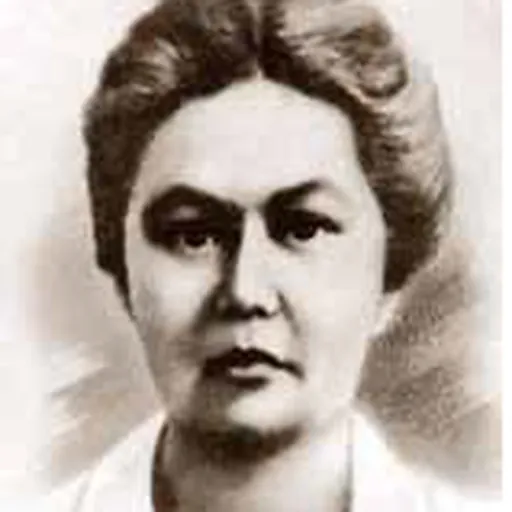
About Gulsum Asfendiyarova
Lived 1880 – 1941 (aged 60–61). Gulsum Asfendiyarova was a Kazakh community leader and physician.
Gülsim Jafarqyzy Asfendiarova (; November 12 1880 – 1937) was the first Kazakh woman to earn a medical degree. She played a key role in organizing the healthcare system in the Turkestan region and was also a dedicated medical educator.
Biography
Early life and education Asfendiyarova was born in 1880 in Tashkent. She was the third daughter of Seitzhafar Asfendiyarov, a descendant of Abu'l Khair Khan of the Junior Jüz, and Gulyandam Asfendiyarova (née Kasymova). Her father served as a military interpreter under the Turkestan Governor-General and retired in 1916 with the rank of Major-General. It is hypothesized that her maternal ancestry traces back to Ablai Khan of the Middle Jüz.
In 1902, after two graduates from the Medical Institute began working in Turkestan, the Governorate Council established a scholarship for 10 local girls to study at the institute. That same year, two Turkestani girls, Gulsum Asfendiyarova and Zeyneb Abdurakhmanova, received scholarship along with eight daughters of Russian officials. Abdurakhmanova was reportedly ethnically Tatar,
Poverty and lack of access to medical care were significant sources of epidemiological problems in the district. Asfendiyarova conducted house-to-house visits, discussing home and personal hygiene with residents.
In 1910, Asfendiyarova transferred first to Xonobod and then to the Pop District of Namangan County, where working conditions were slightly better. In late 1911, Asfendiyarova's father conveyed a proposal from the Khiva Khan for her to work at a city hospital, then still under construction. Gulsum agreed, provided that her salary and benefits were not less than those in the Russian medical service. In 1913, she began her duties as an obstetrician-assistant to the chief physician in Khiva. Here, for the first time in the history of the Khanate of Khiva, she performed a Caesarean section.
In 1913 (or 1914 ), during turbulent times, Asfendiyarova returned to Tashkent and became head of the city maternity hospital. Over time, and with her father’s support, she became actively involved in the region's social and political life. Following the February Revolution she was nominated as a delegate to the All-Russian Congress of Muslim Women, which took place in April 1917 in Kazan. There, Asfendiyarova was elected a member of the Organizing Bureau.
Returning to Tashkent, Asfendiarova continued leading the city maternity hospital and actively participated in the political life of the Turkestan ASSR. She also assisted her brother, Sanjar Asfendiarov, a fellow physician and future Minister of Health of the Kazakh ASSR, in his efforts to organize aid for the hungry and homeless.
In 1918, with the support of the and its head, Turar Ryskulov, Asfandiarova organized obstetric courses for women. The courses were later incorporated into the Akhunbaev Medical College in Tashkent. She continued to teach there until her death. Asfendiyarova was also repeatedly elected a member of the Tashkent City Council, publicly advocating for improvements in the social sphere and the protection of motherhood and childhood.
Since 1922, Asfendiyarova combined teaching with work in the Tashkent City Children's Hospital, where her assistant was , the first graduate of the National University of Uzbekistan. Asfendiyarova had known Dosjanova from the All-Russian Congress of Muslim Women. In this way, the pursuit of equal professional rights for women in Central Asia continued.
Later life Asfendiyarova's later life is largely unknown. During the Great Purge, Asfendiyarova's brother was arrested in 1937 and later executed, and his wife and daughter were exiled to Siberia. As the daughter of a tsarist military Major-General and the sister of an enemy of the people, Asfendiyarova's life hung in the balance. Asfendiyarova died that same year. Her death was announced in a local newspaper on October 25, 1937.
Her burial place was long considered unknown. However, in 2021, local activists found her grave in the , Tashkent.
Don’t just read it —
keep it.
Full-length biographies made to live with: read them, listen on the way to work, watch them tonight.
- E-book
- Audio
- Video
Instant download · yours to keep · every purchase keeps this site free
Important facts
People in Gulsum Asfendiyarova's life
Named in this biography and alive at the same time


Related people
Same field, nearest in time




Contemporaries
People whose lives overlapped Gulsum Asfendiyarova's

Frequently asked questions
Who was Gulsum Asfendiyarova?
Kazakh medical practitioner
When was Gulsum Asfendiyarova born?
Gulsum Asfendiyarova was born on 12 November 1880 in Turkistan Region.
When did Gulsum Asfendiyarova die?
Gulsum Asfendiyarova died in 1941 in Tashkent.
What was Gulsum Asfendiyarova's occupation?
Gulsum Asfendiyarova was a community leader and physician.
What nationality was Gulsum Asfendiyarova?
Gulsum Asfendiyarova was Kazakh.
Sources & further reading
· Wikipedia: Gulsum Asfendiyarova
· DBpedia: Gulsum Asfendiyarova
Cite this page
APA: Biography.guide. (2026). Gulsum Asfendiyarova. https://biography.guide/gulsum-asfendiyarova/
MLA: "Gulsum Asfendiyarova." Biography.guide, https://biography.guide/gulsum-asfendiyarova/.
Chicago: "Gulsum Asfendiyarova." Biography.guide. https://biography.guide/gulsum-asfendiyarova/.
Data last updated: 2026-09-23 · Spot an error? Report a correction.
Portrait: Wikimedia Commons · author & licence
Page generated 2026-09-27 05:05 UTC