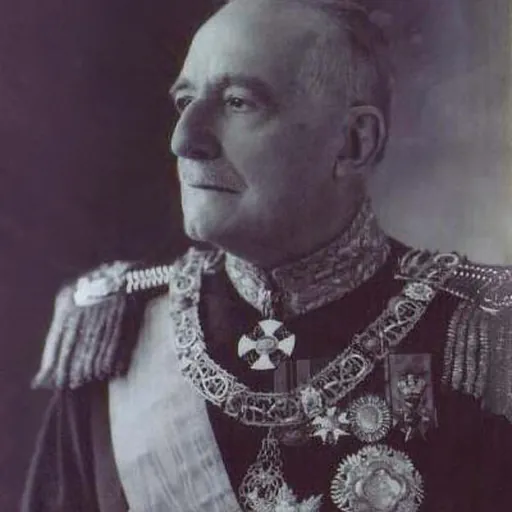
About Guglielmo Imperiali
Lived 1858 – 1944 (aged 85). Guglielmo Imperiali was an Italian politician and diplomat.
Marquis Guglielmo Imperiali (19 August 1858 – 20 January 1944) was an Italian nobleman and diplomat. A liberal associated with the political left, he was a scion of the conservative Imperiali family. His most important position was as the Italian ambassador in London during the First World War (1914–18).
Family
Born at Salerno, Imperiali was the second child and first son of the Marquis Francesco Imperiali di Francavilla (1826–1904), from a cadet branch of the Princes of Francavilla, and Clementina Volpicelli, daughter of Pietro Volpicelli, a businessman and landowner, and Teresa Micheroux, from a family of French soldiers established in Naples with King Charles III of Spain. Saint Caterina Volpicelli (1839–1894), a nun and foundress of the Congregation of the Handmaids of the Sacred Heart of Jesus, was his maternal aunt.
Early career
Imperiali attended law school in Naples, graduating in 1880. He joined the foreign service in 1882, and was posted to the United States at the critical moment of the Italian lynchings in New Orleans, following the assassination of police chief David Hennessy in 1890. In October 1895, just before a posting to Brussels, he married Giovanna Maria Colonna (1867-1946), daughter of Edoardo, Prince of Summonte, from a family influential in political and court circles. Between 1901 and 1903 he was in Berlin, serving as head of mission, where he tried to strengthen the Triple Alliance and criticised the German government for recognising the Treaty of Bardo, whereby France had gained control of Tunisia over Italy. After the fall of Foreign Minister Giulio Prinetti, Imperiali was sent to Sofia, capital of Bulgaria. The recent Mürzsteg Agreement (2 October 1903) between Austria-Hungary and Russia was designed to cut the Italians out of the Macedonian Question.
Imperiali served very briefly in Belgrade at the beginning of 1904 before being sent as ambassador to Constantinople. He was moved from there to London, taking up residence in the latter in May 1910. There he had the task of defending the Italo-Turkish War, provoked by Italy, and furthering Italy's Balkan interests in the London Conference of 1912–1913. In December 1913 he was appointed a senator.
First World War and post-war Although at the start of the World War he preferred neutrality, after Italy and the Triple Entente became allies, he was Italy's negotiator of the Treaty of London (1915), which promised Italy substantial territorial gains in case of victory against Germany and Austria. After the end of the war, he was a member of the Italian delegation to the Paris Peace Conference and a co-signer of the Treaty of Versailles, although his role during this negotiations was less central.
However, in November 1920, due to strong disagreements with the new Italian foreign minister, Carlo Sforza, Imperiali was removed from his post in London, replaced by Giacomo De Martino and mostly excluded from post-war negotiations. In 1921, he was appointed Italy's representative to the Council of the League of Nations and was also involved in humanitarian initiatives like the protection of deported women and children during the Greco-Turkish War.
After the Fascists came to power in 1922, Imperiali left his position at the League of Nations in 1923, but began to attend the Senate more regularly, becoming a prominent member of the opposition and an authority in matters of foreign relations.
In 1932, he was made a knight of the Order of the Most Holy Annunciation, a rare honour for a diplomat. He died in Rome.
List of honours Italian
Foreign
Don’t just read it —
keep it.
Full-length biographies made to live with: read them, listen on the way to work, watch them tonight.
- E-book
- Audio
- Video
Instant download · yours to keep · every purchase keeps this site free
Important facts
People in Guglielmo Imperiali's life
Named in this biography and alive at the same time


Related people
Same field, nearest in time




Contemporaries
People whose lives overlapped Guglielmo Imperiali's




Frequently asked questions
Who was Guglielmo Imperiali?
Italian politician and diplomat (1858–1944)
When was Guglielmo Imperiali born?
Guglielmo Imperiali was born on 19 August 1858 in Salerno.
When did Guglielmo Imperiali die?
Guglielmo Imperiali died on 20 January 1944 in Rome.
What was Guglielmo Imperiali's occupation?
Guglielmo Imperiali was a politician and diplomat.
What nationality was Guglielmo Imperiali?
Guglielmo Imperiali was Italian.
Sources & further reading
· Wikipedia: Guglielmo Imperiali
· DBpedia: Guglielmo Imperiali
Cite this page
APA: Biography.guide. (2026). Guglielmo Imperiali. https://biography.guide/guglielmo-imperiali/
MLA: "Guglielmo Imperiali." Biography.guide, https://biography.guide/guglielmo-imperiali/.
Chicago: "Guglielmo Imperiali." Biography.guide. https://biography.guide/guglielmo-imperiali/.
Data last updated: 2026-09-22 · Spot an error? Report a correction.
Portrait: Wikimedia Commons · author & licence
Page generated 2026-09-27 05:01 UTC