
About Gretel Bergmann
Lived 1914 – 2017 (aged 103). Gretel Bergmann was a German and American athletics competitor and athlete.
Gretel Lambert (born Margarethe Bergmann; April 12, 1914 – July 25, 2017) was a German Jewish track and field athlete who competed as a high jumper during the 1930s.
Due to her Jewish origins, the Nazis prevented her from taking part in the 1936 Summer Olympics, after which she left Germany and vowed never to return. She however visited Germany in 2004 to meet with her 1930s rival Elfriede Kaun, whom she considered a friend. Bergmann turned 100 in 2014. She died in 2017 at her home in Jamaica Estates, Queens, New York.
Life and career Margarethe Bergmann was born in 1914 in Laupheim, Germany, the daughter of Edwin and Paula (née Stern) Bergmann, a businessman. Starting sports at an early age, Gretel practiced all kinds of sports from running, swimming and playing tennis to skiing.
Before ever joining a track and field team, Bergmann started with soccer at the Ulm soccer club. She was able to receive professional training, and eventually her love of high jump began to prosper. Her later career in athletics continued in Laupheim. In 1930 she joined Ulmer FV 1894, winning her first title in high jumping in 1931 when, during the South German Championships, she jumped 1.51 metres. She won that same title again in 1932. Her dream was to attend the German College of Physical Exercise in Berlin, and had even been accepted, but after the Nazis' accession to power on 30 January 1933 she was expelled for being Jewish. Having also been barred from the Ulm soccer club, Bergmann decided to organize her own handball and soccer clubs.
That April her parents sent her to the United Kingdom where in 1934, where she took part in the British 1934 WAAA Championships and won the high jump event with a height of 1.55 metres.
The German government wanted her to return to Germany to help portray the nation as unbiased in its Olympic-team selections.
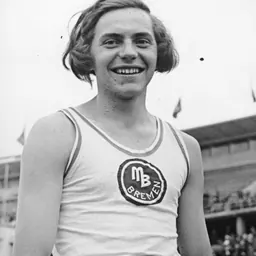
Bergmann was banned from the Berlin Olympics despite matching the high-jump record of 1.60 metres (5 feet 3 inches) to qualify and having spent two years on the team, starting in 1934. However, two weeks before the opening of the Olympics, she received a letter from the German sports authorities that she was being removed from the national team for under-performance. She was not replaced; instead, Germany fielded only two high jumpers: Dora Ratjen, who was later revealed to be a man who had been raised as a girl, and Elfriede Kaun. Bergmann's accomplishment was stricken from the record books some weeks later.
In 1937, Bergmann emigrated to the United States, settling in New York City, where she won the U.S. women's high jump (1.51 metres) and shot put championships, and in 1938 she again won the high jump (1.57 metres). Afterwards, she set other priorities to get her soon to be husband, Bruno Lambert to emigrate to the USA. They married that year. Her sports career ended after the entry of the United States into World War II. In 1942, she received United States citizenship.
Plaque in the house Rudolstädter Strasse 77, Berlin-Wilmersdorf. In translation, the plaque reads:
Awards and recognition
Bergmann's entry into the Jewish Hall of Fame at Wingate Institute in Israel in 1980 revived interest in her story.
In August 1995, a sports complex in Berlin-Wilmersdorf was named after her on the recommendation of the German National Sports Federation. Bergmann, who had vowed never to set foot on German soil again, did not attend the festivities. In 1996 she was admitted to the National Jewish Sports Hall of Fame in the United States. In 1999, she received the for achievements in the sphere of sports and society without the prospect of material gains.
The stadium in Laupheim, from which she had been barred in the 1930s, was named after her in 1999. This time Bergmann attended the dedication, saying:
I was not going to participate, but when I was told that they were naming the facilities for me so that when young people ask, "Who was Gretel Bergmann?" they will be told my story, and the story of those times. I felt it was important to remember, and so I agreed to return to the place I swore I'd never go again. But I had stopped speaking German and didn't even try when I was there. They provided a translator. In 2004, a documentary based on her life in Germany, Hitler's Pawn – The Margaret Lambert Story, mostly focusing on her athletic life, debuted on HBO prior to the 2004 Summer Olympics.
On 23 November 2009 her German national record (1.60 m) from 1936 was officially restored by the German track and field association, which also requested she be admitted to the German sports hall of fame. In September 2009 Berlin 36, a film about her preparation for, and exclusion from, the 1936 Olympics, debuted in German theaters. in her honor.
Don’t just read it —
keep it.
Full-length biographies made to live with: read them, listen on the way to work, watch them tonight.
- E-book
- Audio
- Video
Instant download · yours to keep · every purchase keeps this site free
Important facts
People in Gretel Bergmann's life
Named in this biography and alive at the same time


Related people
Same field, nearest in time


Contemporaries
People whose lives overlapped Gretel Bergmann's



Frequently asked questions
Who was Gretel Bergmann?
German high jumper
When was Gretel Bergmann born?
Gretel Bergmann was born on 12 April 1914 in Laupheim.
When did Gretel Bergmann die?
Gretel Bergmann died on 25 July 2017 in Queens.
What was Gretel Bergmann's occupation?
Gretel Bergmann was an athletics competitor and athlete.
What nationality was Gretel Bergmann?
Gretel Bergmann was German and American.
Sources & further reading
Cite this page
APA: Biography.guide. (2026). Gretel Bergmann. https://biography.guide/gretel-bergmann/
MLA: "Gretel Bergmann." Biography.guide, https://biography.guide/gretel-bergmann/.
Chicago: "Gretel Bergmann." Biography.guide. https://biography.guide/gretel-bergmann/.
Data last updated: 2026-09-20 · Spot an error? Report a correction.
Page generated 2026-09-27 05:20 UTC