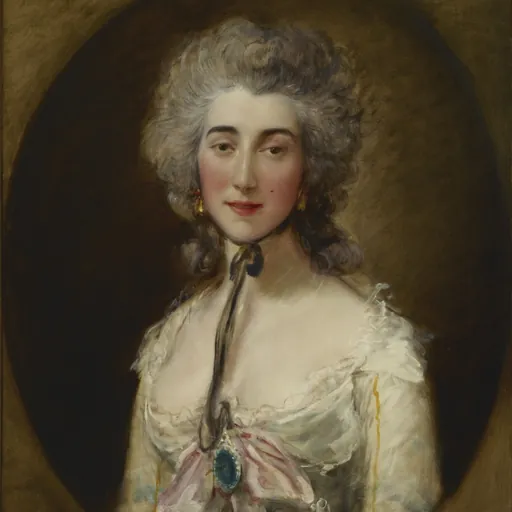
Grace Elliott
British socialite, courtesan and memoirist;
About Grace Elliott
Lived 1754 – 1823 (aged 68–69). Grace Elliott was a British autobiographer, writer and courtesan, known for Louis Philip II, Duke of Orléans.
Grace Dalrymple Elliott ( – 16 May 1823) was a Scottish courtesan, writer and spy resident in Paris during the French Revolution. She was an eyewitness to events detailed in her memoirs, Journal of my life during the French Revolution (Ma Vie sous la Révolution) published posthumously in 1859. She was mistress, first to the future George IV, by whom she is said to have borne an illegitimate daughter, and then to the Duke of Orléans. Elliott trafficked correspondence and helped condemned Royalists and members of the French nobility escape from the First French Republic during the Reign of Terror. She was arrested several times but managed to avoid the guillotine, and was released following the military coup that ended the Terror and resulted in the execution of Robespierre.
In the acclaimed but widely controversial 2001 film adaptation of her memoirs by French New Wave director Éric Rohmer as The Lady and the Duke, Grace Elliot was played by English actress Lucy Russell.
Early life Elliott was born probably in Edinburgh about 1754, the youngest daughter of Grissel Brown (died 30 September 1767) and Hew Dalrymple (died 1774), an Edinburgh advocate concerned in the great Douglas case. Her parents separated around the time of her birth, and she was most likely brought up at her grandparents' house.
She was educated in a French convent, and on her return to Scotland, was introduced by her father into Edinburgh society. Her beauty made such an impression on John Eliot, a prominent and wealthy physician, that he made her an offer of marriage in 1771. She accepted, although Eliot was about 18 years her senior. They were married on 19 October 1771 in London, when she was 17. The couple entered fashionable society, but eventually grew apart due to their difference in age and interests. Thomas Gainsborough painted two portraits of her in 1778, which are in the Frick Collection and the Metropolitan Museum of Art. In 1782, she had a short, concealed intrigue with the Prince of Wales (afterwards George IV) and gave birth to a daughter on 30 March 1782, who was baptised at St Marylebone as Georgiana Augusta Frederica Seymour (d. 1813) but used the name Georgina Seymour.
Elliott declared that the Prince was the father of her child and The Morning Post stated in January 1782 that he admitted responsibility. However, the child was dark in complexion, and when she was first shown to the Prince, he is said to have remarked, "To convince me that this is my girl they must first prove that black is white."
The Prince and many others regarded Lord Cholmondeley as the father of the girl, although the Prince's friends said that Charles William Wyndham (brother of Lord Egremont), whom she was thought to resemble, claimed paternity. Yet others thought she might have been fathered by George Selwyn. Lord Cholmondeley brought up the girl, and after her early death in 1813, looked after her only child.
Life in France: French Revolution Grace Elliott (1754?–1823). Portrait by Thomas Gainsborough, 1778. (In the Metropolitan Museum of Art) George, Prince of Wales, introduced her to the French Duke of Orleans in 1784 and by 1786, she had permanently set up residence in Paris and become one of Orleans' recognised mistresses. In exchange for her companionship, the Duke granted her a home on the Rue Miromesnil and a property in Meudon, to the south of Paris. During this period Elliott also pursued liaisons with the Duke de Fitz-James and the Prince of Conde.
Much of what is known about Elliott's life in France is recorded in her memoirs, Journal of my life during the French Revolution (Richard Bentley, 1859). Although there are a number of inconsistencies in her account, her work has become one of the best-known English-language accounts of The Terror, documenting the movements of the Duke of Orleans and those within his aristocratic Jacobin circle at the Palais-Royal. During her life in Paris, Elliott witnessed the horror of the September massacres and the body of the Princess de Lamballe carried through the streets. Although Elliott was an associate of the Duke of Orleans (who later took the name Philippe Égalité), her royalist sympathies soon became widely known throughout her district, and her home was frequently searched. It has been recently shown that Elliott was trafficking correspondence on behalf of the British government and assisting in the transportation of messages between Paris and members of the exiled French court in Coblenz and in Belgium.
She was buried in Père Lachaise Cemetery.
Works
Depictions in film and literature A dramatic portrayal of part of her life is contained in Eric Rohmer's 2001 historical drama and dystopian film The Lady and the Duke. English actress Lucy Russell played Elliott and Jean-Claude Dreyfus played the Duke of Orleans. The film received praise for its use of digital technology to recreate 18th-century Paris, but was also attacked in France for its graphic violence and harsh criticism of revolutionary terror and some even accused the film of being aristocratic propaganda. When asked about the controversy, lead actress Lucy Russell replied: "There does seem to be a great problem, not just in France, but every country has problems facing up to the nasty parts of its history. But there's a reason it was called the Terror."
Grace Elliott also appears as a major character in Hallie Rubenhold's novel The French Lesson (Doubleday, 2016).
Don’t just read it —
keep it.
Full-length biographies made to live with: read them, listen on the way to work, watch them tonight.
- E-book
- Audio
- Video
Instant download · yours to keep · every purchase keeps this site free
Important facts
Family & relationships
People in Grace Elliott's life
Named in this biography and alive at the same time




Related people
Same field, nearest in time



Contemporaries
People whose lives overlapped Grace Elliott's





Frequently asked questions
Who was Grace Elliott?
British socialite, courtesan and memoirist; (1754-1823)
When was Grace Elliott born?
Grace Elliott was born in 1754 in Edinburgh.
When did Grace Elliott die?
Grace Elliott died on 16 May 1823 in Ville-d'Avray.
What was Grace Elliott's occupation?
Grace Elliott was an autobiographer, writer and courtesan.
What was Grace Elliott known for?
Grace Elliott was known for Louis Philip II, Duke of Orléans.
What nationality was Grace Elliott?
Grace Elliott was British.
Sources & further reading
Cite this page
APA: Biography.guide. (2026). Grace Elliott. https://biography.guide/grace-elliott/
MLA: "Grace Elliott." Biography.guide, https://biography.guide/grace-elliott/.
Chicago: "Grace Elliott." Biography.guide. https://biography.guide/grace-elliott/.
Data last updated: 2026-09-22 · Spot an error? Report a correction.
Portrait: Wikimedia Commons · author & licence
Page generated 2026-09-27 05:02 UTC