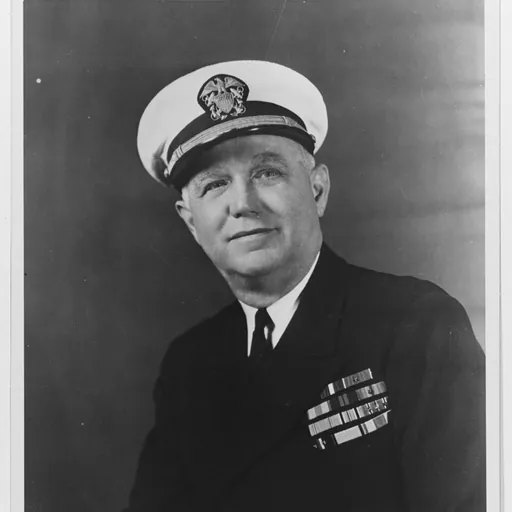
About Glenn B. Davis
Lived 1892 – 1984 (aged 92). Glenn B. Davis was a military personnel.
Glenn Benson Davis (January 2, 1892 – September 9, 1984) was a highly decorated officer in the United States Navy with the rank of Vice Admiral. He distinguished himself as Commanding officer of battleship USS Washington during the Naval Battle of Guadalcanal in November 1942, when Washington sank the Japanese battleship Kirishima.
Davis graduated with Bachelor of Science degree and was commissioned Ensign on June 7, 1913. He was subsequently attached to the battleship USS Kansas and cruised the east coast for the next several months. Davis took part in the patrols in the Gulf of Mexico during the Veracruz Expedition in summer 1914 and then participated in another series of patrols in the Caribbean, protecting life and property during a revolution in Haiti in late 1915.
Interwar period
Following the War, Davis reverted to the permanent rank of Lieutenant, but his temporary rank of Lieutenant commander was extended one month later and he was sent to the Bureau of Ordnance in September 1919 and then to the Naval Postgraduate School. He graduated from the postgraduate course in ordnance in December 1920 and was ordered for additional instruction to the Midvale Steel in Philadelphia.
In July 1921, Davis was assigned to the battleship USS Tennessee and served with her within Pacific Fleet until October 1924, when he was ordered to the Naval Proving Ground Dahlgren, Virginia as Experimental officer under Captain Andrew C. Pickens. Davis was promoted to the permanent rank of Lieutenant commander on June 8, 1923.
He later served at Dahlgren Ground in the same capacity under then-Captain and future CNO, Harold R. Stark and completed course in chemical warfare. Davis later became known in the Navy as Ordnance expert due to his service at Dahlgren. He was transferred to battleship USS Wyoming in June 1927 and took part in her extensive modernization at Philadelphia Navy Yard. After the completion of the works in November that year, Davis sailed with Wyoming to the Caribbean, where patrolled off the coast of Cuba and the Virgin Islands.
Davis was ordered back to the Bureau of Ordnance in July 1930 and after two-year duty there, he was appointed commanding officer of destroyer USS Blakeley and participated in the naval operations and exercises with the Scouting Fleet in the Atlantic until March 1934. While in this capacity, he was promoted to Commander on September 1, 1933. He was subsequently ordered back to Naval Proving Ground Dahlgren, Virginia and served as executive officer under Captain William R. Furlong until June 1937, when he was ordered to Philadelphia Navy Yard for duty in connection with fitting out of light cruiser USS Philadelphia. Upon the commissioning of the ship in January 1938, Davis was appointed her executive officer under Captain Jules James and took part in the shakedown cruise in the West Indies followed by additional alterations at Philadelphia and further sea trials off the Maine coast. During the official visits to Haiti and Dominican Republic, Davis was decorated by that countries.
Davis returned to the Bureau of Ordnance in June 1939 and was appointed assistant to Chief of Bureau, now Rear Admiral William R. Furlong. Davis served as Furlong's deputy at Naval Proving Ground Dahlgren in 1936–1937. He was promoted to Captain on May 1, 1940.
Davis commanded Washington until April 1943, when he was promoted to the temporary rank of Rear Admiral and assumed command of newly activated Battleship Division 8 (BatDiv 8), built around the battleships Indiana, Massachusetts, North Carolina, and South Dakota. He led his force during the Isolation of Rabaul, New Britain during the summer of 1943, and after a brief stop at Pearl Harbor, Hawaii, Davis returned with BatDiv 8 to the Southwest Pacific area.
Davis was succeeded by Rear Admiral John F. Shafroth Jr. in December 1944 and prepared for return to the United States, but Typhoon Cobra changed his plans. Admiral William F. Halsey unwittingly sailed the Third Fleet into the center of the typhoon, and due to 100 mph (87 kn; 45 m/s; 160 km/h) winds, high seas, and torrential rain, three destroyers capsized and sank, with 790 lives lost. Nine other warships were damaged, and over 100 aircraft were wrecked or washed overboard.
The Navy Department ordered Halsey to be court-martialed and Commander-in-Chief, Pacific Fleet, Fleet Admiral Chester Nimitz appointed a three-man court of inquiry with Vice Admiral John H. Hoover as the president of the court, and Davis and Vice Admiral George D. Murray as associate judges. Hoover, Davis and Murray ultimately recommended Halsey face court-martial for sailing the Third Fleet into a typhoon, but the court's recommendation was ignored by the Chief of Naval Operations Ernest J. King and President Franklin D. Roosevelt, who likely felt Halsey was too much of a popular hero to be subjected to public rebuke.
Davis then returned to the United States and assumed duty as Deputy Commander and Chief of Staff, Western Sea Frontier, headquartered in San Francisco under Admiral Royal E. Ingersoll. He served in this capacity for the rest of the War.
Davis remained in that command until July 1951, when he was ordered to Charleston Navy Yard for duty as Commandant, Sixth Naval district. While in this capacity, he was responsible for the defense of the coast of South Carolina, Georgia, and North Carolina, and Navy installation in this states. Davis retired from active duty on July 1, 1953, after 40 years of service and was advanced to the rank of vice admiral on the retired list for having been specially commended in combat.
Vice admiral Glenn B. Davis died there on September 9, 1984, aged 92 and was buried with full military honors at Arlington National Cemetery, Virginia. His wife, Ruth Manahan Davis, sister of Commodore Stewart A. Manahan, is buried beside him. They had one son, Glenn B. Davis, Jr.
Decorations
Here is the ribbon bar of Vice admiral Davis:
Don’t just read it —
keep it.
Full-length biographies made to live with: read them, listen on the way to work, watch them tonight.
- E-book
- Audio
- Video
Instant download · yours to keep · every purchase keeps this site free
Important facts
People in Glenn B. Davis's life
Named in this biography and alive at the same time

Related people
Same field, nearest in time





Contemporaries
People whose lives overlapped Glenn B. Davis's

Frequently asked questions
Who was Glenn B. Davis?
American Vice admiral
When was Glenn B. Davis born?
Glenn B. Davis was born on 2 January 1892 in Norwalk.
When did Glenn B. Davis die?
Glenn B. Davis died on 9 September 1984 in Hilton Head Island.
What was Glenn B. Davis's occupation?
Glenn B. Davis was a military personnel.
Sources & further reading
Cite this page
APA: Biography.guide. (2026). Glenn B. Davis. https://biography.guide/glenn-b-davis/
MLA: "Glenn B. Davis." Biography.guide, https://biography.guide/glenn-b-davis/.
Chicago: "Glenn B. Davis." Biography.guide. https://biography.guide/glenn-b-davis/.
Data last updated: 2026-09-22 · Spot an error? Report a correction.
Portrait: Wikimedia Commons · author & licence
Page generated 2026-09-27 05:04 UTC