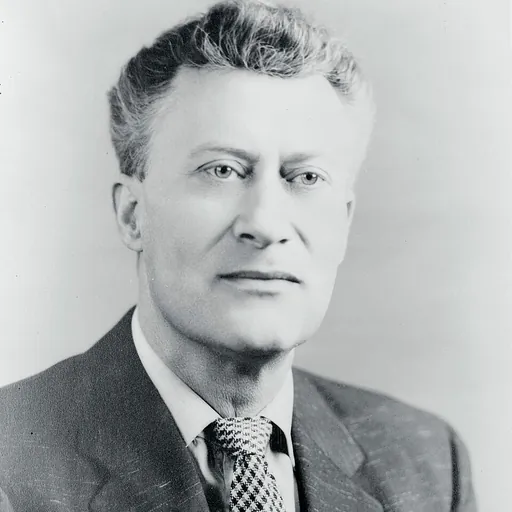
About Glen H. Taylor
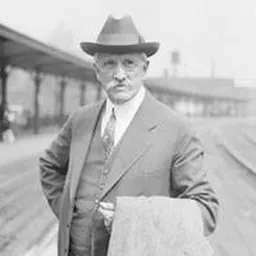
Lived 1904 – 1984 (aged 80). Glen H. Taylor was an American politician, business executive, singer and entrepreneur.
Glen Hearst Taylor (April 12, 1904 – April 28, 1984) was an American politician, entertainer, businessman, and U.S. senator from Idaho.
He was the vice presidential candidate on the Progressive Party ticket in the 1948 election.
Early life Born in a boarding house in Portland, Oregon, Taylor was the twelfth of thirteen children of Pleasant John Taylor and Olive Higgins Taylor. His father was a retired Texas ranger and wandering preacher, and the family was with him in Portland for a protracted soul-saving meeting.
The family homesteaded in North Central Idaho, near Kooskia, and Taylor attended the public schools. In 1919, after completing eighth grade, he joined his older brother's stock theater company,
Taylor was inspired to run for political office by King Camp Gillette's book The People's Corporation
Career
By the late 1930s, Taylor had settled in eastern Idaho at Pocatello. His first political campaign was in 1938 for an open seat in the United States House of Representatives from the second district, but he finished a distant fourth in the Democratic primary. Nugget also accompanied Taylor during a 1947 tour of the country highlighting his antiwar activism and opposition to U.S. foreign policy of the time.
When Taylor moved to Washington in preparation to be sworn in in January 1945, the housing shortage caused by World War II was still in full swing and so he and his family had a difficult time finding a place to live. In response, Taylor, a musician and songwriter, stood outside the US Capitol building and sang, "O give us a home, near the Capitol dome, with a yard for two children to play ..." to the tune of "Home on the Range". He and his family were offered several places to rent.
Taylor was appointed to the Committee on Banking and Currency after telling Senator Robert F. Wagner of New York that he was qualified for the post because he had been a depositor with several banks. In October 1945, Taylor submitted a resolution to the Senate "favoring the creation of a world republic."
On election night in 1946, Taylor made national headlines by allegedly breaking the jaw of local Republican leader Ray McKaig in a hotel lobby in Boise. Taylor claimed that McKaig had called him an obscene name, and struck him first with a punch that broke his nose, but McKaig denied those claims. McKaig, 66, claimed that while he was lying on the floor Taylor proceeded to kick him in the face, but Taylor denied that claim. When Taylor lost his reelection bid in the 1950 primary, McKaig sent a telegram that said, "You may have broken my jaw, but I just broke your back!!!"
Taylor also feuded with other Idaho Democrats, often making critical remarks about Charles C. Gossett, who resigned as governor in November 1945 to have his successor appoint him to the vacant Senate seat. During the 1946 Democratic primary in June, Taylor openly supported Gossett's opponent, George E. Donart, calling the appointed incumbent Gossett a "conservative" who "hobnobbed" with Republicans in Congress.
In the Senate, Taylor became noted for lengthy speeches that were often critical of President Harry S. Truman's policies, particularly in foreign affairs. He was particularly critical of the Truman Doctrine and the Marshall Plan, both of which he believed brought the United States closer to war with the Soviet Union. Taylor was decidedly less critical of the Soviet Union than most of his Senate colleagues, once noting that there was no need to criticize Soviet policy when there were 90 other senators willing to do it every day.
Taylor was arrested on May 1, 1948, in Birmingham, Alabama, by Police Commissioner Eugene "Bull" Connor, for attempting to use a door reserved for African Americans, rather than the whites-only door, while Taylor was attempting to attend a meeting of the Southern Negro Youth Congress. He was later convicted of disorderly conduct. He appealed his conviction to the Court of Appeals of Alabama (part of which became the Alabama Court of Criminal Appeals in 1969), but lost the appeal. When Taylor refused to return to Alabama to serve a 180-day sentence of hard labor, Idaho Governor C. A. Robins declined to extradite him.
Roswell comments In July 1947, Taylor was asked by a United Press reporter what he thought about reports that remnants of a UFO had been found by the Air Force near Roswell, New Mexico. Taylor replied that he almost hoped flying saucers would turn out to be spaceships from another planet: "They could end our petty arguments on earth." He went on to say that no matter what the UFOs turned out to be, they "can't be laughed off."
"Even if it is only a psychological phenomenon, it is a sign of what the world is coming to," Taylor explained. "If we don't ease the tensions, the whole world will be full of psychological cases and eventually turn into a global nuthouse."
1948 vice presidential nomination
In 1948 Taylor was chosen as the vice presidential candidate on the Progressive ticket headed by former Vice President Henry A. Wallace of Iowa.
1950 reelection run
In 1950, former Senator David Worth Clark sought to regain his Senate seat from Taylor, whose run on the Progressive ticket earned him a reputation as an "incorrigible leftist" in Idaho. It contributed to Taylor's primary defeat by Clark, who in turn lost in the general election to conservative Republican Herman Welker.
Election results + U.S. Senate elections in Idaho (Class II & III): Results 1940–1956Year ClassDemocratVotesPctRepublicanVotesPct3rd PartyPartyVotesPct 1940 IIGlen H. Taylor110,61447.0% John Thomas (inc.)124,53553.0% 1942 IIGlen H. Taylor68,98948.5% John Thomas (inc.)73,35351.5% 1944 IIIGlen H. Taylor107,09651.1%C. A. Bottolfsen102,37348.9% 1954 IIGlen H. Taylor84,13937.2%Henry Dworshak (inc.)142,26962.8% 1956 IIIFrank Church149,09656.2%Herman Welker (inc.)102,78138.7%Glen H. TaylorWrite-In 13,4155.1% Source: 1940 was a special election (November) to complete the final two years of the term vacated by the death of William Borah on January 19, 1940. Thomas, a former U.S. senator (1928–1933), was appointed to the seat by Governor C. A. Bottolfsen on January 27.
Later career
Taylor served as president of Coryell Construction Company from 1950 to 1952 but was forced to resign after being labeled a "security risk," jeopardizing a government contract. Afterwards, he was often forced to work manual labor construction jobs. and then got 5.1 percent of the vote in the general election as a write-in candidate. In March 1958, Taylor proposed that Church take a lie detector test about fraud in the 1956 primary.
In 1958, Taylor and his wife Dora moved to Millbrae, California, and began making hairpieces by hand based on one Taylor had made for himself in the early 1940s. In 1958, he was granted a patent (#2,850,023) for his innovative product. Glen and Dora Taylor were successful at manufacturing hairpieces, and Taylor Toppers became famous. The company, now known as Taylormade Hair Replacement, is still active in Millbrae.
Personal life Glen and Dora Taylor had three sons between 1935 and 1946, Glen Arod (Dora spelled backward) and then Paul Jon and Greg.
Taylor died at 80 in April 1984 from complications from Alzheimer's disease; Dora Taylor remained in the San Mateo County area until her death at 93 in 1997. They are interred at Skylawn Memorial Park in San Mateo.
Filmography
Television
Don’t just read it —
keep it.
Full-length biographies made to live with: read them, listen on the way to work, watch them tonight.
- E-book
- Audio
- Video
Instant download · yours to keep · every purchase keeps this site free
Important facts
People in Glen H. Taylor's life
Named in this biography and alive at the same time







Related people
Same field, nearest in time



Contemporaries
People whose lives overlapped Glen H. Taylor's

Frequently asked questions
Who was Glen H. Taylor?
American politician (1904-1984)
When was Glen H. Taylor born?
Glen H. Taylor was born on 12 April 1904 in Portland.
When did Glen H. Taylor die?
Glen H. Taylor died on 28 April 1984 in Millbrae.
What was Glen H. Taylor's occupation?
Glen H. Taylor was a politician, business executive, singer and entrepreneur.
What nationality was Glen H. Taylor?
Glen H. Taylor was American.
Sources & further reading
Cite this page
APA: Biography.guide. (2026). Glen H. Taylor. https://biography.guide/glen-h-taylor/
MLA: "Glen H. Taylor." Biography.guide, https://biography.guide/glen-h-taylor/.
Chicago: "Glen H. Taylor." Biography.guide. https://biography.guide/glen-h-taylor/.
Data last updated: 2026-09-21 · Spot an error? Report a correction.
Portrait: Wikimedia Commons · author & licence
Page generated 2026-09-27 04:58 UTC