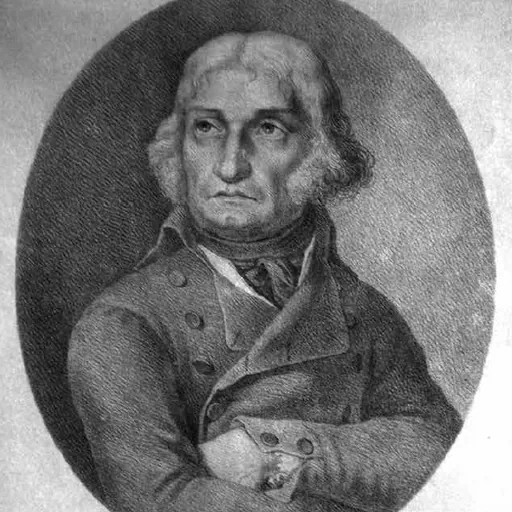
Giovanni Mariti
Italian antiquarian seller and scientist
About Giovanni Mariti
Lived 1736 – 1806 (aged 69). Giovanni Mariti was an antiquarian seller, catholic priest, travel writer and botanist.
Giovanni Mariti (Florence, 4 November 1736 – Florence, 13 September 1806) was an Italian scientist, historian, and traveler. His father was Marcantonio di Luigi, a chancellor, and his mother was Alessandra Moriani. Mariti lost of his father at an early age and so was raised by his stepfather, Calvani, a merchant from Volterra, who moved the family to the port city of Livorno.
Livorno was a bustling, international port and it was here that Mariti first developed an interest in the study of natural science. This environment also facilitated his acquisition of English and French languages through interactions with foreigners, particularly those from Britain. His first destination in the Levant was Acre, Palestine, where he spent two years serving as a procurator and commercial agent for the English company Wasson. Following this, he returned to Cyprus and settled in Larnaca as an employee of the English consul, Timothy Turner, who also held the position of vice-consul representing the Grand Duke of Tuscany.
Mariti's favorable relationship with Consul Turner led to his appointment as the chancellor of the consulate, succeeding Antonio Mondaini (who was also from Livorno). During his seven-year stay on Cyprus, Mariti undertook extensive travels throughout the island, meticulously documenting his observations of the local environment and culture. (On the Wine of Cyprus). He also authored "Della Robbia. Sua Coltivazione e suoi Usi" ("On Madder. Its Cultivation and Uses"), a specialized treatise on the madder plant (Rubia tinctorum) and its important application as a source of red dye. He also engaged in correspondence with the renowned Swedish botanist from Uppsala, Carl Peter Thunberg and had knowledge of Turkish and Arabic languages. His translator Claude Delaval Cobham finds him "observant and conscientious". His scientific essays were characterized by an intent to convey technical information to a wider, non-specialist audience. a nine-volume chorographic study published between 1769 and 1776, contained his initial historical observations on the regions he explored. and "Istoria della guerra della Soria proseguita sino alla fine di Aly-Bey dell'Egitto," about the rebellion of Ali Bey in Egypt and Syria. a biographical work focused on Aymar the Monk, a Florentine who became Archbishop of Caesarea, Palestine (1181 until 1194) and then Latin Patriarch of Jerusalem (1194 until 1202).
"Cronologia de' Re latini di Gerusalemme" was published in 1784, and in 1787 "Dissertazione istorico-critica sull'antica città di Citium" a topography of ancient Kition (Citium, near Larnaca), a further contribution by Mariti to the history and archaeology of the Levant.
In 1787, Mariti also published "Istoria di Faccardino, grand'emir de' Drusi", a work which chronicled the life of the Druze leader Fakhr al-Dīn II.
Upon his return to Florence in 1768, Mariti joined the Florentine Tribunale di Sanità (health board). His expertise in public health led to his appointment as lieutenant in 1782, and then in 1784 as captain of the Lazzaretto di S. Jacopo (quarantine station) in Livorno. In this capacity, he was responsible for overseeing the health system of Livorno. Drawing upon his direct experience with the plague during his travels in Palestine and Syria, he contributed to the reform of leprosy hospitals in Tuscany and the implementation of measures to contain the devastating yellow fever outbreak in Livorno in 1804.
Returning to Florence in 1790, Mariti assumed various administrative roles, including the reorganizing the Archivio delle Reali Possessioni (Archive of the Royal Possessions) and his final post of Archivio della Camera delle Comunità (Archive of the Chamber of Communities), where he served until his death from apoplexy on 13 September 1806.
Mariti was married twice - first in 1776 to Teresa Bonacchi, with whom he had three daughters and a son. In 1791, when his first wife died, he married Anna Gargani, from whom he separated after having a daughter who died prematurely.
Don’t just read it —
keep it.
Full-length biographies made to live with: read them, listen on the way to work, watch them tonight.
- E-book
- Audio
- Video
Instant download · yours to keep · every purchase keeps this site free
Important facts
People in Giovanni Mariti's life
Named in this biography and alive at the same time
Related people
Same field, nearest in time




Contemporaries
People whose lives overlapped Giovanni Mariti's





Frequently asked questions
Who was Giovanni Mariti?
Italian antiquarian seller and scientist
When was Giovanni Mariti born?
Giovanni Mariti was born on 4 November 1736 in Florence.
When did Giovanni Mariti die?
Giovanni Mariti died on 13 September 1806 in Florence.
What was Giovanni Mariti's occupation?
Giovanni Mariti was an antiquarian seller, catholic priest, travel writer and botanist.
Sources & further reading
Cite this page
APA: Biography.guide. (2026). Giovanni Mariti. https://biography.guide/giovanni-mariti/
MLA: "Giovanni Mariti." Biography.guide, https://biography.guide/giovanni-mariti/.
Chicago: "Giovanni Mariti." Biography.guide. https://biography.guide/giovanni-mariti/.
Data last updated: 2026-09-23 · Spot an error? Report a correction.
Portrait: Wikimedia Commons · author & licence
Page generated 2026-09-27 05:05 UTC