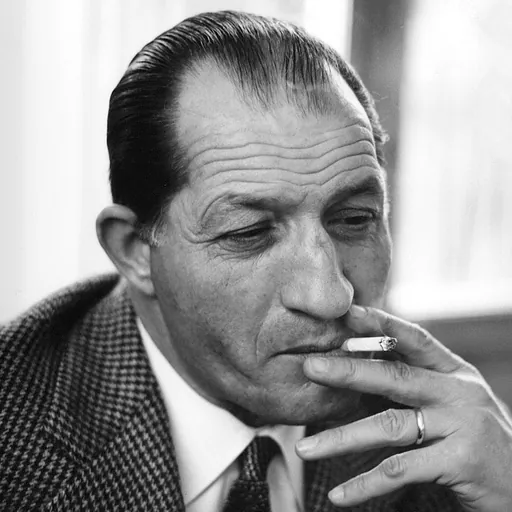
About Gino Bartali
Lived 1914 – 2000 (aged 85). Gino Bartali was an Italian sport cyclist, sporting director and athlete.
Gino Bartali, (; 18 July 1914 – 5 May 2000), nicknamed Gino the Pious and (in Italy) Ginettaccio, was a champion road cyclist. He was the most renowned Italian cyclist before the Second World War, having won the Giro d'Italia twice, in 1936 and 1937, and the Tour de France in 1938. After the war, he added one more victory in each event: the Giro d'Italia in 1946 and the Tour de France in 1948. His second and last Tour de France victory in 1948 gave him the largest gap between victories in the race.
In September 2013, 13 years after his death, Bartali was recognised as a "Righteous Among the Nations" by Yad Vashem for his efforts to aid Jews during World War II.
Early life and amateur career
Gino Bartali was born in Ponte a Ema, Florence, Italy, the third son of four children of a smallholder, He earned pocket money by selling raffia to makers of covers for wine bottles. He began work in a bicycle shop when he was 13. He started racing at 13, became a promising amateur and turned professional in 1935 when he was 21. He was the Italian champion the next year. On 14 November 1940, Bartali married Adriana Bani in Florence. The wedding was celebrated by Cardinal Dalla Costa and was blessed by Pope Pius XII, to whom Bartali donated a bicycle.
Professional career
Bartali won a stage of the 1935 Giro d'Italia and was King of the Mountains, the first of seven times he won the title in the Giro. He was 20. In 1936, before he turned 22, he won the Giro and the Giro di Lombardia, although his season was marred when his brother, Giulio, died in a racing accident on 14 June. Bartali came close to giving up cycling.
He was persuaded to return and, in 1937, won the Giro again. His reputation outside Italy was that he was yet another Italian who could not ride well outside his country. There was some truth in the claim. The writer Tim Hilton said: "Bartali was essentially an Italian cyclist, a champion who rode within sight of his own people, and was uneasy when the Tour de France travelled north of Paris. He never disputed the northern classics."
Stung by the claim, he rode the Tour de France in 1937. He got off to a bad start, losing more than eight minutes by the third stage and more than ten by the Ballon d'Alsace, a mountain in the Vosges. He took the leader's jersey in Grenoble, with a 1m 14s lead. Later in the race, he and two helpers, Jules Rossi and Francesco Camusso, while crossing a wooden bridge over the river Colau, Rossi skidded, causing Bartali to ride into a parapet and fall into the river.
Roger Lapébie wrote: "In the valley that leads to Briançon, I saw the accident to the maillot jaune, Bartali. The narrow and bumpy road ran along the foot of a rock. Suddenly, Rossi, who was leading, took a bend badly, braked and his back wheel hit the parapet of a bridge. Bartali, who was beside Rossi, couldn't get clear and I saw him fall over the bridge and into the little river three metres below." Camusso pulled him out. Bartali was cut on his arm and knee and had trouble breathing because of a blow to the chest. He rode on to the end of the day, often pushed by his helpers. He finished 10 minutes behind the rest but kept his lead.
He got through the Alps, by then having lost his jersey, and retired in Marseille. In one account, before he dropped out, he notified the organiser, Henri Desgrange, who said: "You are the first rider to come to see me before dropping out. You're a good man [un brave garçon], Gino. We'll see each other again next year and you'll win."
He did return in 1938 and overcame the teamwork of the Belgians, the cold and rain and a puncture on the Col de l'Iseran. He won the hardest stage, from Digne to Briançon, by more than five minutes. The radio commentator Georges Briquet, after he had seen the crowds of Italians greeting Bartali with green-white-red flags, said: "These people had found a superman. Outside Bartali's hotel at Aix-les-Bains, an Italian general was shouting 'Don't touch him – he's a god.'" A public subscription was started in his name in Italy, and Benito Mussolini was among the contributors.
The approaching war led Italy not to send a team in 1939.
Bartali won the Giro d'Italia twice before the war – in 1936 and 1937 – and once after it (1946). He won classics such as Milan–San Remo, the Giro di Lombardia and the Züri-Metzgete. His most famous victory was the 1948 Tour de France.
1948: Second Tour
Bartali returned to the Tour in 1948 to find that many riders he had known had died in the war and that there were as many more who had started racing since he stopped (see below for Bartali's war record). He was so worried that he spent an evening memorising two dozen riders he did not know. The Tour started in a rainstorm, and Bartali found he could identify nobody because the whole field was wearing waterproofs. He took his chance and found he was with Briek Schotte. The two finished together at Trouville, and Bartali took the yellow jersey.
It was during that Tour that the leader of the Italian Communist Party, Palmiro Togliatti, was shot in the neck by a sniper as he was leaving the parliament building. The writer Bernard Chambaz said:
History and myth united, and a miracle if you like because that evening Bartali got a phone call at his hotel. In a bad mood, dubious, he didn't want to answer. But someone whispered that it was Alcide de Gasperi, his old friend from Catholic Action, now parliamentary president, who told him that Palmiro Togliatti, secretary-general of the communist party, had been shot at and had survived by a miracle. The situation in the peninsula was very tense amid the ravages of the Cold War. Italy needed Bartali to do what he best knew how to do, to win stages. ran into the chamber shouting 'Bartali's won the Tour de France!' All differences were at once forgotten as the feuding politicians applauded and congratulated each other on a cause for such national pride. That day, with immaculate timing, Togliatti awoke from his coma on his hospital bed, inquired how the Tour was going and recommended calm. All over the country political animosities were for the time being swept aside by the celebrations and a looming crisis was averted.
1950: Tour de France
Bartali had a row during the 1950 Tour de France with the French rider Jean Robic. Newspapers made much of it, and the atmosphere was tense. Robic got clear of Bartali on the col d'Aubisque in the Pyrenees. Bartali made up ground over the Tourmalet, took the descent to Sainte-Marie-de-Campan and started up the col d'Aspin. There, he caught Robic and the two rode together. The two rubbed shoulders, and they fell.
Bartali said French fans by the road were so angry, accusing him of sabotaging Robic's chances, that they punched him, and one threatened him with a knife. Bartali remounted and won the stage. Fiorenzo Magni, leading the Italian 'B' team, the Cadetti, took the yellow jersey. The pair and their teams had barely returned to their hotel when Bartali said he was going home, and so, he said, were the two Italian teams.
The affair escalated to the national level when the French foreign minister, Robert Schuman, apologised to his Italian counterpart for what seemed to be no more than a man interrupted in the making of a sandwich. René de Latour said: To say that Magni was sore is putting it very mildly indeed. When he spoke to men he could trust, he would say: 'Gino knows what his little game is. He is too clever to ignore the facts that he will be lucky to win this Tour, and he prefers a foreign team win rather than see one of our team succeed, especially me. It was bad enough for him with Coppi winning last year.
Bartali used his fame to carry messages and documents to the Italian Resistance, hidden in the frame and handlebars of his bicycle. Bartali cycled from Florence through Tuscany, Umbria, and Marche, many times traveling as far afield as Assisi, all the while wearing the racing jersey emblazoned with his name. Neither the Fascist police nor the German troops risked discontent by arresting him.
Giorgio Nissim, a Jewish accountant from Pisa, founded by the Union of the Israelitic Communities to help Jewish Italians escape persecution. The network in Tuscany was discovered in autumn 1943, and all Jewish members except Nissim were sent to concentration camps. With the help of the Archbishops of Genoa Pietro Boetto and Florence Elia Dalla Costa, the Franciscan Friars of Assisi and others, Nissim reorganized DELASEM in Tuscany and helped 800 survive.
Nissim died in 2000. His sons found from his diaries that Bartali had used his fame to help. Nissim and the Oblati Friars of Lucca forged documents and needed photographs of those they were helping. Bartali used to leave Florence in the morning, pretending to train, ride to Assisi where many Jews were hiding in the Franciscan convents, collect their photographs and ride back to Nissim. At Assisi Bartali was in direct contact with Rufino Niccacci. Bartali also used his position to learn about raids on safehouses.
Bartali was eventually taken to Villa Triste in Florence. The SD and the Italian RSS official Mario Carità questioned Bartali, threatening his life.
Bartali continued working with the Assisi Network. In 1943, he led Jewish refugees towards the Swiss Alps himself. He cycled, pulling a wagon with a secret compartment, telling patrols it was just part of his training. Bartali told his son Andrea only that "One does these things and then that's that".
In 2013, Yad Vashem awarded Gino Bartali the honour Righteous Among the Nations. He is a central figure in the 2014 documentary My Italian Secret: The Forgotten Heroes.
In 2017, research by Michele Sarfatti questioned Bartali's efforts to save Jewish lives, referring to the very limited sources and contradicting that Bartali would have described this in his diaries. In 2021, Marco and Stefano Pivato corroborated this stance by Sarfatti, calling the whole story 'invented' ('una storia inventata '). In 2021, an interview with Sergio Della Pergola, an Israeli-Italian academic who was involved in Yad Vashem’s investigation of Bartali’s role during the war, was published in the Corriere della Sera. Outlining some of the evidence regarding Bartali's efforts during the war, he disagreed with the argument put forth by Sarfatti and Marco and Stefano Pivato. He was quoted as saying: “To question whether Gino Bartali risked his life to save Jews is like denying that the Earth is round.”
Riding style and legacy
I have never seen a sports hero so adored. I remember times when Gino could not get out of a hotel even, such was the crush of fans waiting to see him. All the time there would be the roar of shouts which he knew so well, which was really music in his ears: ' Gi-no, Gi-no, Gi-no... ' During the Tour of Italy, Bartali always needed a box of wax balls to stop his ears when he was in bed. Without them there would have been no peace; For right through the night the row kept on, under the window of his room. — René de Latour
The thaw partly broke when the pair shared a drink bottle during the climb of the Col d'Izoard in the 1952 Tour but the two men fell out over who had offered it. "I did," Bartali insisted. "He never gave me anything." Their rivalry was the subject of intense coverage and resulted in many epic races.
When professional cycle racing resumed in 1946 after World War II, Bartali narrowly beat Coppi in that year's Giro, while Coppi won Milan–San Remo. Bartali won the Tour de Suisse twice, another Milan–San Remo, and the 1948 Tour de France – a full ten years after his last victory. Coppi took victories in the 1947 Giro d'Italia, the Giro di Lombardia and the Grand Prix des Nations.
Despite the rivalry, perhaps heightened by Coppi's victory in the 1949 Giro, Bartali supported Coppi's bid in the 1949 Tour de France. The two Italian teammates destroyed the race as a contest in a mountainous Alpine stage over the Col de Vars and Col d'Izoard. When Coppi had a puncture on the Izoard, Bartali waited for him, then Bartali did the same, and Coppi waited. On the final climb to Briançon, Coppi allowed Bartali to win (on his 35th birthday) and take the yellow jersey. But Coppi assumed the maillot jaune the following day after Bartali had a puncture with 40 km of the stage still to race. Coppi retained the lead to Paris, while Bartali took second place.
The 1950 Tour de France saw him lead the Italian team again, with Coppi electing not to contest the race, but having been threatened by frenzied fans, the entire Italian team resigned from the race.
Bartali always suspected that Coppi took drugs. On the hairpins of the Col di Bracco, during a stage of the 1946 Giro from Genoa to Montecatini Terme, Coppi drank from a glass phial and threw it into the verge. Bartali drove back after the race and found it. He said:
With the meticulous care of a detective collecting evidence for fingerprinting I picked it up, dropped it into a white envelope and put it carefully in my pocket. The next day I rushed round to my personal doctor and asked him to send the phial to a lab for analysis. Disappointment: no drug, no magic potion. It was nothing more than an ordinary tonic, made in France, that I could have bought without a prescription.
I realised that I should have to try to outsmart him and I devised my own investigation system. The first thing was to make sure I always stayed at the same hotel for a race and to have the room next to his so I could mount surveillance. I would watch him leave with his mates, then I would tiptoe into the room which ten seconds earlier had been his headquarters. I would rush to the waste bin and the bedside table, go through the bottles, flasks, phials, tubes, cartons, boxes, suppositories – I swept up everything. I had become so expert in interpreting all these pharmaceuticals that I could predict how Fausto would behave during the course of the stage. I would work out, according to the traces of the product I found, how and when he would attack me.
1935
1st Stages 2, 3 & 5 1st Coppa Bernocchi 2nd Giro della Romagna 3rd Giro di Lombardia 3rd Giro della Provincia di Milano (with Giuseppe Martano) 4th Milan–San Remo 7th Overall Giro d'Italia 1st Mountains classification 1st Stage 6 7th Giro di Campania 8th Grand Prix des Nations 1936
1st Mountains classification 1st Stages 9, 17b & 18 1st Giro di Lombardia 1st Giro della Provincia di Milano (with Learco Guerra) 4th Giro di Toscana 7th Road race, UCI Road World Championships 1937
1st Mountains classification 1st Stages 5a (TTT), 8a, 10, 16 & 17 1st Giro del Piemonte 1st Giro del Lazio Tour de France 1st Stage 7
2nd Giro di Lombardia 2nd Giro della Provincia di Milano (with Pierino Favalli) 1938
1st Mountains classification 1st Stages 11 & 14 1st Tre Valli Varesine 1st Giro della Provincia di Milano (with Pierino Favalli) 2nd Road race, National Road Championships 2nd Giro di Lombardia 6th Giro di Toscana 7th Milan–San Remo 1939 1st Milan–San Remo 1st Giro di Lombardia 1st Giro del Piemonte 1st Giro di Toscana 1st Giro della Provincia di Milano (with Pierino Favalli) 2nd Overall Giro d'Italia 1st Mountains classification 1st Stages 2, 9b, 15 & 17
2nd Tre Valli Varesine 2nd Giro di Campania 1940
1st Milan–San Remo 1st Giro di Lombardia 1st Giro di Toscana 1st Giro di Campania 1st Giro della Provincia di Milano (with Pierino Favalli) 9th Overall Giro d'Italia 1st Mountains classification 1st Stages 17 & 19 10th Giro dell'Umbria 1941 2nd Giro di Toscana 2nd Giro del Piemonte 3rd Tre Valli Varesine 3rd Giro dell'Emilia 4th Giro del Lazio 9th Giro di Lombardia 1942 2nd Giro di Lombardia 2nd Giro di Toscana 2nd Giro del Piemonte 3rd Road race, National Road Championships 4th Giro dell'Emilia 4th Giro di Campania 5th Giro del Veneto 8th Giro del Lazio 1943 2nd Giro della Provincia di Milano (with Pierino Favalli) 3rd Giro di Toscana 5th Milan–San Remo 1945 1st Giro di Campania 3rd Giro di Lombardia 3rd Tre Valli Varesine 4th Trofeo Matteotti 7th Road race, National Road Championships 1946
1st Mountains classification
1st Mountains classification 1st Stages 1, 5, 6 & 8 1st Trofeo Matteotti 1st Züri-Metzgete 4th Milan–San Remo 6th Tour des Quatre-Cantons 1947
1st Points classification 1st Mountains classification 1st Stages 1c & 2 1st Milan–San Remo 2nd Overall Giro d'Italia 1st Mountains classification 1st Stages 2 & 15
2nd Overall Tour de Romandie 1st Stage 3b 2nd Giro di Lombardia 2nd Giro dell'Emilia 2nd Giro della Romagna 9th Gent–Wevelgem 1948
1st Mountains classification 1st Stages 1, 7, 8, 13, 14, 15 & 19 1st Giro di Toscana 1st Züri-Metzgete 2nd Tre Valli Varesine 8th Overall Giro d'Italia 1949
1st Stages 1b & 2 2nd Overall Tour de France 1st Stage 16
2nd Overall Giro d'Italia 4th Giro della Romagna 5th Giro del Piemonte 1950 1st Milan–San Remo 1st Giro di Toscana 1st Stage 11 Tour de France 2nd Overall Giro d'Italia 1st Stage 9 2nd Giro della Provincia di Reggio Calabria 1951 1st Giro del Piemonte 2nd Road race, National Road Championships 2nd La Flèche Wallonne 2nd Sassari-Cagliari 2nd Trofeo Baracchi (with Ferdinand Kübler) 4th Overall Tour de France 4th Overall Roma–Napoli–Roma 5th Gran Premio di Lugano 6th Liège–Bastogne–Liège 6th Tre Valli Varesine 9th Road race, UCI Road World Championships 9th Giro della Romagna 10th Overall Giro d'Italia 1952
1st Giro dell'Emilia 1st Giro della Provincia di Reggio Calabria 2nd Tour du Lac Léman 4th Overall Tour de France 4th Overall Roma–Napoli–Roma 1st Stage 2 5th Overall Giro d'Italia 7th Gran Premio di Lugano 7th Trofeo Baracchi (with Giovanni Corrieri) 1953 1st Giro dell'Emilia 1st Giro di Toscana 4th Overall Giro d'Italia 4th Tre Valli Varesine 7th Giro del Piemonte 8th Overall Tour de Romandie 1954 9th Giro dell'Emilia 10th Giro di Campania
Grand Tour general classification results timeline
Classics results timeline
Major championship results timeline
+ Legend — Did not compete DNF Did not finish NH Not Held
Don’t just read it —
keep it.
Full-length biographies made to live with: read them, listen on the way to work, watch them tonight.
- E-book
- Audio
- Video
Instant download · yours to keep · every purchase keeps this site free
Important facts
People in Gino Bartali's life
Named in this biography and alive at the same time


Related people
Same field, nearest in time




Contemporaries
People whose lives overlapped Gino Bartali's


Frequently asked questions
Who was Gino Bartali?
Italian road cyclist (1914–2000)
When was Gino Bartali born?
Gino Bartali was born on 18 July 1914 in Ponte a Ema.
When did Gino Bartali die?
Gino Bartali died on 5 May 2000 in Florence.
What was Gino Bartali's occupation?
Gino Bartali was a sport cyclist, sporting director and athlete.
What nationality was Gino Bartali?
Gino Bartali was Italian.
Sources & further reading
Cite this page
APA: Biography.guide. (2026). Gino Bartali. https://biography.guide/gino-bartali/
MLA: "Gino Bartali." Biography.guide, https://biography.guide/gino-bartali/.
Chicago: "Gino Bartali." Biography.guide. https://biography.guide/gino-bartali/.
Data last updated: 2026-09-20 · Spot an error? Report a correction.
Portrait: Wikimedia Commons · author & licence
Page generated 2026-09-27 04:58 UTC