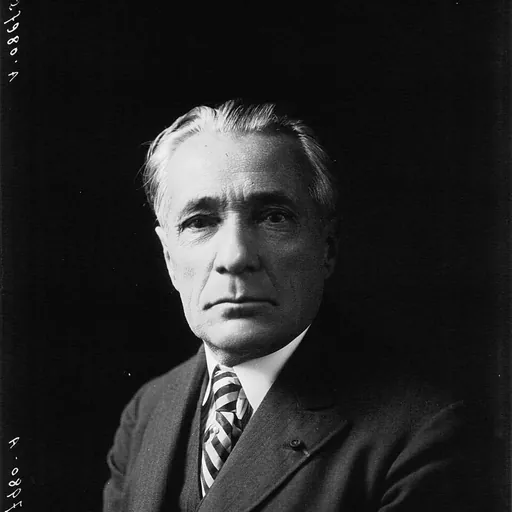
Henri Desgrange
French racing cyclist, journalist and organiser of the first Tour de France
About Henri Desgrange
Lived 1865 – 1940 (aged 75). Henri Desgrange was a French journalist, sport cyclist, track cyclist, notary's clerk, lawyer and editor.
Henri Desgrange (; 31 January 1865 – 16 August 1940) was a French bicycle racer and sports journalist. He set twelve world track cycling records, including the hour record of on 11 May 1893. He was the first organiser of the Tour de France.
Youth and early career Henri Desgrange was born into a comfortably prosperous middle-class family living in Paris. Desgrange worked as a clerk at the Depeux-Dumesnil law office near the Place de Clichy in Paris and may have qualified as a lawyer. Legend says he was fired from there either for cycling to work or for exposing the outline of his calves in tight socks as he did so. Desgrange saw his first bicycle race in 1891 when he went to the finish of Bordeaux–Paris. He also established records at 50 and 100 km and 100 miles and became a tricycle champion in 1893.
He wrote a training book in 1894, La tête et les jambes, which included the advice that an ambitious rider has no more need of a woman than an unwashed pair of socks. In 1894 he wrote another book, Alphonse Marcaux. In 1897 he became director of the Parc des Princes velodrome and then in December 1903 of France's first permanent indoor track, the Vélodrome d'Hiver, near the Eiffel Tower.
Publications and journalism
Unease with the attention paid to his track business by the leading sports paper, Le Vélo, and support from business magnates like Jules-Albert de Dion and Adolphe Clément-Bayard, who were displeased with the paper's advertising rates (and their political stance on the Dreyfus affair), led Desgranges to become the editor of a newly-founded competing sports paper, L'Auto-Vélo, later renamed L'Équipe,
The first issue of L'Auto-Vélo appeared on 16 October 1900. It was printed on yellow paper to distinguish itself from the green of Le Vélo but a court case brought by the original paper agreed in January 1902 that the name was too similar and the consortium was ordered to drop "vélo" from the title.
The Tour de France
Desgrange is credited with founding the Tour de France in 1903 but the idea came from one of his journalists, Géo Lefèvre. L'Auto announced the race on 19 January 1903.
Promotion of the Tour de France proved a great success for the newspaper. Circulation leapt from 25,000 before the Tour to 65,000 after it. In 1908, the race boosted circulation past a quarter of a million, and during the 1923 Tour, it was selling 500,000 copies a day. The record circulation claimed by Desgrange was 854,000, achieved during the 1933 Tour.
Management style
The reporter Pierre Chany wrote: "He knew the imperfections of his work, which was still in progress, but it was as if he didn't see them. He rejected advice, certain of his authority and decisions, powerful in a world where his word had the force of law. He followed a narrow path between the interests of cycling in general and his own, a way of thinking that justified his reputation as a despot". — in the 1904 Tour de France, imposing penalties which went beyond those Desgrange had already imposed and which he thought excessive. The winner, Maurice Garin, for example, had already been fined 500 francs for taking food where taking food was not allowed.
What annoyed Desgrange more was that the UVF had waited until the following 30 November before acting, to avoid igniting public passion. And that it hadn't explained the detail. He wrote in L'Auto:
"It is extremely difficult to establish whether the heavy punishments handed out by the UVF to the principle riders were motivated by serious reasons, when we are given only the results of these decisions while at the same time the documents which they used are withheld from us. It is no exaggeration to say that public opinion will demand from the Union Vélocipédique some explanation, which will no doubt be forthcoming.
A suggestion of how Desgrange already perceived his race came in the paragraph that followed:
"We are convinced that the sporting commission has judged with its soul and with its conscience and that this conscience is entirely clear. I believe, however... I believe that it has made a big mistake by sanctioning in this way, a race of the magnitude of the Tour de France".
The "magnitude of the Tour de France", by then only in its second year, came close to be ended there and then. Desgrange wrote in L'Auto:
"The Tour de France is finished and the second edition will, I fear, also be the last. It has died of its success, of the blind passions that it unleashed, the abuse and the dirty suspicions... We will therefore leave it to others to take the chance of taking on an adventure on the scale of the Tour de France".
Desgrange soon thought otherwise and ran his Tour de France for another three decades. It was "his" Tour de France with rules that he drew up, rules that he imposed strictly - the French favourite Henri Pélissier stalked off in 1920 after Desgrange penalised him two minutes for leaving a flat tyre by the roadside. In 1924 he and two other riders walked out of the race in Coutances after a row about whether riders were allowed to take off clothing as the day grew hotter.
Desgrange dismissed Pélissier as "a pigheaded, arrogant champion". because of the way the race followed the country's frontiers... By the cartography of France that it helped make known, the Tour acted as a teacher in showing a map printed with the contours of the country - which was rare at least until the Great War - and as avant-gardiste in very quickly popularising the notion of France as more or less hexagonal, a France amputated from 1903 not only of its "lost provinces" but also of possessions overseas and of Corsica, (which the race has) never visited in a century nor figured on maps of the race. When, with the decolonialisation of the Fifties and Sixties, the national area contracted to essentially the contours of a hexagon... the Tour had largely - and for some decades - sensibilised opinion to the contraction of European and continental France into this hexagon". Géo Lefèvre, who was involved, suggested that French cyclists could go to meet them, under the administration of the newspaper. And that created the idea of a French organisation of the same sort. So much so that on 7 January 1904, Desgrange could announce the creation of Audax Français".
That in turn led to long-distance rides across France. The first ride under Audax rules was on 3 April 1904, followed by a walking event on 26 June. The cycling distances extended to and ultimately to Paris–Brest–Paris which was originally a race but became an international Audax ride.
The Audax movement extends to swimming, with Audax brevets created over on 27 June 1913, then to rowing over and finally, in 1985, to skiing. The Union des Audax Parisien was created on 14 July 1921 to administer brevets across the world. It became the Union des Audax Français on 1 January 1956.
Health campaigning
Throughout his life, Desgrange was passionate about improving the health of the nation. He was concerned that so many Frenchmen had been rejected by the army because of their poor health that France had not been able to protect itself adequately in the Franco-Prussian war. He set a personal example by running for a couple of hours a day all through his life. Jacques Goddet (son of Victor Goddet) said:
"Henri Desgrange... imposed on himself a life of submitting himself to daily physical exercises. They had to demand, according to his draconian theories, a violent effort, prolonged, repeated, sometimes going as far as pain, demanding tenacity and even a certain stoicism. He took on a crusade against Original Inertia, against the softening of the body in the face of a society keen to suppress physical effort. He appointed himself the apostle of the fight to safeguard character. Suffer and sweat! And that meant a permanent individual culture of cross-country, at least three times a week, in the parc de St-Cloud. Nor did he hold back: he ran for at least an hour, never missing out Jardies hill, the fierce slope in the centre of the park used by hardened runners".
Desgrange used L'Auto to help his campaign, going as far as listing riders he had seen his Parc des Princes cycle track without having a shower. The column's title was Dirty Feet.
A monument to his memory, paid for by subscription, stands at the Col du Galibier. The Souvenir Henri Desgrange is a cash prize awarded in his honour each year in the Tour De France to the first rider who crosses the race's highest point.
Don’t just read it —
keep it.
Full-length biographies made to live with: read them, listen on the way to work, watch them tonight.
- E-book
- Audio
- Video
Instant download · yours to keep · every purchase keeps this site free
Important facts
People in Henri Desgrange's life
Named in this biography and alive at the same time


Related people
Same field, nearest in time


Contemporaries
People whose lives overlapped Henri Desgrange's



Frequently asked questions
Who was Henri Desgrange?
French racing cyclist, journalist and organiser of the first Tour de France (1865–1940)
When was Henri Desgrange born?
Henri Desgrange was born on 31 January 1865 in 10ᵗʰ arrondissement of Paris.
When did Henri Desgrange die?
Henri Desgrange died on 16 August 1940 in Grimaud.
What was Henri Desgrange's occupation?
Henri Desgrange was a journalist, sport cyclist, track cyclist, notary's clerk, lawyer and editor.
What nationality was Henri Desgrange?
Henri Desgrange was French.
Sources & further reading
Cite this page
APA: Biography.guide. (2026). Henri Desgrange. https://biography.guide/henri-desgrange/
MLA: "Henri Desgrange." Biography.guide, https://biography.guide/henri-desgrange/.
Chicago: "Henri Desgrange." Biography.guide. https://biography.guide/henri-desgrange/.
Data last updated: 2026-09-21 · Spot an error? Report a correction.
Portrait: Wikimedia Commons · author & licence
Page generated 2026-09-27 05:00 UTC