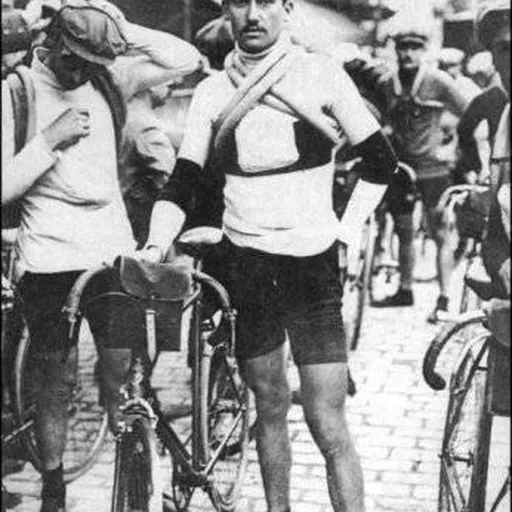
About Henri Pélissier
Lived 1889 – 1935 (aged 46). Henri Pélissier was a French sport cyclist.
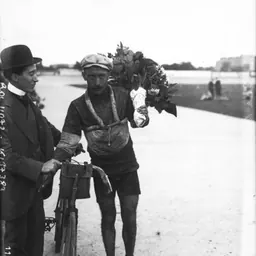
Henri Pélissier (; 22 January 1889 – 1 May 1935) was a French racing cyclist from Paris and champion of the 1923 Tour de France. In addition to his 29 career victories, he was known for his long-standing feud with Tour founder Henri Desgrange and for protesting against the conditions endured by riders in the early years of the Tour. He was killed by his lover with the gun that his wife had used to commit suicide. had to work for their father on leaving school at the easy but very early-morning job of delivering the milk from a horse-drawn cart. That was around 1910. The elder boy [Henri] did not think much of this. He had started bike racing, was a good amateur, and wanted to turn professional. Father Pélissier had different ideas; to him the bicycle was not a god but a devil.
Racing career Henri Pélissier first rode a bicycle when he was eleven, because he needed to get rid of his energy. When he was 15 years old, he rode his first race, a track race that was meant for 17-year-olds. Henri Pélissier was so thin as a young man that friends called him Ficelle, after France's thinnest loaf of bread. The word also means "string". One of four brothers, three of whom became professional cyclists, he was by far the strongest. He also became known for a stubborn, difficult personality which had led his father to banish him from the family farm when he was 16. In the next years, Henri Pélissier rode a few small road races, but it was not until 1908 when he started to ride seriously as an amateur. By 1910, he had established his name as a competent rider, and in 1911, 22 years old, he got a professional licence.
The two knew each other slightly but Pélissier was more in awe of Petit-Breton than the other way round because Petit-Breton had already ridden the Tour de France four times and won it in 1907 and 1908. He had also won Milan–San Remo in 1907, which led to a further engagement to ride in Italy. He asked Pélissier if he wanted to join him. He had six hours to make up his mind, collect his bags and bike and meet him for the 9pm train to Milan.
Their first race was the Tour of Romany-Tuscany. Pélissier crashed and didn't finish. But he won Turin-Florence-Rome and the Tour of Lombardy. He returned to ride the Tour of Lombardy the following year as well, crashing at the entrance to the horse track in Milan with Costante Girardengo, the Italian star. There were 400m to the finish and the leaders were going flat out. A heap of riders came down with them. Pélissier got back on and passed the rest before the line and the crowd was so angry at how it perceived he had ruined Girardengo's chances that they ran onto the circuit and began pushing and punching Pélissier so much that he had scramble into the judges' watchtower and wait for 80 policemen to quieten the angry spectators three metres below him. abandoned the Tour at Coutances in 1924 after Desgrange had not let Pélissier remove a jersey as the sun came up. They were met in the station café by the journalist Albert Londres, who normally wrote about social and international affairs but was following the Tour for Le Petit Parisien. Londres' piece, reproduced largely as a dialogue, appeared under the headline Les Forçats de la Route.
"You wouldn't believe that all this is about nothing more than a few jerseys. This morning, in Cherbourg, a race official came up to me and without a word, he pulled up my jersey to check that I'm not wearing two. What would you say if I pulled open your waistcoat to see if your shirt was clean? That's the way these people behave and I won't stand for it. That's what this is all about."
"But what if you were wearing two jerseys?"
"That's the point. If I want to, I can wear 15. What I can't do is start with two and finish with only one."
"Why not?"
"Because that's the rule. We don't only have to work like donkeys, we have to freeze or suffocate as well. Apparently that's an important part of the sport. So I went off to find Desgrange. 'I can't throw my jersey on the road, then?' 'No,' he said, 'you can't throw away anything provided by the organisation.' 'But this isn't the organisation's—it's mine.'
"'I don't conduct arguments in the street,' he said. 'OK,' I said, 'if you're not prepared to talk about it in the street, I'm going back to bed.'
"'We'll sort it all out in Brest', he said. It will definitely be sorted out in Brest, I said, because I'm quitting. And I did."
Pélissier went to his brother, Francis, told him his decision and encouraged him to do the same. Francis said that suited him because he had a bad stomach and no enthusiasm for racing. Ville said he hadn't been part of the strike but that the other two had picked him up along the road. He was too tired to go on, he said.
"You have no idea what the Tour de France is,' Henri said. "It's a calvary. And what's more, the way to the cross only had 14 stations — we've got 15. We suffer on the road. But do you want to see how we keep going? Wait...'
From his bag he takes a phial. "That, that's cocaine for our eyes and chloroform for our gums..."
"Here," said Ville, tipping out the contents of his bag, "horse liniment to keep my knees warm. And pills? You want to see the pills?" They got out three boxes apiece.
"In short," said Francis, "we run on dynamite.'
Henri takes up the story. "You ever seen the baths at the finish? It's worth buying a ticket. You go in plastered with mud and you come out as white as a sheet. We're drained all the time by diarrhoea. Have a look at the water. We can't sleep at night. We're twitching as if we've got St Vitus's Dance. You see my shoelaces? They're leather, as hard as nails, but they're always breaking. So imagine what happens to our skin. And our toenails. I've lost six. They fall off a bit at a time all through the stage. They wouldn't treat mules the way we're treated. We're not weaklings, but my God, they treat us so brutally. And if I so much as stick a newspaper under my jersey at the start, they check to see it's still there at the finish. One day they'll start putting lumps of lead in our pocket because God made men too light."
Londres had the best colour piece he'd ever written, although Francis claimed afterwards they'd taken advantage of his gullibility by exaggerating.
Retirement
Pélissier rode his last Tour de France in 1925. He did not finish. He stopped racing in 1927. He did nothing for two years after ending his career, then returned as a motorcycle-pacer and team manager. He had little success at either. In 1932 he wrote his impressions of the Tour de France for Paris-Soir.
Death Pélissier's first wife, Léonie, despaired and shot herself in 1933. Three years later Pélissier took a lover, Camille Tharault whom he called Miete, who was 20 years his junior. He threatened her with a knife at least once. He was 46 and had not raced for eight years. She ran back to the kitchen and found Pélissier waiting with the knife.
At that moment both saw the other threatening and Camille pulled the trigger five times. Pélissier fell to the floor. A bullet had hit the carotid artery. His body was placed in the room where Léonie had killed herself.
Next day, Paris-Soir's headline was:
Albert Baker d'Isy wrote: "He had few friendships because of his absolute opinions, and the way he expressed them cost him many friends... But they all bowed to the great quality of a champion that they considered the greatest French rider since the [first world] war." Léo Breton, president of the UVF, the French federation, called Pélissier the greatest rider of all time.
Camille's trial opened a year later, almost to the day. She pleaded self-defence and on 26 May 1936, she got a year's suspended jail sentence. It was as close as the court could come to acquitting her.
Memorial
Fans at the Parc des Princes bought a bas-relief memorial to Henri, Francis and Charles Pélissier and put it up at the velodrome. It was moved to the Piste Municipale after demolition of the Parc des Princes. It is on the right beyond the inner metal gate.
Career achievements
Major results
1911 1st Giro di Lombardia 1st Milano–Torino 1912 1st Milan–San Remo 1913 1st Giro di Lombardia 1st Stage 3 Tour de France 1914 2nd Overall Tour de France 1st Stages 10, 12 & 15 1919 1st Paris–Roubaix 1st Bordeaux–Paris Tour de France 1st Stages 2 & 3 1920 1st Giro di Lombardia 1st Paris–Brussels 1st Circuit des Champs de Bataille Tour de France 1st Stages 3 & 4 1921 1st Paris–Roubaix 1922 1st Paris–Tours 1923 1st Overall Tour de France 1st Stages 3, 10 & 11 1924 2nd Overall Tour of the Basque Country
Grand Tour results timeline 1912 1913 1914 1915 1916 1917 1918 1919 1920 1921 1922 1923 1924 1925 Giro d'Italia DNE DNE DNE N/A N/A N/A N/A DNE DNE DNE DNE DNE DNE DNEStages won — — — — — — — — — — Tour de France DNF-4 DNF-6 2 N/A N/A N/A N/A DNF-5 DNF-5 DNE DNE 1 DNF-3 DNF-4Stages won 0 1 3 1 2 — — 3 0 0 Vuelta a España N/A N/A N/A N/A N/A N/A N/A N/A N/A N/A N/A N/A N/A N/AStages won
Don’t just read it —
keep it.
Full-length biographies made to live with: read them, listen on the way to work, watch them tonight.
- E-book
- Audio
- Video
Instant download · yours to keep · every purchase keeps this site free
Important facts
People in Henri Pélissier's life
Named in this biography and alive at the same time

Related people
Same field, nearest in time



Contemporaries
People whose lives overlapped Henri Pélissier's


Frequently asked questions
Who was Henri Pélissier?
French racing cyclist (1889–1935)
When was Henri Pélissier born?
Henri Pélissier was born on 22 January 1889 in 18th arrondissement of Paris.
When did Henri Pélissier die?
Henri Pélissier died on 1 May 1935 in Dampierre-en-Yvelines.
What was Henri Pélissier's occupation?
Henri Pélissier was a sport cyclist.
What nationality was Henri Pélissier?
Henri Pélissier was French.
Sources & further reading
Cite this page
APA: Biography.guide. (2026). Henri Pélissier. https://biography.guide/henri-pelissier/
MLA: "Henri Pélissier." Biography.guide, https://biography.guide/henri-pelissier/.
Chicago: "Henri Pélissier." Biography.guide. https://biography.guide/henri-pelissier/.
Data last updated: 2026-09-21 · Spot an error? Report a correction.
Portrait: Wikimedia Commons · author & licence
Page generated 2026-09-27 04:58 UTC