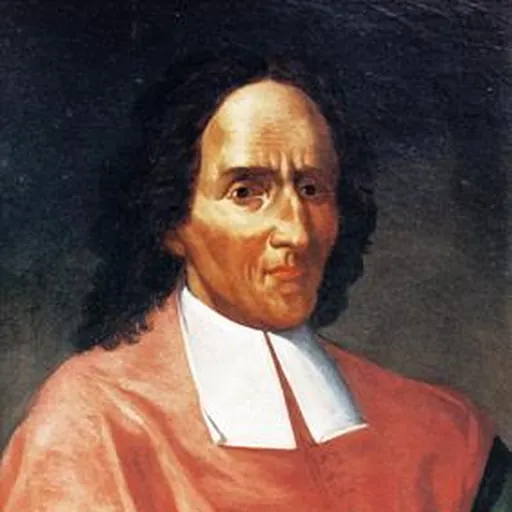
Giambattista Vico
Italian philosopher, rhetorician, historian and jurist
About Giambattista Vico
Lived 1668 – 1744 (aged 75). Giambattista Vico was an Italian philosopher, sociologist, historian, collector of fairy tales, jurist and legal scholar.
Giambattista Vico (born Giovanni Battista Vico ; ; 23 June 1668 – 23 January 1744) was an Italian philosopher, rhetorician, historian, and jurist during the Italian Enlightenment. He criticized the expansion and development of modern rationalism, finding Cartesian analysis and other types of reductionism impractical to human life, and he was an apologist for classical antiquity and the Renaissance humanities, in addition to being the first expositor of the fundamentals of social science and of semiotics. He is recognised as one of the first Counter-Enlightenment figures in history.
The Latin aphorism "" ("truth is itself something made") coined by Vico is an early instance of constructivist epistemology. He inaugurated the modern field of the philosophy of history, and, although the term philosophy of history is not in his writings, Vico spoke of a "history of philosophy narrated philosophically." Although he was not an historicist, contemporary interest in Vico usually has been motivated by historicists, such as Isaiah Berlin, a philosopher and historian of ideas, and Hayden White, a metahistorian.
Vico's intellectual magnum opus is the book Scienza Nuova or New Science (1725), which attempts a systematic organization of the humanities as a single science that records and explains the historical cycles by which societies rise and fall.
Biography "In this little room Giambattista Vico was born on June 23 1668. Here he resided until he was seventeen years old, and in the subdued little workshop of his bookseller father he used to spend the nights in his study. Youthful eve of his sublime work. The city of Naples poses." Tombstone in the house where he was born in Via San Biagio dei Librai. Born to a bookseller in Naples, Italy, Giovanni Battista Vico attended several schools, but ill health and dissatisfaction with the scholasticism of the Jesuits led to his being educated at home by tutors. Evidence from his autobiographical work indicates that Vico likely was an autodidact educated under paternal influence, during a three-year absence from school, consequence of an accidental fall when the boy was seven years old. Giovanni Battista's formal education was at the University of Naples from which he graduated in 1694, as Doctor of Civil and Canon Law. The principle states that truth is verified through creation or invention and not, as per Descartes, through observation: "The criterion and rule of the true is to have made it. Accordingly, our clear and distinct idea of the mind cannot be a criterion of the mind itself, still less of other truths. For while the mind perceives itself, it does not make itself." This criterion for truth would later shape the history of civilization in Vico's opus, the Scienza Nuova (The New Science, 1725), because he would argue that civil life—like mathematics—is wholly constructed.
The Scienza Nuova
The New Science (1725, Scienza Nuova) is Vico's major work. It has been highly influential in the philosophy of history, and for historicists such as Isaiah Berlin and Hayden White.
Influence Samuel Beckett's first published work, in the selection of critical essays on James Joyce entitled Our Exagmination Round His Factification for Incamination of Work in Progress, is "Dante... Bruno. Vico.. Joyce". In it, Beckett sees a profound influence of Vico's philosophy and poetics—as well the cyclical form of the Scienza Nuova—on the avant-garde compositions of Joyce, and especially the titular Work in Progress, viz. Finnegans Wake.
In Knowledge and Social Structure (1974), Peter Hamilton identified Vico as the "sleeping partner" of the Age of Enlightenment. Despite having been relatively unknown in his 18th-century time, and read only in his native Naples, the ideas of Vico are predecessors to the ideas of the intellectuals of the Enlightenment. Moreover, recognition of Vico's intellectual influence began in the 19th century, when the French Romantic historians used his works as methodological models and guides. Marx and Vico saw social-class warfare as the means by which men achieve the end of equal rights; Vico called that time the "Age of Men". Marx concluded that such a state of affairs is the optimal end of social change in a society, but Vico thought that such complete equality of rights would lead to socio-political chaos and the consequent collapse of society. In that vein, Vico proposed a social need for religion, for a supernatural divine providence to keep order in human society.
Arriving at Vico through both Marx and Michelet, the French philosopher Georges Sorel (1847–1922) used the Neapolitan philosopher's epistemology to develop an anti-determinist account of social scientific explanation. Insisting on the verum ipsum factum principle, Sorel developed a notion of social science as the study of how human groups produce institutions, cultures, and other forms of social relations, rather than as a search for causal laws capable of explaining historical developments. Through Vico, Sorel also further developed his interest in collective psychology and popular imagination. In the context of a discussion of Marxist theory, Sorel used Vico's insights to develop the idea that any material condition that influences a social formation is always mediated by this psychological layer. This severely limited the plausibility of economic determinism.
In Orientalism (1978), Edward Said acknowledged his scholar's debt to Vico, whose "ideas anticipate and later infiltrate the line of German thinkers I am about to cite. They belong to the era of Herder and Wolff, later to be followed by Goethe, Humboldt, Dilthey, Nietzsche, Gadamer, and finally the great twentieth century Romance philologists Erich Auerbach, Leo Spitzer, and Ernst Robert Curtius." As a humanist and early philologist, Vico represented "a different, alternative model that has been extremely important to me in my work", which differed from mainstream Western prejudice against the Orient and the dominating "standardization" that came with modernity and culminated in National Socialism. That the interdependence of human history and culture facilitates the scholars' task to "take seriously Vico's great observation that men make their own history, that what they can know is what they have made, and extend it to geography. As geographical and cultural entities—to say nothing of historical entities—such locales, regions, and geographical sectors as 'Orient' and 'Occident' are man-made."
Works Opere di G. B. Vico. Fausto Nicolini (ed.), Bari: Laterza, 1911–41. De nostri temporis studiorum ratione (1708) De Antiquissima Italorum Sapientia ex Linguae Originibus Eruenda Libri Tres (On the Most Ancient Wisdom of the Italians Unearthed from the Origins of the Latin Language). 1710, Palmer, L. M., trans. Ithaca: Cornell UP, 1988. Institutiones Oratoriae (The Art of Rhetoric). 1711–1741, Pinton, Girogio, and Arthur W. Shippee, trans. Amsterdam: Editions Rodopi B.V., 1984.* "On Humanistic Education", trans. Giorgio A. Pinton and Arthur W. Shippee. Ithaca: Cornell UP, 1993. On the Study Methods of Our Time, trans. Elio Gianturco. Ithaca: Cornell UP, 1990. Universal right (Diritto universale). Translated from Latin and Edited by Giorgio Pinton and Margaret Diehl. Amsterdam/New York, Rodopi, 2000 On the Most Ancient Wisdom of the Italians: Unearthed from the Origins of the Latin Language, trans. L. M. Palmer. Ithaca, Cornell UP, 1988. Scienza Nuova (The First New Science). 1725, Pompa, Leon, trans. Cambridge: Cambridge UP, 2002. The New Science of Giambattista Vico, (1744). trans. Thomas G. Bergin and Max H. Fisch. Ithaca: Cornell UP, 2nd ed. 1968. De rebus gestis Antonj Caraphaei (1713×1715), trans. Giorgio A. Pinton, Statecraft: The Deeds of Antonio Carafa (Peter Lang, 2004), a biography of Antonio Carafa (died 1693).
Don’t just read it —
keep it.
Full-length biographies made to live with: read them, listen on the way to work, watch them tonight.
- E-book
- Audio
- Video
Instant download · yours to keep · every purchase keeps this site free
Important facts
People in Giambattista Vico's life
Named in this biography and alive at the same time

Related people
Same field, nearest in time



Contemporaries
People whose lives overlapped Giambattista Vico's






Frequently asked questions
Who was Giambattista Vico?
Italian philosopher, rhetorician, historian and jurist
When was Giambattista Vico born?
Giambattista Vico was born on 23 June 1668 in Naples.
When did Giambattista Vico die?
Giambattista Vico died on 23 January 1744 in Naples.
What was Giambattista Vico's occupation?
Giambattista Vico was a philosopher, sociologist, historian, collector of fairy tales, jurist and legal scholar.
What nationality was Giambattista Vico?
Giambattista Vico was Italian.
Sources & further reading
· Wikipedia: Giambattista Vico
Cite this page
APA: Biography.guide. (2026). Giambattista Vico. https://biography.guide/giambattista-vico/
MLA: "Giambattista Vico." Biography.guide, https://biography.guide/giambattista-vico/.
Chicago: "Giambattista Vico." Biography.guide. https://biography.guide/giambattista-vico/.
Data last updated: 2026-09-24 · Spot an error? Report a correction.
Portrait: Wikimedia Commons · author & licence
Page generated 2026-09-27 05:09 UTC