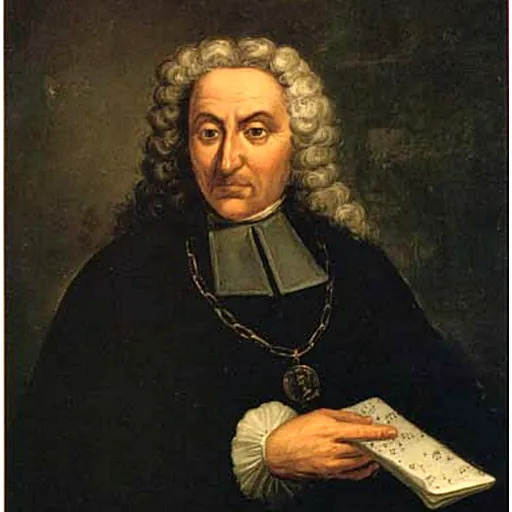
About Giacomo Antonio Perti
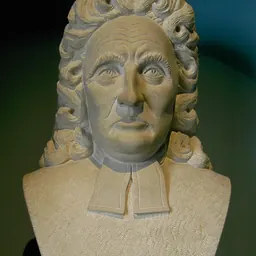
Lived 1661 – 1756 (aged 94). Giacomo Antonio Perti was an opera composer, violinist, chapelmaster, music educator, composer and conductor.
Collocazione: International museum and library of music - Bologna
Giacomo Antonio Perti (6 June 1661 – 10 April 1756) was an Italian composer of the Baroque era. He was mainly active at Bologna, where he was Maestro di Cappella for sixty years. He was the teacher of Giuseppe Torelli and Giovanni Battista Martini.
Life He was born in Bologna, then part of the Papal States, and began studying music early, learning harpsichord and violin there; later he studied counterpoint. By the age of 17, he had already written a mass, a motet, and a setting of the Magnificat; and in 1678 he wrote his first opera and oratorio. During a stay in Parma, where he studied with Giuseppe Corsi da Celano, he formed his sacred music style; most of his psalm settings of the 1680s and 1690s show the influence of Corsi. Later he went to Venice, most likely for a production of one of his operas.
In 1690 he was appointed to the post of Maestro di Cappella at S Pietro, replacing his uncle Lorenzo Perti. In 1696 he became Maestro di Cappella in another Bolognese church, S. Petronio, after the death of Giovanni Paolo Colonna the year before. He remained in charge for exactly sixty years, until his death at age 95.
Perti was a prolific composer of operas and sacred music, and was recognized as a distinguished musician not only by other composers but also by aristocrats and emperors, including Ferdinando de' Medici (one of the last of the Medici) and Emperors Leopold I and Charles VI.
Works Perti was highly regarded for his sacred music and his operas. Of the 26 operas he composed, few remain today. Perti maintained in his Op. 1 that he was influenced by the melodic style of Francesco Cavalli, Antonio Cesti, and Luigi Rossi; however, he shows considerable originality in instrumentation, use of dialogue and countermelody. His output of sacred music was even more remarkable: he wrote 120 psalm settings, for one voice, chorus, basso continuo, and various other instruments; 54 motets, for similar forces; 28 masses; 83 versetti and other liturgical works.
He also wrote secular music, including 142 solo cantatas (one of the commonest secular vocal forms in late 17th century Italy), and some instrumental music including sonatas and sinfonias for a variety of instruments.
Operas Marzio Coriolano, 1683 Oreste in Argo, 1685 L'incoronazione di Dario, 1686 La Flavia, 1686 La Rosaura, 1689 Dionisio Siracusano, 1689 Brenno in Efeso, 1690 L'inganno scoperto per vendetta, 1691 Il Pompeo, 1691 Furio Camillo, 1692 Nerone fatto cesare, 1693 La forza della virtù, 1694 Laodicea e Berenice, 1695 Penelope la casta, 1696 Fausta restituita all'impero, 1697 Apollo geloso, 1698 Lucio Vero, 1700 Astianatte, 1701 Dionisio re di Portogallo, 1707 Il Venceslao, ossia Il fraticida innocente, 1708 Ginevra principessa di Scozia, 1708 Berenice regina d'Egitto, 1709 Demetrio, 1709 Rodelinda regina de' Longobardi, 1710 Un prologo per il cortegiano, 1739
Oratorios Due gigli porporati nel martirio di santa Serafia e santa Sabina, Bologna, 1679 Abramo vincitor de' propri affetti, Bologna, 1683 (rev. Agar, 1689; spurious titles: Agar scacciata, Sara) Il Mosè conduttor del popolo ebreo, Modena, 1685 Oratorio della Passione, Bologna, 1685 (rev. Gesù al sepolcro, 1703) La beata Imelda Lambertini bolognese, (:it:beata Imelda Lambertini child saint), Bologna, 1686 «Oratorio à 6 Voci, con concertino, e concerto grosso» (unknown subject), Modena (?), 1687 (lost) San Galgano Guidotti, Bologna, 1694 La Passione di Cristo, Bologna, 1694 (= Oratorio sopra la passione del Redentore = Affetti di compassione alla morte del Redentor della Vita; composed in collaboration with pupils) Christo al Limbo, Bologna, 1698 La morte del giusto, overo Il transito di san Giuseppe, Venice, 1700 (lost) La Morte delusa, Milan, 1703 (collaboration to the pasticcio) I trionfi di Giosuè, Florence, 1704 (collaboration to the pasticcio; lost) La sepoltura di Cristo, Bologna, 1704 San Petronio, Bologna, 1720 (pasticcio) La Passione del Redentore, Bologna, 1721 I conforti di Maria Vergine addolorata per la morte del suo divin Figliuolo, Bologna, 1723 (spurious title: L'Amor Divino) Il figlio prodigo, undated Oratorio della nascita del Signore, undated San Francesco, undated La sepoltura di Cristo, undated (attributed to Perti; spurious title: San Giovanni)
Selected recordings Messa a 5, Silvia Vajente, Pamela Lucciarini, Gloria Banditelli, Orchestra Barocca di Bologna, Paolo Faldi Messa a 8, New College Choir, Cappella Musicale, Sergio Vartolo Messa a 12. Color Temporis Vocal Ensemble, Collegium usicum Almae Matris Chamber Choir, Choir & Orchestra of the Cappella Musicale Di San Petronio. Lamentations. Capella Musicale di S. Petronio di Bologna, dir. Sergio Vartolo Musiche sacre Arìon Choir & Consort, dir Giulio Prandi. Disc with Amadeus magazine, Italy 2010 Cantate morali e spirituali op.1, 2 CDs. Frisani, Calvi, Lepore, Cappella musicale San Petronio, Sergio Vartolo Abramo Vincitor De' Proprii Affetti, Laura Antonaz, Elena Biscuola, Gastone Sarti, Ensemble "Il Continuo" Bongiovanni (record label) Gesu al Sepolcro. Akerlund, Zanetti, Claudio Cavina, Schultze, Cechetti, Cappella Musicale di S. Petronio, Vartolo San Petronio (Oratorio), Pace, Nirouet, Zennaro, Spagnoli, Ensemble Seicentonovecento, Flavio Colusso. Bongiovanni 1990 Il Mosè conduttor del popolo ebreo. Mosè: Gloria Banditelli; Faraone: Marco Bussi, Generale di Faraone: Laura Antonaz. Ensemble Les Nations. Maria Luisa Baldassari. Tactus (record label) TC 661603 (1 CD, January 2013).
Don’t just read it —
keep it.
Full-length biographies made to live with: read them, listen on the way to work, watch them tonight.
- E-book
- Audio
- Video
Instant download · yours to keep · every purchase keeps this site free
Important facts
People in Giacomo Antonio Perti's life
Named in this biography and alive at the same time



Related people
Same field, nearest in time


Contemporaries
People whose lives overlapped Giacomo Antonio Perti's



Frequently asked questions
Who was Giacomo Antonio Perti?
Italian composer (1661-1756)
When was Giacomo Antonio Perti born?
Giacomo Antonio Perti was born on 6 June 1661 in Bologna.
When did Giacomo Antonio Perti die?
Giacomo Antonio Perti died on 10 April 1756 in Bologna.
What was Giacomo Antonio Perti's occupation?
Giacomo Antonio Perti was an opera composer, violinist, chapelmaster, music educator, composer and conductor.
Sources & further reading
· Wikipedia: Giacomo Antonio Perti
· DBpedia: Giacomo Antonio Perti
Cite this page
APA: Biography.guide. (2026). Giacomo Antonio Perti. https://biography.guide/giacomo-antonio-perti/
MLA: "Giacomo Antonio Perti." Biography.guide, https://biography.guide/giacomo-antonio-perti/.
Chicago: "Giacomo Antonio Perti." Biography.guide. https://biography.guide/giacomo-antonio-perti/.
Data last updated: 2026-09-24 · Spot an error? Report a correction.
Portrait: Wikimedia Commons · author & licence
Page generated 2026-09-27 05:08 UTC