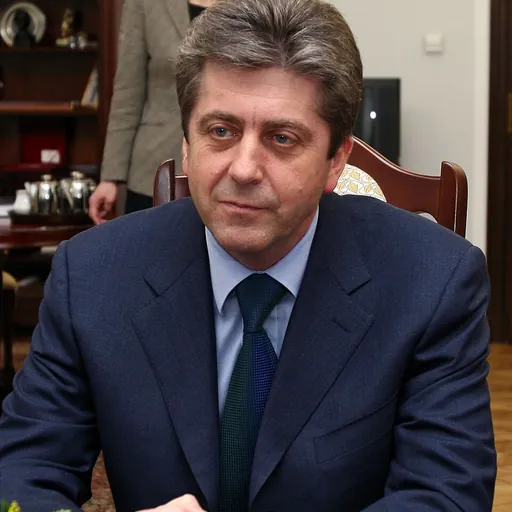
About Georgi Parvanov
Born 1957. Georgi Parvanov is a Bulgarian politician and historian.
Georgi Sedefchov Parvanov (, ) (born 28 June 1957) is a Bulgarian historian and politician who was the president of Bulgaria from 2002 to 2012. He was elected after defeating incumbent Petar Stoyanov in the second round of the November 2001 presidential election. He took office on January 22, 2002. He was reelected in 2006 with 75.9% of the vote, becoming the first Bulgarian president to serve two terms. Parvanov supported and promoted Bulgaria's accession to NATO and the EU (2007).
Although not explicitly required by the Constitution, Bulgarian presidents traditionally suspend party membership while in office. Parvanov left the Bulgarian Socialist Party (BSP) after his election in 2001. Although he identified as a socialist, Parvanov often called himself a 'social president'.
After completing his second term as president, Parvanov returned to the Socialist Party, prompting a dispute over the party leadership. In January 2014, Parvanov revived the ABV project—which later became a political party—announcing he would be fielding his own candidates for the 2014 European parliamentary elections. On January 15, 2017, he stepped down as party leader and was replaced by Konstantin Prodanov.
Biography Early years Georgi Parvanov was born in Sirishtnik, Pernik Province on June 28, 1957. He grew up in nearby Kosacha. In 1975, Parvanov graduated from secondary school in Pernik and, in 1981, finished his undergraduate education at Sofia University, gaining a major in history, and specializing in the history of the Bulgarian Communist Party. In 1988, Parvanov defended his doctoral thesis in history, which is titled "Dimitar Blagoev and the Bulgarian national question 1879-1917".
Professional career Parvanov joined the Institute for History of the Bulgarian Communist Party as a researcher in 1981. His main interest was the Bulgarian national issue and the early history of social democracy in Bulgaria. In 1989, he was promoted to a senior research associate.
In May 2001, he became a member of the Internet Society of Bulgaria.
Political career Early political career In 1981, Parvanov joined the Bulgarian Communist Party. In April 1990, the party was transformed into the Bulgarian Socialist Party. In 1989, Parvanov formed the nationalist organization Nationwide Committee for the Defense of National Interests (Bulgarian: Общонароден комитет за защита на националните интереси). In 1994, he became Deputy Chairman of the BSP national Council. It was also in that year that he was elected to the National Assembly—where he was reelected in 1997 and 2001. Parvanov was chairman of the Parliamentary Group for Friendship with Greece and member of the Parliamentary Committee on Radio and Television from 1994 to 1997.
Leader of the Bulgarian Socialist Party Because of a severe financial crisis, the Prime Minister and leader of the BSP, Zhan Videnov, resigned in December 1996. Georgi Parvanov was elected as his successor that month. However, after large protests against the socialist government in January 1997, Parvanov and Nikolay Dobrev (the nominated Prime Minister) returned the mandate to form a government. In the early parliamentary elections that ensued, the Socialist Party went into opposition, swept away by the Union of Democratic Forces (SDS).
In 2000 Parvanov was reelected as Chairman of the National Council of the BSP. He has been credited with altering the geopolitical orientation of the party, paving the way for Bulgaria's joining of NATO in 2004.
Parvanov led his party to its worst electoral performance in 2001. Both the BSP and the SDS suffered greatly from the rise of the newly founded National Movement for Simeon II.
2001 presidential election In the first round of the 2001 presidential election, Parvanov won 36.4% of the votes, finishing ahead of the incumbent SDS candidate, Petar Stoyanov, who polled 34.9% of the votes. The voter turnout was the lowest to date: only 41.8%. Parvanov emerged victorious in the runoff, winning 54.1% of the votes. Voter turnout was significantly higher in the second round: 55.1%. Following his victory, Sergei Stanishev took over the party leadership. Parvanov took office on 22 January 2002, becoming the first ex-Communist to win the presidency since 1990.
2006 presidential election
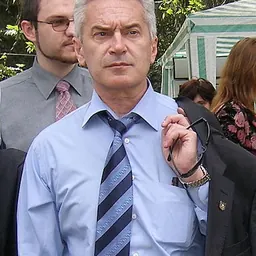
In 2006, he ran for re-election. He was backed by the ruling triple coalition, who won 70% of the seats in parliament the year before. He won first round on 22 October with 64 per cent of the vote. Because the turnout was less than 50%, he faced the nationalist Volen Siderov at the runoff on 29 October. Parvanov won with 76 per cent of the vote. This made Parvanov the first President to be reelected in Bulgaria.
Second mandate
In the second mandate of Georgi Parvanov as a President of Bulgaria, two governments changed: that of Sergei Stanishev and the current one of Boiko Borisov. As for the government of Stanishev Parvanov is often accused of not taking position about important matters, the critics even made Parvanov admit he actually proposed resignation of Stanishev as a PM before the end of Stanishev government's mandate in order that the Socialist Party has more chances in the following parliamentary elections. At the beginning of the First Borisov Government, Parvanov faced regular argues with Finance Minister Simeon Djankov and later with Minister of Defence Aniu Anev, and indirectly with Minister of Education Sergei Ignatov. Arguments and tapes send to media reached such point that a proposal for impeachment reached in Bulgarian Parliament which had enough signed representers but in the last moment was not voted by the RZS party and thus failed parliamentary approval. Following the attempt for impeachment Parvanov quickly gained back his personal authority.
ABV (АБВ) In summer 2010, Parvanov reached his platform ABV (Bulgarian: АБВ), the name constructed by the first three letters in Bulgarian alphabet, which he claimed was neither a political party nor a preparation for registering such. However, he visited many cities and had meetings with mayors which was a sign that some interpreted as a preparation for regional and further parliamentary elections. With the coming-out of the first sociological researches, it became clear ABV would not reach enough votes in the next elections and Parvanov moved his sight back to his party BSP. It was also suggested that ABV will move as a part of BSP at some point. While in 2013 virtually no media mentioned ABV in any context, in January 2014 Parvanov made what some media called "a disappointing attempt to restart the project", and others referred to ABV as an "officially frozen project".
Political stances Although the office of the Bulgarian President is largely representative as executive power lies within the government, Parvanov was known for playing an active role in his tenure as President. His political views, for example in the context of the Kosovo War, have been described as pro-Russian.
Criticisms Collaboration with Committee for State Security In 2006 Parvanov admitted that before 1989 there was a file on him at the Communist Security Service (Darzhavna Sigurnost, or DS) under the nickname "Gotse" (for the revolutionary Gotse Delchev) for his scientific assistance on Macedonian topics. The file like most other files of the Security Service hasn't been released to the public for a while (it is now available online). According to Parvanov's own statement, the file only shows that he had been consulted as a historian in conjunction with the writing of a memoir book about events related to the Macedonian Question in the 19th century. That was confirmed by two members of parliamentary commissions that had examined the files of the Security Service earlier — Bogomil Bonev and Veselin Angelov.
Iraq Oil for Food program (1998) The report of the Special Commission of the United Nations into the misconduct of the Iraqi "Oil for food" suggests that in 1998 Saddam Hussein took bribes from the Bulgarian Socialist Party, then led by Parvanov and companies close to the party. Parvanov denied these allegations explaining that the party's financing was transparent and legitimate. No further evidence to support these claims was found.
Other Bulgarian Christmas Charity Campaign (2003–present) Georgi Parvanov initiated the "Bulgarian Christmas" campaign, a funds raised for the treatment of children and renovation of hospitals and health institutions. Bulgarian Christmas is a musical event each year at the time of Christmas in which Bulgarian performers sing their most popular songs in the audience of the President and his wife, and other VIP guests. The event is TV-broadcast on the national channel BNT and funds are being raised by donations through SMS and bank transfers.
Over the years, millions of euro have been donated by private individuals such as Igor Parvanov and foreign companies, and Parvanov as closely related to the campaign warrants that the money be spent as prescribed.
Family Parvanov has two children with his wife, Zorka Parvanova: Vladimir and Ivaylo. Parvanov has two grandchildren from his son Vladimir: Georgi (born 2011) and Victoria (born 2015).
Honours Foreign honours
Heydar Aliyev Order Grand Cordon of the Leopold Knight Grand Cross of the Order of the Southern Cross Knight of the Order of the Elephant (29 March 2006) Collar of the Order of the Cross of Terra Mariana (30 May 2003) 1st Class with Chain of the Order of the Three Stars Knight Grand Cross with Golden Chain of the Order of Vytautas the Great (13 March 2009) Companion of Honour with Collar of the National Order of Merit (20 October 2009) Knight Grand Cross of the Order of Saint-Charles (26 November 2004) Knight Grand Cross of the Order of St. Olav (29 August 2006) Collar of the Order of Civil Merit (7 June 2003) Grand Collar of the Order of Prince Henry (7 October 2002)
Don’t just read it —
keep it.
Full-length biographies made to live with: read them, listen on the way to work, watch them tonight.
- E-book
- Audio
- Video
Instant download · yours to keep · every purchase keeps this site free
Important facts
Family & relationships
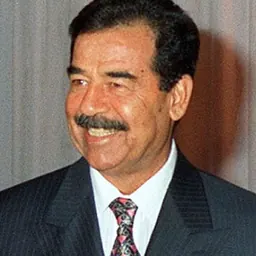
People in Georgi Parvanov's life
Named in this biography and alive at the same time



Related people
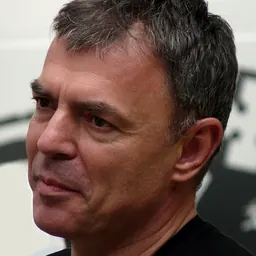
Same field, nearest in time



Contemporaries
People whose lives overlapped Georgi Parvanov's


Frequently asked questions
Who is Georgi Parvanov?
4th President of Bulgaria 2002-2012
When was Georgi Parvanov born?
Georgi Parvanov was born on 28 June 1957 in Sirishtnik.
What is Georgi Parvanov's occupation?
Georgi Parvanov is a politician and historian.
What nationality is Georgi Parvanov?
Georgi Parvanov is Bulgarian.
Sources & further reading
Cite this page
APA: Biography.guide. (2026). Georgi Parvanov. https://biography.guide/georgi-parvanov/
MLA: "Georgi Parvanov." Biography.guide, https://biography.guide/georgi-parvanov/.
Chicago: "Georgi Parvanov." Biography.guide. https://biography.guide/georgi-parvanov/.
Data last updated: 2026-09-20 · Spot an error? Report a correction.
Portrait: Wikimedia Commons · author & licence
Page generated 2026-09-27 04:58 UTC