
About George William Lemon
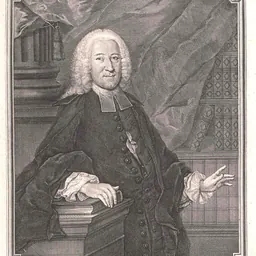
Lived 1726 – 1797 (aged 70–71). George William Lemon was a British lexicographer and linguist.
The Reverend George William Lemon (1726 – 4 October 1797) was the author of an early etymological dictionary of the English language, published in 1783.
Lemon graduated from Queens' College, Cambridge, in 1748. He was Rector of Geytonthorpe, Vicar of East Walton, Norfolk from 1755, and master of Norwich School from 1769 to 1778. He also held the living of Mundham St Peter and St Ethelbert, and also Seething, however he was never instituted to them.
Lemon married Elizabeth Young (1735 – 25 September 1804) on 31 May 1760. Both are buried in East Walton.
English Etymology (1783) Lemon considered the English language as founded on six older idioms: "The Hebrew, or Phoenician" (Semitic) "The Greek" "The Latin, or Italian" (Romance) "The Celtic, or French" "The Saxon, Teutonic, or German" (West Germanic) "The Icelandic, and other Northern dialects" (North Germanic)
The entries consequently focus on English words of Latin or Greek derivation. Twenty years before the discovery of Grimm's law, Lemon could not be expected to give sound etymologies of Germanic words, and promptly derived acorn from Greek akros, or addle from Greek athlos. Yet Lemon's dictionary is of historical interest as a pioneer work of philology on the eve of the discoveries of William Jones, Friedrich Schlegel and Rasmus Rask that mark the beginning of modern linguistics.
Ralph Griffiths' Monthly Review in 1785 (vol. 71 , 171-177 ) reviewed Lemon's dictionary as an extraordinary and delectable work:
Works Two Tracts, London, 1773 (a) ‘Additional Observations on the Greek Accents, by the late Edward Spelman, esq.,’ (ed. Lemon) (b) ‘The Voyage of Æneas from Troy to Italy, in part intended to “lay before the readers specimens of a much larger attempt, viz: an intire new translation of the works of Virgil.”’ Græcæ Grammaticæ Rudimenta, 1774 English Etymology Or, A Derivative Dictionary Of The English Language: In Two Alphabets. Tracing the Etymology of those Words that are derived (1.) from the Greek and Latin Languages; (2.) from the Saxon and Northern Tongues. The Whole Compiled From Vossius, Meric Casaubon, Spelman, Somner, Minshew, Junius, Skinner, Verstegan, Ray, Nugent, John Upton, Cleland, And Other Etymologists, 1783. The History of the Civil War between York and Lancaster, comprehending the lives of Edward IV and his brother Richard III. Lynn, W. Whittingham, 1792
Don’t just read it —
keep it.
Full-length biographies made to live with: read them, listen on the way to work, watch them tonight.
- E-book
- Audio
- Video
Instant download · yours to keep · every purchase keeps this site free
Important facts
People in George William Lemon's life
Named in this biography and alive at the same time




Related people
Same field, nearest in time

Contemporaries
People whose lives overlapped George William Lemon's





Frequently asked questions
Who was George William Lemon?
British lexicographer
When was George William Lemon born?
George William Lemon was born in 1726.
When did George William Lemon die?
George William Lemon died on 4 October 1797.
What was George William Lemon's occupation?
George William Lemon was a lexicographer and linguist.
What nationality was George William Lemon?
George William Lemon was British.
Sources & further reading
· Wikipedia: George William Lemon
· DBpedia: George William Lemon
Cite this page
APA: Biography.guide. (2026). George William Lemon. https://biography.guide/george-william-lemon/
MLA: "George William Lemon." Biography.guide, https://biography.guide/george-william-lemon/.
Chicago: "George William Lemon." Biography.guide. https://biography.guide/george-william-lemon/.
Data last updated: 2026-09-20 · Spot an error? Report a correction.
Page generated 2026-09-27 05:15 UTC