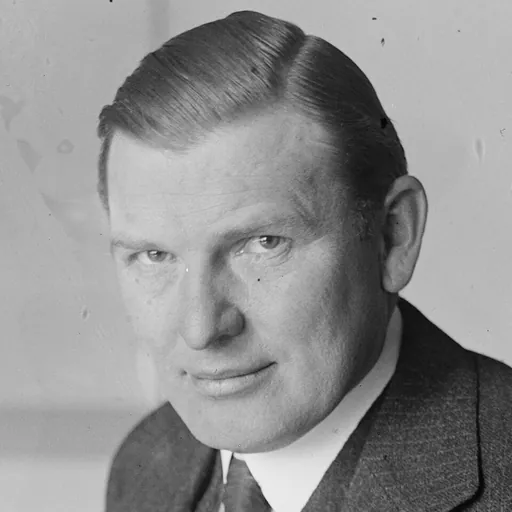
About George Peek
Lived 1873 – 1943 (aged 70). George Peek was an American economist.
George Nelson Peek (November 19, 1873 – December 17, 1943) was an American agricultural economist, business executive, and civil servant. He was the first administrator of the Agricultural Adjustment Administration (AAA) and the first president of the two banks that would become the Export-Import Bank of the United States.
Early life and business career
Peek was born in Polo, Illinois, on November 19, 1873; His father was a farmer. Peek graduated from Oregon High School in Oregon, Illinois. He attended Northwestern University from 1891 to 1892, but did not graduate. In 1919, he left Deere & Co. and became president of the Moline Plow Company, where he earned the relatively large salary of $100,000 a year. Peek and Johnson were deeply interested in farm economics, especially since the post-World War I recession. Peek and Johnson became strong advocates of the McNary–Haugen Farm Relief Bill, proposed federal legislation which would have established the first national system of price supports for agriculture. and after the war was a member of the Industrial Board advising the United States Department of Commerce on post-war reconversion.
New Deal When the Republican Party refused to support the legislation, Peek became a Democrat. Instead, Bernard Baruch, who knew Peek from their service on the War Industries Board, convinced Roosevelt to put Peek in charge of the AAA.
Peek also disagreed with one of the three fundamental programs created by the Agricultural Adjustment Act, which created three programs designed to boost farm prices. It established marketing programs designed to increase the purchase of American agricultural products overseas. It established a system of price supports. It established a system of incentives to discourage overproduction.
For farmers to participate in the price support program, they had to agree to cut production. The same day, President Roosevelt named Peek his special advisor on foreign trade. Roosevelt created a Second Export-Import Bank of Washington by executive order on March 9 and named Peek president of the second bank as well. and resigned from the bank on December 2, 1935.
In 1936, he published a book on economic matters, Why Quit Our Own, which he co-authored with Samuel Crowther.
Retirement and death Peek retired to Rancho Santa Fe, California, in 1937 with his wife, Georgia. He rejoined the Republican Party, and supported Alf Landon in the 1936 presidential election.
Peek died at his home in Rancho Santa Fe on December 17, 1943. He was survived by his wife.
During his lifetime, Peek received numerous awards and honors, including the Distinguished Service Medal, the Légion d'honneur, the Belgian Order of the Crown, and the Order of the Crown of Italy.
Don’t just read it —
keep it.
Full-length biographies made to live with: read them, listen on the way to work, watch them tonight.
- E-book
- Audio
- Video
Instant download · yours to keep · every purchase keeps this site free
Important facts
People in George Peek's life
Named in this biography and alive at the same time



Related people
Same field, nearest in time

Contemporaries
People whose lives overlapped George Peek's


Frequently asked questions
Who was George Peek?
American economist
When was George Peek born?
George Peek was born on 19 November 1873 in Polo.
When did George Peek die?
George Peek died on 17 December 1943 in Rancho Santa Fe.
What was George Peek's occupation?
George Peek was an economist.
What nationality was George Peek?
George Peek was American.
Sources & further reading
Cite this page
APA: Biography.guide. (2026). George Peek. https://biography.guide/george-peek/
MLA: "George Peek." Biography.guide, https://biography.guide/george-peek/.
Chicago: "George Peek." Biography.guide. https://biography.guide/george-peek/.
Data last updated: 2026-09-22 · Spot an error? Report a correction.
Portrait: Wikimedia Commons · author & licence
Page generated 2026-09-27 05:01 UTC