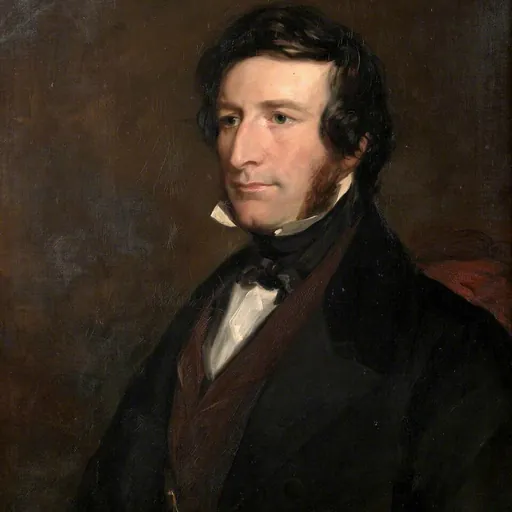
About George Cornewall Lewis
Lived 1806 – 1863 (aged 56). George Cornewall Lewis was a British politician, classical scholar and writer.
Sir George Cornewall Lewis, 2nd Baronet, (21 April 180613 April 1863) was a British statesman and man of letters. He is best known for preserving neutrality in 1862 when the British cabinet debated intervention in the American Civil War.
Early life
He was born in London, the son of Thomas Frankland Lewis of Harpton Court, Radnorshire and his wife Harriet Cornewall, daughter of the banker and plantation owner Sir George Cornewall, 2nd Baronet and his wife Catherine Cornewall, daughter of Velters Cornewall.
Lewis was educated at Eton College and matriculated in 1824 at Christ Church, Oxford, where in 1828 he earned a first-class in classics and a second-class in mathematics. He then entered the Middle Temple, studying under Barnes Peacock. He was called to the bar in 1831, and briefly from November 1831 went the Oxford circuit. But he shortly gave up on a career in the law, for health reasons. He assisted Connop Thirlwall and Julius Charles Hare in starting The Philological Museum, a journal published from 1831 to 1833. Its successor was The Classical Museum, which he also supported.
Commissioner
Nassau Senior in 1832 recommended Lewis to Henry Brougham as a candidate for the Poor Law Commission then under consideration. At the time there was no outcome.
In 1836, at the request of Charles Grant, 1st Baron Glenelg, Lewis accompanied John and Sarah Austin to Malta. They spent nearly two years reporting on the condition of the island and framing a new code of laws. One main object of both commissioners was to associate the Maltese in the responsible government of the island. On his return to Britain, Lewis succeeded his father as one of the principal poor-law commissioners.
Editor
On the dissolution of parliament which followed the resignation of Lord John Russell's ministry in 1852, Lewis sought re-election in the 1852 United Kingdom general election. He was defeated for Herefordshire and then for Peterborough. He accepted the editorship of the Edinburgh Review, and remained in the post until 1855. During this period he served on the Oxford commission, and on the commission to inquire into the government of London.
Death Lewis fell ill and shortly died, on 13 April 1863, at Harpton Court. He was buried in Old Radnor church on the 17th. D. A. Smith, writing in the Oxford Dictionary of National Biography, does not accept that, though saying he would have had a role to play. The Essay on the Government of Dependencies (1841) was a systematic statement and discussion of the relations in which colonies may stand towards the mother country. About 1850, his Essay on the Influence of Authority in Matters of Opinion was published.
Legacy
A marble bust of Lewis, by Henry Weekes, stands in Westminster Abbey. A large monument was built in his memory in the small village of New Radnor, Powys and still stands today, as does a statue in front of the Shirehall, Hereford.
Don’t just read it —
keep it.
Full-length biographies made to live with: read them, listen on the way to work, watch them tonight.
- E-book
- Audio
- Video
Instant download · yours to keep · every purchase keeps this site free
Important facts
Family & relationships
People in George Cornewall Lewis's life
Named in this biography and alive at the same time




Related people
Same field, nearest in time



Contemporaries
People whose lives overlapped George Cornewall Lewis's






Frequently asked questions
Who was George Cornewall Lewis?
British politician; (1806-1863)
When was George Cornewall Lewis born?
George Cornewall Lewis was born on 21 April 1806 in London.
When did George Cornewall Lewis die?
George Cornewall Lewis died on 13 April 1863 in Radnorshire.
What was George Cornewall Lewis's occupation?
George Cornewall Lewis was a politician, classical scholar and writer.
What nationality was George Cornewall Lewis?
George Cornewall Lewis was British.
Sources & further reading
· Wikipedia: George Cornewall Lewis
· DBpedia: George Cornewall Lewis
Cite this page
APA: Biography.guide. (2026). George Cornewall Lewis. https://biography.guide/george-cornewall-lewis/
MLA: "George Cornewall Lewis." Biography.guide, https://biography.guide/george-cornewall-lewis/.
Chicago: "George Cornewall Lewis." Biography.guide. https://biography.guide/george-cornewall-lewis/.
Data last updated: 2026-09-22 · Spot an error? Report a correction.
Portrait: Wikimedia Commons · author & licence
Page generated 2026-09-27 05:01 UTC