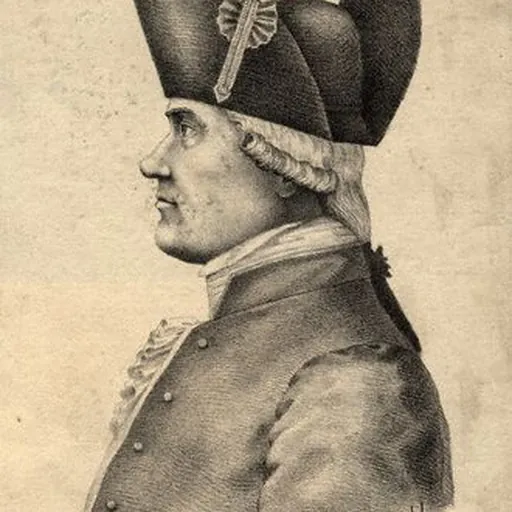
About George Baldwin
Lived 1744 – 1826 (aged 81–82). George Baldwin was a British diplomat.
George Baldwin was a British merchant, writer and diplomat of the late eighteenth and early nineteenth centuries whose career was principally based in Egypt, where he established valuable trade links for the East India Company and negotiated directly with the Ottoman governors. Despite repeated warnings of the importance of Egypt to links with British India, his advice was ignored and thus when Napoleon Bonaparte invaded Egypt in 1798 the British were ill-placed to respond directly. In 1801 he assisted the British counter-invasion of Egypt and later returned to Britain with his wife Jane Maltass, a famous society beauty. Although a highly successful merchant and diplomat, Baldwin found himself a subject of ridicule on his return to Britain for his belief in the healing power of magnets, then widely considered a pseudoscience. He retired to Earl's Court in London and died there in 1826.
Early life George Baldwin was born in May 1744 (although some sources give 1743), the son of hop merchant William Baldwin of Borough, London. Aged 16 he was sent to join his brother in Cyprus, where he was consul-general and three years later was sent to Acre.
Career During his trading operations in the Eastern Mediterranean, Baldwin became increasingly aware of the political and commercial structures of the Middle East, and in 1768, he traveled to Britain to seek permission to investigate the possibilities of trade running from British India across Egypt via the Red Sea. Although this route was nominally blocked off to non-Muslims, developing trade would be possible if it brought profit to the rulers of Egypt. On his brother's death, Baldwin returned to the Mediterranean and took up his post on Cyprus. In 1773, Mehmed Bey summoned him to Cairo and encouraged British shipping to use Suez, declaring that he would cut a canal from Suez to the Nile for ships to pass directly from the Red Sea to the Mediterranean. He was also well received in Constantinople.
East India Company In 1774, Baldwin returned to Cairo and then back to England, where he learned that the East India Company had successfully begun a trade route between India and Suez. Offering his services to the Company, Baldwin was accepted and returned again to Egypt, where he was the only British merchant. With his knowledge of Arabic he was able to monopolise British trade caravans passing from Suez to the Nile, and ensured a fast, safe and efficient service. At some point between 1776 and 1778 he was reported to have climbed the Great Pyramid at Giza and drunk a mixture of waters from the Nile, Ganges and Thames, symbolically linking the trade routes he managed. By 1779, his trade was so successful that it began to impinge on that of the Ottoman Sultan and of the Cape of Good Hope, prompting protests and restrictions on his activities. In May, one of his caravans was attacked and looted, with some merchants taken hostage. Baldwin exchanged himself for the merchants and later escaped, reaching Smyrna. In London, she was painted by Joshua Reynolds, William Pyne and Richard Cosway. Baldwin became popular in society and became an acquaintance of William Blake, who mentions him and Cosway in one of his poems. It was his friendship with Cosway that led to his introduction into the field of magnetic therapy, the theory that magnetic force had healing powers.
He died in 1826 in Earl's Court and his art collection was sold at Christie's in May 1828 over two days.
Don’t just read it —
keep it.
Full-length biographies made to live with: read them, listen on the way to work, watch them tonight.
- E-book
- Audio
- Video
Instant download · yours to keep · every purchase keeps this site free
Important facts
People in George Baldwin's life
Named in this biography and alive at the same time

Related people
Same field, nearest in time


Contemporaries
People whose lives overlapped George Baldwin's




Frequently asked questions
Who was George Baldwin?
British diplomat, writer and merchant (1744-1826)
When was George Baldwin born?
George Baldwin was born in 1744 in Southwark.
When did George Baldwin die?
George Baldwin died on 19 February 1826 in Earl's Court.
What was George Baldwin's occupation?
George Baldwin was a diplomat.
What nationality was George Baldwin?
George Baldwin was British.
Sources & further reading
· DBpedia: George Baldwin (diplomat)
Cite this page
APA: Biography.guide. (2026). George Baldwin. https://biography.guide/george-baldwin-diplomat/
MLA: "George Baldwin." Biography.guide, https://biography.guide/george-baldwin-diplomat/.
Chicago: "George Baldwin." Biography.guide. https://biography.guide/george-baldwin-diplomat/.
Data last updated: 2026-09-24 · Spot an error? Report a correction.
Portrait: Wikimedia Commons · author & licence
Page generated 2026-09-27 05:09 UTC