
About Gellu Naum
Lived 1915 – 2001 (aged 86). Gellu Naum was a Romanian writer, poet, children's writer, translator and philosopher.
Gellu Naum (1 August 1915 – 29 September 2001) was a Romanian poet, dramatist, novelist, children's writer, and translator. He is remembered as the founder of the Romanian Surrealist group. The artist Lyggia Naum, his wife, was the inspiration and main character in his 1985 novel Zenobia.
Biography Of Aromanian descent, he was born in Bucharest, and was the son of the poet (who had been drafted in World War I and died during the Battle of Mărășești) and his wife Maria Naum, née Rosa Gluck. In 1933, he began studying philosophy at the University of Bucharest. In 1938, he left for France, where he continued his studies at the University of Paris. He took his PhD diploma with a thesis on the scholastic philosopher Pierre Abelard.
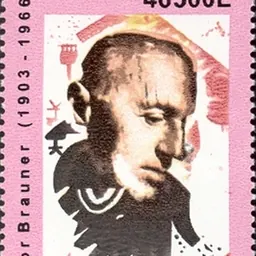
In 1936 (the year when he published his first book), Naum met Victor Brauner, who became his close friend and who later introduced him to André Breton and his Surrealist circle in Paris.
In 1941, he helped create the Bucharest group of Surrealists (which also included Gherasim Luca, Paul Păun, Dolfi Trost, and ). Naum was drafted into Romanian Army during World War II and served on the Eastern Front after the invasion of the Soviet Union (see Romania during World War II). Marked by his wartime experience, he was discharged in 1944, after he had fallen ill.
In December 1947, the Surrealist group succumbed to the vicissitudes of postwar Soviet occupation and successful Communist takeover of Romania's government. As Socialist realism had officially become Romania's cultural policy, he could only publish books for children (out of which the two books with Apolodor were reissued several times). Although he published several books in the line of Socialist realism, which he reneged on afterwards, he never stopped writing Surrealist poems, such as the 1958 poem composed of several parts Heraclitus (published in the 1968 volume Athanor) or the esoteric manuscript The Way of the Snake, written in 1948–1949 and published after his death, in 2002.
Between 1950 and 1953, he taught philosophy at the Agronomic Institute of Bucharest, while working also as a translator. He translated works by Samuel Beckett, René Char, Denis Diderot, Alexandre Dumas, père, Julien Gracq, Victor Hugo, Franz Kafka, Gérard de Nerval, Jacques Prévert, Stendhal, and Jules Verne.
He resumed his literary career in 1968, in the wake of a relative cultural liberalization under Nicolae Ceaușescu's regime. In 1971 he was awarded the Order of the Star of the Romanian Socialist Republic, 3rd class.
After the Romanian Revolution of 1989, he traveled abroad and gave public readings in France, Germany, Switzerland, and the Netherlands. In 1995, the German Academic Exchange Service appointed him scholar at the University of Berlin. Naum spent much of his final years at his retreat in Comana. He died at in Bucharest at age 86; after a memorial service at Amzei Church, he was buried in the city's Bellu Cemetery.
Works
Drumețul incendiar ("The Incendiary Traveler"; poems, illustrated by Victor Brauner), Bucharest, 1936 Vasco de Gama, (poem, illustrated by Jacques Hérold), Bucharest, 1940 Culoarul somnului, ("The Corridor of Sleep"; poems, illustrated by Victor Brauner), Bucharest, 1944 Medium (prose), Bucharest, 1945 Critica mizeriei ("Critique of Misery"; manifesto, co-written with Paul Păun and )), Bucharest, 1945 Teribilul interzis ("The Terrible Forbidden"; drama, illustrated by Paul Păun), Bucharest, 1945 Spectrul longevității: 122 de cadavre ("The Specter of Longevity: 122 corpses"; drama, co-written with Virgil Teodorescu), Bucharest, 1946 Castelul Orbilor ("Castle of the Blind"; drama), Bucharest, 1946 L'infra-noir ("Infra-Black"; manifesto, co-written with Gherasim Luca, Paul Păun, Virgil Teodorescu, and Dolfi Trost), Bucharest, 1947 Éloge de Malombra – Cerne de l'amour absolu ("Malombra's Eulogy – Black Circle of Absolute Love"; manifesto, co-written with Gherasim Luca, Paul Păun, and Dolfi Trost), Bucharest, 1947 Filonul, Bucharest, 1952 ("The Vein"; prose) Tabăra din munți, Bucharest, 1953 ("The Camp in the Mountains"; prose) Așa-i Sanda, Bucharest, 1956 ("So Is Sanda"; poems for children) Cartea cu Apolodor, Bucharest, 1959 ("The Book With Apolodor"; poems for children, illustrated by Jules Perahim) Poem despre tinerețea noastră, Bucharest, 1960 ("Poem About Our Youth"; poems, illustrated by Jules Perahim) Soarele calm, Bucharest, 1961 ("The Calm Sun"; poems, illustrated by Jules Perahim) A doua carte cu Apolodor, Bucharest, 1964 ("The Second Book With Apolodor"; poems for children, illustrated by Jules Perahim) Athanor (poems), Bucharest, 1968 Poetizați, poetizați... ("Poeticize, Poeticize..."; prose), Bucharest, 1970 Copacul-animal ("The Animal-Tree"; poems), Bucharest, 1971 Tatăl meu obosit ("My Tired Father"; poems), Bucharest, 1972 Poeme alese ("Selected Poems"; poems), Bucharest, 1974 Cărțile cu Apolodor ("The Apolodor Books", poems for children), Bucharest, 1975 Descrierea turnului ("Description of the Tower"; poems), Bucharest, 1975 Insula. Ceasornicăria Taus. Poate Eleonora ("The Island. The Taus Clockmakers. Eleonora, Perhaps"; drama), Bucharest, 1979 Partea cealaltă ("The Other Side"; poems), Bucharest, 1980 Zenobia (novel), Bucharest, 1985 Amedeu, cel mai cumsecade leu, Bucharest, 1988 ("Amedeu, The Most Honest Lion"; poems for children, illustrated by N. Nobilescu) Apolodor, un mic pinguin călător, Bucharest, 1988 ("Apolodor, A Small Travelling Penguin"; poems for children, illustrated by N. Nobilescu) Malul albastru ("The Blue Shore"; prose), Bucharest, 1990 Fața și suprafaţa, urmat de Malul albastru ("Face and Surface, followed by The Blue Shore", poems), Bucharest, 1994 Focul negru ("Black Fire"; poems), Bucharest, 1995 Sora fântână ("Sister Fountain"; poems), Bucharest, 1995 Întrebătorul ("The Inquirer"; prose), Bucharest, 1996 Copacul-animal, urmat de Avantajul vertebrelor ("The Animal-Tree, followed by The Advantage of Vertebrae"), Cluj-Napoca, 2000 Ascet la baraca de tir ("Recluse in the Firing Range Shack"; poems), Bucharest, 2000 Calea șearpelui ("The Way of the Snake"), Bucharest, 2002 (posthumous)
Presence in English language anthologies Testament – Anthology of Romanian Verse – American Edition - monolingual English edition - Daniel Ioniță (editor and principal translator), with Eva Foster, Daniel Reynaud and Rochelle Bews – Australian-Romanian Academy for Culture – 2017 – Testament - 400 Years of Romanian Poetry - 400 de ani de poezie românească - bilingual edition - Daniel Ioniță (editor and principal translator) with Daniel Reynaud, Adriana Paul & Eva Foster - Editura Minerva, 2019 - Romanian Poetry from its Origins to the Present - bilingual edition English/Romanian - Daniel Ioniță (editor and principal translator) with Daniel Reynaud, Adriana Paul and Eva Foster - Australian-Romanian Academy Publishing - 2020 - ;
Don’t just read it —
keep it.
Full-length biographies made to live with: read them, listen on the way to work, watch them tonight.
- E-book
- Audio
- Video
Instant download · yours to keep · every purchase keeps this site free
Important facts
People in Gellu Naum's life
Named in this biography and alive at the same time





Related people
Same field, nearest in time


Contemporaries
People whose lives overlapped Gellu Naum's



Frequently asked questions
Who was Gellu Naum?
Romanian writer (1915–2001)
When was Gellu Naum born?
Gellu Naum was born on 1 August 1915 in Bucharest.
When did Gellu Naum die?
Gellu Naum died on 29 September 2001 in Bucharest.
What was Gellu Naum's occupation?
Gellu Naum was a writer, poet, children's writer, translator and philosopher.
What nationality was Gellu Naum?
Gellu Naum was Romanian.
Sources & further reading
Cite this page
APA: Biography.guide. (2026). Gellu Naum. https://biography.guide/gellu-naum/
MLA: "Gellu Naum." Biography.guide, https://biography.guide/gellu-naum/.
Chicago: "Gellu Naum." Biography.guide. https://biography.guide/gellu-naum/.
Data last updated: 2026-09-20 · Spot an error? Report a correction.
Page generated 2026-09-27 05:34 UTC