
Gao Jixing
Founder of the Jingnan Kingdom (858-929) during the 10th-century Ten Kingdoms
About Gao Jixing
Lived 858 – 929 (aged 70–71). Gao Jixing was a politician and ruler.
Gao Jixing (858 According to the New History of the Five Dynasties, which the Spring and Autumn Annals of the Ten Kingdoms also adopted, he became a servant of Li Rang , who later loaned money to Zhu and became an adoptive son of Zhu's, with his name changed to Zhu Yourang ; Under both accounts, when Gao managed to meet Zhu, Zhu was impressed by his talent, and had his master adopt him as a son — thus making him Zhu's adoptive grandson and having him take on the surname of Zhu. As of fall 902, Zhu Quanzhong had had Fengxiang under siege for about a year, but was unable to capture it, with his siege efforts hampered by rain and his soldiers becoming ill. He thus considered withdrawing to Huguo Circuit (護國, headquartered in modern Yuncheng, Shanxi), which he also possessed. Zhu Jichang and fellow officer Liu Zhijun, however, opposed, pointing out that Li Maozhen was in desperate straits. Zhu Quanzhong, however, was concerned about Li Maozhen's strategy of refusing to engage the Xuanwu troops and putting up a strong defense at Fengxiang. At Zhu Jichang's suggestion, Zhu Quanzhong decided to try trickery — and asked for a volunteer soldier to try to trick Li Maozhen into engaging the Xuanwu army. One Ma Jing volunteered, and pretended to surrender to the Fengxiang army. Ma then informed Li Maozhen that Zhu Quanzhong had already left, leaving only about 10,000 ill soldiers to pretend to be still putting up a siege, and that even they would depart that night. He suggested that Li Maozhen attack the Xuanwu camp. Li Maozhen agreed and attacked — and his army immediately fell into a trap set by the Xuanwu army, suffering large losses. From this point on, Li Maozhen, while not surrendering immediately, began to negotiate with Zhu Quanzhong for peace, promising to give the emperor to him (which occurred eventually in spring 903). For Zhu Jichang's contributions to this victory, Zhu Quanzhong made him the military prefect (團練使, Tuanlianshi) of Song Prefecture (宋州, in modern Shangqiu, Henan).
During Later Liang
During Emperor Taizu's reign In 907, Zhu Quanzhong had Emperor Zhaozong's son and successor Emperor Ai yield the throne to him, ending Tang and starting a new Later Liang as its Emperor Taizu. He commissioned Gao Jichang as the full military governor of Jingnan. By this point, Jingnan, which formerly consisted of eight prefectures (counting Jiangling Municipality as a prefecture), had suffered much through warfare, and most of its prefectures had been taken by warlords ruling other circuits. Even Jiangling itself had its walls and buildings in disrepair, and its population greatly reduced. When Gao arrived at Jiangling, he comforted the people and encouraged them to return, and it was said that the people's lives began to return to normal.
In fall 907, Lei Yangong, with aid from Ma Yin the Prince of Chu (even though that Ma was formally a Later Liang vassal), attacked Jiangling. Gao stationed troops at Gong'an (公安, in modern Jingzhou) to cut off Lei's food supply route, and then defeated him. He withdrew, as did Chu troops. Later, Lei attacked Cenyang (涔陽, also in modern Jingzhou) and Gong'an, but could not capture them. Later that year, Emperor Taizu bestowed the honorary chancellor designation of Tong Zhongshu Menxia Pingzhangshi on Gao.
After Emperor Taizu's reign In summer 912, Emperor Taizu was assassinated by his son Zhu Yougui the Prince of Ying, who, after blaming the assassination on his adoptive brother Zhu Youwen the Prince of Kang and killing Zhu Youwen, took the throne.
In 917, Gao and Kong repaired their relationship, and he resumed submitting tributes to the Later Liang imperial government.
In 921, Gao ordered Ni, whose son Ni Zhijin had married a daughter of Gao's by this point, to oversee a project to repair Jiangling's outer walls. When Gao himself went to review the project, he blamed Ni Kefu for the project's slow pace and publicly caned him. However, he stated to his daughter, "Go back to your home and tell your father-in-law: all I wanted to do was to display my authority in front of the people." He also secretly gave her a large amount of platinum for her to give to Ni Kefu.
During Later Tang
During Emperor Zhuangzong's reign In 923, Li Cunxu the Prince of Jin declared himself emperor of a new Later Tang (as Emperor Zhuangzong). Shortly after, he made a surprise attack on the Later Liang capital Daliang, catching the city defenseless. Zhu Zhen committed suicide, ending Later Liang. The Later Liang-commissioned military governors, including Gao Jichang subsequently all submitted petitions to him pledging loyalty. Gao further changed his name to Gao Jixing to observe naming taboo (as Emperor Zhuangzong's grandfather was Li Guochang). To show his faithfulness to the new Later Tang emperor, he further wanted to go to Daliang to pay homage to the new emperor. Liang Zhen tried to stop him, stating:
When Gao arrived at Daliang, Emperor Zhuangzong bestowed the greater honorary chancellor title of acting Zhongshu Ling on him. On one occasion, the emperor asked him, "We would like to attack Wu and Shu. Which one should be first?" Gao, not actually wanting Emperor Zhuangzong to succeed and believing that Former Shu would be more difficult to conquer due to the geographical barriers, responded, "Wu has infertile lands and poor people; conquering it would do no good. Shu should be attacked first. Its lands are rich; its ruler [(Wang Jian's son and successor Wang Zongyan) is frivolous; and its people are discontented. You will surely be able to conquer it if you attack it. After conquering it, go down the river [(i.e., the Yangtze)], and it would be easy to conquer Wu." Emperor Zhuangzong was pleased with his suggestion.
Subsequently, after Emperor Zhuangzong, believing in false rumors of their planning to rebel against him, had Guo and another major general, Zhu Youqian, killed, many rebellions started against him.
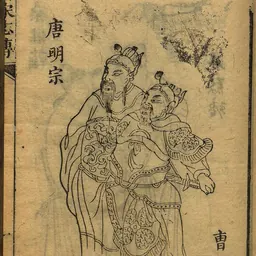
During Emperor Mingzong's reign In the aftermaths of Emperor Zhuangzong's death, Emperor Zhuangzong's adoptive brother Li Siyuan claimed imperial title (as Emperor Mingzong). Meanwhile, Gao Jixing prepared his fleet and wanted to attack Chu. His official Sun Guangxian, whom Liang Zhen had recommended to him to be his scribe, pointed out that Jingnan had barely recovered from the wars, and if it were engaged in a war with Chu, other states might take advantage and attack Jingnan. Gao agreed and stopped his plans to attack Chu. Meanwhile, he requested that Jingnan be given control of Kui, Zhong, and Wan Prefectures; Emperor Mingzong agreed.
However, soon thereafter Gao began a series of actions that provoked Emperor Mingzong's administration. He had requested, after Emperor Mingzong gave him Kui, Zhong, and Wan Prefectures, that the imperial government not commission prefects for those prefectures, but allow him to commission his own family members; Emperor Mingzong refused. Soon thereafter, when Pan Kang (a former Former Shu official) left his post as prefect of Kui, Gao sent an army to Kui, killed the soldiers already stationed there, and took direct control, and when Emperor Mingzong subsequently commissioned the officer Xifang Ye to be the prefect, Gao refused to allow Xifang to take office. He also launched a surprise attack on Fu Prefecture, but was unable to capture it. Further, when Han Gong , an officer that Li Jiji (who committed suicide after his own soldiers refused to follow his orders after Emperor Zhuangzong's death) had sent to escort Former Shu treasures down the Yangtze to Luoyang, went through the Three Gorges, Gao sent an army to surprise and kill Han, and he took over the treasures. When Emperor Mingzong sent an emissary to question Gao about what happened to Han, Gao responded: "Han Gong and the others took ships down the Gorges and had to go thousands of li. If you want to know why their ships overturned and they drowned, you should question the river god." In anger, Emperor Mingzong stripped Gao of his titles and commissioned Liu Xun the military governor of Shannan East to attack Gao from the north, with Xia Luqi the military governor of Zhongwu Circuit (忠武, headquartered in modern Xuchang) as Liu's deputy; Dong Zhang the military governor of Dongchuan Circuit (東川, headquartered in modern Mianyang, Sichuan) to attack him from the west, with Xifang as Dong's deputy; and Ma Yin to attack from the south.
Liu quickly put Jiangling under siege, but as Jiangling was humid, and it happened to be rainy season, the siege was hampered, with many of Liu's soldiers and Liu himself becoming ill. Emperor Mingzong sent Kong Xun, who had become his chief of staff, to Jiangling to oversee the siege. Kong, who was also unable to capture Jiangling, sent emissaries into the city to try to persuade Gao to submit. Gao not only refused to do so, but was rude to Kong's emissaries. Meanwhile, despite Emperor Mingzong's sending much gifts to Ma, Ma found excuses not to attack Jiangling. With the siege unsuccessful, Emperor Mingzong ordered Liu to withdraw. However, Xifang was able to defeat Jingnan forces stationed at Kui, Zhong, and Wan, and recapture those three prefectures for the Later Tang imperial government. Emperor Mingzong created a Ningjiang Circuit , with its headquarters at Kui, and made Xifang its military governor. Despite Xifang's victory, Emperor Mingzong blamed the approval of Gao's petition to take the three prefectures on the former chancellors Doulu Ge and Wei Yue, and ordered them to commit suicide. Around the same time, Gao intercepted and captured Ma's tributary emissary to Emperor Mingzong, Shi Guangxian , as well as the awards that Emperor Mingzong was sending Ma via Shi. He thereafter submitted a petition requesting to be a Wu vassal. However, the Wu regent Xu Wen believed that it would be ill-advised for Wu to accept Gao as a vassal, pointing out that Jiangling was much closer to the Later Tang capital Luoyang than to Wu's capital Guangling (廣陵, in modern Yangzhou, Jiangsu) and therefore it would be difficult Wu to aid Jingnan if Later Tang attacked again; he therefore accepted Gao's tributes but refused to accept him as a vassal.
In spring 928, Xifang captured Jingnan's Gui Prefecture (歸州, in modern Yichang, Hubei), but soon Jingnan forces recaptured it.
Also in spring 928, Ma sent Yuan Quan , Wang Huan , and his son Ma Xizhan to attack Jingnan. Gao himself engaged the Chu forces, but Ma Xizhan was able to lay a trap for him at Liulang Ford (劉郎袱, in modern Jingzhou) and defeat him. The Chu forces then approached Jiangling. In fear, Gao sued for peace and returned Shi to Chu. (When Ma Yin subsequently questioned Wang why the Chu army did not go ahead and try to capture Jiangling, Wang pointed out that Jingnan served as a buffer zone between Chu and Later Tang, Wu, and the Shu region. Ma understood Wang's point and did not question him further.)
In summer 928, the Wu generals Miao Lin and Wang Yanzhang were attacking Chu's Yue Prefecture, and they were set to rendezvous with Jingnan forces. Xu Dexun defeated and captured them, however, and it is not clear whether Jingnan forces actually participated in the battle.
Soon thereafter, Gao again requested to be a Wu vassal. With Xu Wen's having died and his adoptive son Xu Zhigao now regent, Wu agreed to accept Gao as a vassal and created him the Prince of Qin. Emperor Mingzong thereafter ordered Ma Yin to attack Gao. Ma sent Xu and his son Ma Xifan to advance to Shatou (沙頭, in modern Jingzhou). When the armies engaged, Gao's nephew Gao Congsi challenged Ma Xifan to a one-on-one combat, but the Chu officer Liao Kuangqi instead took the challenge and killed Gao Congsi in the one-on-one combat. Gao Jixing then sued for peace, and Ma Yin agreed, recalling Xu and Ma Xifan.
In fall 928, Emperor Mingzong commissioned the general Fang Zhiwen to attack Jingnan, and he summoned the troops from many circuits to converge at Xiang Prefecture to prepare to attack Jiangling. However, before the Later Tang forces could converge and attack, Gao himself died around the new year 929. The Wu emperor Yang Pu commissioned Gao Conghui as the new military governor of Jingnan. Subsequently, Gao Conghui, who had not been supportive of Gao Jixing's resistance against Later Tang, submitted a petition to Later Tang's Emperor Mingzong, asking to again be a vassal of Later Tang. In spring 929, Emperor Mingzong agreed and ended the campaign against Jingnan. Emperor Mingzong subsequently posthumously created Gao Jixing the Prince of Chu.
Personal information Wife?/Concubine? Lady Zhang, mother of Gao Conghui Children Gao Conghui , later Prince Wenxian Gao Congxu Gao Congshen Gao Congrang Gao Congqian Four other sons Daughter, wife of Ni Zhijin , son of the general Ni Kefu Five other daughters
Notes and references
History of the Five Dynasties, vol. 133. New History of the Five Dynasties, vol. 69. Spring and Autumn Annals of the Ten Kingdoms, vol. 100. Zizhi Tongjian, vols. 263, 265, 266, 267, 268, 269, 270, 271, 272, 273, 274, 275, 276.
Don’t just read it —
keep it.
Full-length biographies made to live with: read them, listen on the way to work, watch them tonight.
- E-book
- Audio
- Video
Instant download · yours to keep · every purchase keeps this site free
Important facts
People in Gao Jixing's life
Named in this biography and alive at the same time





Related people
Same field, nearest in time



Contemporaries
People whose lives overlapped Gao Jixing's


Frequently asked questions
Who was Gao Jixing?
founder of the Jingnan Kingdom (858-929) during the 10th-century Ten Kingdoms
When was Gao Jixing born?
Gao Jixing was born in 858.
When did Gao Jixing die?
Gao Jixing died on 28 January 929.
What was Gao Jixing's occupation?
Gao Jixing was a politician and ruler.
What nationality was Gao Jixing?
Gao Jixing's recorded nationality: Jingnan.
Sources & further reading
Cite this page
APA: Biography.guide. (2026). Gao Jixing. https://biography.guide/gao-jixing/
MLA: "Gao Jixing." Biography.guide, https://biography.guide/gao-jixing/.
Chicago: "Gao Jixing." Biography.guide. https://biography.guide/gao-jixing/.
Data last updated: 2026-09-20 · Spot an error? Report a correction.
Page generated 2026-09-27 05:26 UTC