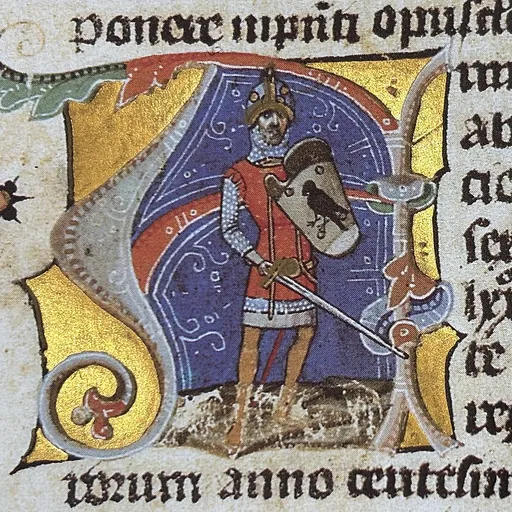
Álmos, Grand Prince of the Magyars
Kende or gyula of the Hungarians (fl. 9. century)
About Álmos, Grand Prince of the Magyars
Lived 820 – 895 (aged 74–75). Álmos, Grand Prince of the Magyars was a traditional leader or chief.
Álmos , also Almos or Almus ( 820 – 895), was—according to the uniform account of Hungarian chronicles—the first head of the "loose federation" of the Hungarian tribes from around 850. Whether he was the sacred ruler (kende) of the Hungarians or their military leader (gyula) is subject to scholarly debate. According to Constantine Porphyrogenitus, he accepted the Khazar khagan's suzerainty in the first decade of his reign, but the Hungarians acted independently of the Khazars from around 860. The 14th-century Illuminated Chronicle narrates that he was murdered in Transylvania at the beginning of the Hungarian conquest of the Carpathian Basin around 895.
Ancestry
An anonymous notary during the reign of Béla III, author of the Gesta Hungarorum — who wrote his "historical romance" around 1200 or 1210 — stated that Álmos descended "from the line" of Attila the Hun. A late-13th-century chronicler, Simon of Kéza, wrote that Álmos was "of the Turul kindred". He also wrote that Attila the Hun carried a banner which bore "the image of the bird the Hungarians call turul", probably either a gyrfalcon or a hawk. A bird has an important role in the legend about Álmos's birth, which was preserved by both the Gesta Hungarorum and the Illuminated Chronicle. The legend says that Álmos's mother, already pregnant with him, dreamed of a bird of prey "which had the likeness of a hawk" impregnating her. This story has close analogies in the nomadic, steppe environment. Notably, in The Secret History of the Mongols, it is reported that Genghis Khan's mother-in-law had a dream that a white falcon ("holding the Sun and the Moon its claws" they are popular in the traditions and symbolism of the steppe people, and are not exclusive or originary of any specific ethnic group living therein.
Historians Gyula Kristó and Victor Spinei wrote that this story initially narrated the origin of Álmos's family from a totemic ancestor.
According to the Gesta Hungarorum, Álmos was born to the Scythian leader Ügyek The name of Álmos's father is uncertain because the Hungarian chronicles preserved it in two variants. Anonymus states that Ügyek was his name, but the 14th-century Illuminated Chronicle says that Előd—himself the son of Ügyek—was Álmos's father. Kristó says that both names may have been the chroniclers' inventions, since Ügyek's name derives from the ancient Hungarian ügy ("saint, holy") word, and Előd's name simply refers to an ancestor. Anonymus writes that Ügyek married Emese in 819. If this date is correct, Álmos was born around 820.
Anonymus makes a connection between the name of Álmos and the Hungarian word for dream (álom), which is perhaps the most cited origin for the name. In modern Hungarian, the name means "sleepy", "drowsy"; however, the given name Álmos likely derives from álom, as mentioned, "dream", itself the root of álmos, "drowsy".
Historians András Róna-Tas, and Victor Spinei argued that his name is of Turkic origin. However, Spinei himself responded to the suggestion of a Turkic origin of the individual based on the Turkic etymology of his name by saying that a name's etymology does not always reflect its bearer's ethnicity. 10% of words in modern Hungarian are of Turkic origin, who made a consistent genetic and cultural contribution to the Magyars. In the 19th century, a Turkic, rather than Uralic origin for Hungarian was proposed, due to the large and varied layer of loans and all the influences absorbed by Hungarians after several centuries of cohabitation. The Magyars' historical social structure itself is said to be of Turkic origin. The words "Hungarian" and "Hun", too, are considered of Turkic origin. Many Hungarian names, and also animal and plant names, are of Turkic origin, and the majority of Hungarian tribal names were of Turkic origin. However, the Magyars are not a Turkic people. According to the Turkic theory, the name meant "the bought one" in Turkic.
Linguist Bela Kalman wrote that: "The name Álmos, however, is not of Turkic origin, but the Hungarian secondary formation of the Hungarian word of Finno-Ugric origin álom, meaning that which is dreamt about."
Álmos, born to a Hungarian prince and Emese, "the mother of all ethnic Hungarians", led his people to the conquest of the Carpathian Basin after they were attacked by the Turkic Pechenegs. He was chosen as leader of the Magyars by the latter's chieftains, who had initially appointed Lebed as their permanent leader. The ethnic Hungarians became known after Álmos' tribe, which proved the strongest of the seven Hungarian tribes.
Reign Álmos, according to Gesta Hungarorum, was freely elected by the heads of the seven Hungarian tribes as their "leader and master". after they had been forced by the Pechenegs to leave their dwelling places near the Khazar Khaganate and to settle in a new territory called Etelköz. The khagan was planning to appoint one of the voivodes named Levedi to lead the Hungarian tribes to represent the khagan's interests. Although Levedi refused the khagan's offer, he proposed one of his peers, Álmos or Álmos's son Árpád, to the proposed new position. The khagan accepted Levedi's offer. Upon his initiative, the Hungarians elected their first prince, but they preferred Árpád to his father. The work of Constantine VII, who referred to Magyars as Turks,
Kristó says that Álmos stood at the head of the Hungarian tribal confederation from around 850. Porphyrogenitus's narration says that he initially accepted the khagan's suzerainty. The Hungarians apparently achieved their independence around 860, since the earliest reports on their plundering raids in Central Europe were recorded thereafter. The Annals of St. Bertin mentions their incursion into Louis the German's realm in 862. Three tribes seceding from the Khazar Khaganate, together known by Porphyrogenitus as "Kabaroi", also joined with the Hungarians in the 860s or 870s. Spinei says that the memory of their arrival was preserved by Anonymus, who mentions "the seven dukes of the Cumans" who "subjected themselves to Prince Álmos" at Kiev.
Anonymus writes of a war between the Hungarians and the Kievan Rus', ending with the victory of the Hungarians, who were commanded by Álmos. The Russian Primary Chronicle refers to a "Hungarian hill" at Kiev in connection with the town's occupation by Oleg of Novgorod in 882. The same chronicle mentions "a castle of Ol'ma" (Олъминъ дворъ) standing on the same hill. George Vernadsky says that this fortress had been named after Álmos, but this theory has not been widely accepted by historians.
Death
The Hungarians who lived in the westernmost parts of the Pontic steppes were occasionally hired by neighboring powers to intervene in their wars. For instance, they invaded Moravia in alliance with Arnulf of East Francia in 892. Their intervention in a conflict between the First Bulgarian Empire and the Byzantine Empire caused a joint counter-invasion by the Bulgars and Pechenegs. The Hungarians were forced to leave the Pontic steppes and to cross the Carpathians in search of a new homeland around 895.
According to the Gesta Hungarorum, the Hungarians invaded the Carpathian Basin under Álmos, who "appointed his son, Árpád, as leader and master" of the Hungarian tribal federation at Ungvár (Uzhhorod, Ukraine). Thereafter Anonymous does not mention Álmos. In a contrasting report, the Illuminated Chronicle says that Álmos "could not enter Pannonia, for he was killed in Erdelw" (Transylvania). Kristó says that the chronicle preserves the memory of Álmos's sacrifice because of the catastrophic defeat of his people by the Pechenegs. If this is true, his ritual murder proves that Álmos was the sacred leader of the Hungarian tribal federation. Róna-Tas refutes this and says that if the chronicle's report is reliable, Álmos became the victim of a political murder committed or initiated by his own son. Preferring the narration of the Gesta Hungarorum to the report by the Illuminated Chronicle, Victor Spinei states that Álmos was not murdered in Transylvania since Anonymus writes that the Hungarians bypassed this region when invading the Carpathian Basin.
Family
No source preserved the name of Álmos's wife. Anonymus writes that she was "the daughter of a certain most noble prince". Álmos's only child known by name was Árpád, who succeeded Álmos after his death. The following is a family tree presenting Álmos's closest relatives:
Don’t just read it —
keep it.
Full-length biographies made to live with: read them, listen on the way to work, watch them tonight.
- E-book
- Audio
- Video
Instant download · yours to keep · every purchase keeps this site free
Important facts
Family & relationships
People in Álmos, Grand Prince of the Magyars's life
Named in this biography and alive at the same time

Related people
Same field, nearest in time



Contemporaries
People whose lives overlapped Álmos, Grand Prince of the Magyars's

Frequently asked questions
Who was Álmos, Grand Prince of the Magyars?
kende or gyula of the Hungarians (fl. 9. century)
When was Álmos, Grand Prince of the Magyars born?
Álmos, Grand Prince of the Magyars was born in 820 in Khazar Khaganate.
When did Álmos, Grand Prince of the Magyars die?
Álmos, Grand Prince of the Magyars died in 895 in First Bulgarian Empire.
What was Álmos, Grand Prince of the Magyars's occupation?
Álmos, Grand Prince of the Magyars was a traditional leader or chief.
What nationality was Álmos, Grand Prince of the Magyars?
Álmos, Grand Prince of the Magyars's recorded nationality: Khazar Khaganate.
Sources & further reading
· Wikipedia: Álmos, Grand Prince of the Magyars
Cite this page
APA: Biography.guide. (2026). Álmos, Grand Prince of the Magyars. https://biography.guide/almos-grand-prince-of-the-magyars/
MLA: "Álmos, Grand Prince of the Magyars." Biography.guide, https://biography.guide/almos-grand-prince-of-the-magyars/.
Chicago: "Álmos, Grand Prince of the Magyars." Biography.guide. https://biography.guide/almos-grand-prince-of-the-magyars/.
Data last updated: 2026-09-22 · Spot an error? Report a correction.
Portrait: Wikimedia Commons · author & licence
Page generated 2026-09-27 05:02 UTC