
About Liang Zhen
Lived 801 – 901 (aged 99–100). Liang Zhen was a poet.
Liang Zhen , né Liang Ai (梁靄), known as the Hermit of Jing Tower (荊臺隱士) after retirement, was the chief strategist for Gao Jixing (Gao Jichang), the founding prince of the Chinese Five Dynasties and Ten Kingdoms period state of Jingnan (Nanping).
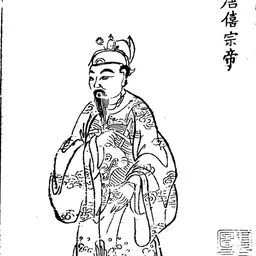
Background It is not known when Liang Ai was born, but it is known that he was from Yizheng (依政, in modern Chengdu, Sichuan). During the time when Emperor Xizong of Tang was at Chengdu, fleeing from the agrarian rebellion led by Huang Chao, Liang had the chance to meet the imperial official Liu Xiang (劉象) and present his poetry to Liu. Liu complimented him on his poetry, but urged him to change his name as portending poor fortune in politics — pointing out that Ai (靄) was made up of the character parts "rain" (雨) and "meet" (謁), which suggested that he would be meeting people in the rain — in other words, not being very successful, politically. Liu suggested that Liang change his name to Zhen (震), made up of "rain" and "dragon" (辰), as dragons thrived in the rain. Liang agreed. Shortly after, Liang passed the imperial examinations in the Jinshi class, but apparently did not succeed in an official career, as he was said to be living in the imperial capital Chang'an (apparently after Tang imperial forces recaptured it) and not holding offices.
Service under Gao Jixing
During Later Liang In or around 908, by which time Tang had been destroyed and its central region been taken over by the succeeding Later Liang, Liang Zhen was trying to return to his homeland (which was then ruled by Later Liang's rival Former Shu). When he went through the city of Jiangling, the Later Liang military governor (Jiedushi) of Jingnan Circuit (荊南, headquartered at Jiangling), Gao Jichang, was impressed by his talent. Gao kept Liang at Jiangling and wanted to make Liang his secretary. Liang found this humiliating (as Gao, while a prominent general at the time, was of a low social station by birth and had served as a servant before) but did not dare to leave against Gao's wishes, fearful that Gao might get angry and kill him. He thus stated to Gao:
Gao did not listen, and he went to greet Emperor Zhuangzong. Emperor Zhuangzong treated him with great honor, but for months kept him at the imperial court and did not return him to Jingnan, and had him follow the emperor to the new Later Tang capital Luoyang. Emperor Zhuangzong further considered keeping him at Luoyang permanently. Emperor Zhuangzong's chief of staff, Guo Chongtao, however, argued that keeping Gao at the imperial court would discourage other former Later Liang subjects from fully devoting themselves to Later Tang, so Emperor Zhuangzong allowed Gao to leave to return to Jingnan around the new year 924. When Gao reached Jiangling, he held Liang's hands and stated, "I did not follow your words, sir, and I almost got stuck in the tiger's mouth." Subsequently, Emperor Zhuangzong's wife Empress Liu, believing that Guo had stripped the Shu territory of its wealth, ordered Guo killed, leading to the collapse of the Later Tang army morale and Emperor Zhuangzong's death in a mutiny. It was said that when this news arrived at Jiangling, Gao was impressed with and became even more respectful of Liang. It was also around this time that Liang recommended Sun Guangxian to Gao — Gao Conghui continued to honor Liang Zhen, referring to Liang as an older brother, and Liang referred to him as master. By 935, though, Liang wanted to retire, and he stated,
Liang therefore firmly requested retirement. Gao Conghui could not keep him further, so he built a mansion for Liang on an island. Liang took up the habit of wearing coats made of crane feathers and referred to himself as the "Hermit of the Jing Tower." He still occasionally visited Gao Conghui at Gao's headquarters, and he would ride a yellow cow to get there. Gao also often visited his mansion and gave him many gifts. After Liang's retirement, Gao entrusted the matters of state to Sun Guangxian instead. It was said that Liang lived out his years in comfort, but it was not recorded when he died.
Notes and references
Spring and Autumn Annals of the Ten Kingdoms (十國春秋), vol. 102. Zizhi Tongjian, vols. 267, 272, 274, 275, 279.
Don’t just read it —
keep it.
Full-length biographies made to live with: read them, listen on the way to work, watch them tonight.
- E-book
- Audio
- Video
Instant download · yours to keep · every purchase keeps this site free
Important facts
People in Liang Zhen's life
Named in this biography and alive at the same time




Related people
Same field, nearest in time

Contemporaries
People whose lives overlapped Liang Zhen's

Frequently asked questions
Who was Liang Zhen?
Chief strategist and politician
When was Liang Zhen born?
Liang Zhen was born in 801.
When did Liang Zhen die?
Liang Zhen died in 901.
What was Liang Zhen's occupation?
Liang Zhen was a poet.
Sources & further reading
Cite this page
APA: Biography.guide. (2026). Liang Zhen. https://biography.guide/liang-zhen/
MLA: "Liang Zhen." Biography.guide, https://biography.guide/liang-zhen/.
Chicago: "Liang Zhen." Biography.guide. https://biography.guide/liang-zhen/.
Data last updated: 2026-09-20 · Spot an error? Report a correction.
Page generated 2026-09-27 05:21 UTC