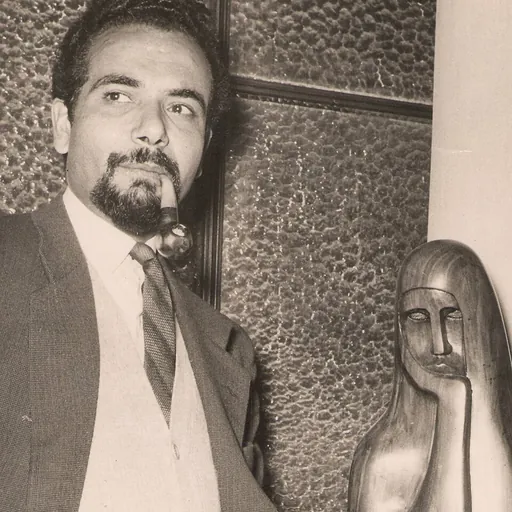
About Gamal El-Sagini
Lived 1917 – 1977 (aged 60). Gamal El-Sagini was an Egyptian painter, sculptor and medalist.
Gamal El-Sagini (Arabic: جمال السجيني) (January 7, 1917 – November 19, 1977) was an Egyptian sculptor, painter and medalist.
Childhood and Education
Born on January 7, 1917, in Bab El Shaaria, a poor suburb of Cairo, Egypt, El-Sagini discovered his passion for art at a very early age where he grew fond of the architectural nature of old Cairo such as domes, mosques and Islamic architecture which led him in 1934 to join the sculpture department at the First school of Fine Arts founded by prince Youssef Kamal. Guided and mentored by great artists teaching sculpture in Cairo at the time, El-Sagini earned his diploma in sculpture in 1938. El Sagini traveled to Paris at his own expense to pursue higher studies where he was greatly affected by English sculptor Henry Moore who was best known for his abstract technique and reclining figures. El Sagini followed this in 1947 by traveling to Rome to resume his post graduate studies where he received a diploma in Sculpture and Medal Arts in 1950.
His Message El-Sagini reflected his thoughts of a better future for his country Egypt through his work and he summarized his reason in life through "The Will" (Hammered copper relief-33x28cm-1954) where he pictured himself – like in the times of pharaohs – in his grave surrounded by all the things he stood for and cherished during his lifetime such as love, hope, art and music. On the headstone he wrote the following words that describe his life and what he stood for:
Gamal El Sagini, Son of Abdel Wahab El Sagini, Born January 7th 1917
Lived For His Society, An Enemy of Exploitation and Slavery
A Strong Believer in Freedom and Peace
Egypt Constantly concerned with his home country's issues, El-Sagini featured Egypt in most of his works expressing hope, encouragement, disappointment or just pure unconditional love. Introducing symbolism in Egyptian sculpture, El-Sagini used different symbols of Egypt during times of joy, despair, victory and defeat.
In the period 1952-1967, following the Egyptian revolution of 1952, Egypt played a leading role in the Arab world under the leadership of Egyptian president and revolutionary icon Gamal Abdel Nasser. The Egyptian revolution was a spark that triggered what turned out to be a series of independence revolutions in the Arab world.
In his statue "Egypt My Mother Land" (Bronze- 40x30x 10 cm-1957) El-Sagini symbolized Egypt as the giving mother of the entire Arab world featuring a mother breastfeeding her infants while holding over her shoulders symbols of prosperity (wheat stem), development (bricks Built) and culture (book).
As a result of the Six-Day War 1967 and the nationwide feeling of frustration and despair, El-Sagini often featured Egypt in his paintings of that period as a candy doll – a famous symbol in Egyptian carnivals– that is crippled, tortured or even hanged. alt=A bronze statue by Egyptian artist Gamal Sagini showing a woman standing with her fist closed and her hand directed straight forward Following the Yom Kippur War 1973 and the blood pumping again into Egypt's and the whole Arab world's veins, El-Sagini pictured Egypt as a beautiful woman with strong facial features in two of his most expressive statues of that era in Egypt's modern history, In his statue "The Great Crossing of The Suez Canal" (Bronze- 33x127x 38 cm-1973) El-Sagini pictures the Egyptian soldiers in a ship –Egypt– rowing relentlessly to cross the Suez Canal.
El Sagini's second statue "Egypt, The Future" (Bronze- 90x80x 30 cm-1975) features a woman –Egypt– standing proudly in an expressive position that shows strength, hope and determination towards a better future.
The River Nile
El Sagini's special relation with the river Nile was clearly pictured in 1969 when he decided as an act of rebellion to throw some of his sculptures in the Nile as a result of the state's lack of recognition and support as his statues were piling up in his atelier instead of standing tall in the streets and squares of Egypt.
This unprecedented act of rebellion took the Egyptian art scene by storm and made the Egyptian society think about every artist's true passion and purpose of the work he is creating. This purpose is simply to get the artist's work to be seen by others, feeding the viewers’ minds and souls, making them think, dream, enjoy and sometimes change.
Death
In 1977 El Sagini traveled to Spain for a comprehensive exhibition of his works organized by the Egyptian General Organization for Information held in Madrid and then Barcelona, where he died on November 17 at the age of 60. His body was accompanied by his wife – Hoda – back to Egypt where he was buried at the family cemetery in Cairo.
Prizes
El Sagini received several prizes and honors such as: The "Mokhtar" Trophy for Sculpture – 1937 The Honorary Title "Cavaliero" (Knight) from the Italian Government Science and Art Prize from the Egyptian Government The First Prize in the High Council for the Support of Arts and Literature Competition Egypt's Prestigious Award presented by Former President Gamal Abdel Nasser – 1962 Italy's Medal of Honor presented by the Italian Ambassador in Egypt - 1963 First Place in the Alexandria Biennial Exhibition for Mediterranean Countries First Place in the International Moscow Exhibition First Place in the International Brussels Exhibition
Main exhibitions
Venice Biennial Seattle International Exhibition Alexandria Biennial for Mediterranean Countries China International Exhibition International Moscow Exhibition -1957 International Brussels Exhibition – 1958 Mediterranean Studies Center Exhibition – Madrid/Barcelona, Spain 1977 Extra Gallery – Cairo 1996 Safar Khan Gallery - Cairo 1999 Zamalek Art Gallery – Cairo 2010 Zamalek Art Gallery – Cairo 2012 Zamalek Art Gallery – Cairo 2013 Zamalek Art Gallery – Cairo 2015 Centennial Retrospective Exhibition at the Mahmoud Mokhtar Museum and Zamalek Art Gallery - Cairo 2017
Main Acquisitions
Museum of Modern Egyptian Art - Cairo, Egypt Gamal Abdel Nasser Museum - Cairo, Egypt Oriental Art Museum – Moscow, Russia Pushkin State Museum of Arts – Moscow, Russia State Museum of the History of Russian Literature – Moscow, Russia Beijing Museum – Beijing, China Ahmed Shawqi statue in Villa Borghese Gardens – Rome, Italy New York Public Library – NY, US Museum of Islamic Ceramics - Cairo, Egypt Dalloul Art Foundation – Beirut, Lebanon
Don’t just read it —
keep it.
Full-length biographies made to live with: read them, listen on the way to work, watch them tonight.
- E-book
- Audio
- Video
Instant download · yours to keep · every purchase keeps this site free
Important facts
People in Gamal El-Sagini's life
Named in this biography and alive at the same time



Related people
Same field, nearest in time
Contemporaries
People whose lives overlapped Gamal El-Sagini's

Frequently asked questions
Who was Gamal El-Sagini?
Egyptian sculptor,painter & artist (1917-1977)
When was Gamal El-Sagini born?
Gamal El-Sagini was born on 7 January 1917 in Cairo.
When did Gamal El-Sagini die?
Gamal El-Sagini died on 17 November 1977.
What was Gamal El-Sagini's occupation?
Gamal El-Sagini was a painter, sculptor and medalist.
What nationality was Gamal El-Sagini?
Gamal El-Sagini was Egyptian.
Sources & further reading
Cite this page
APA: Biography.guide. (2026). Gamal El-Sagini. https://biography.guide/gamal-el-sagini/
MLA: "Gamal El-Sagini." Biography.guide, https://biography.guide/gamal-el-sagini/.
Chicago: "Gamal El-Sagini." Biography.guide. https://biography.guide/gamal-el-sagini/.
Data last updated: 2026-09-22 · Spot an error? Report a correction.
Portrait: Wikimedia Commons · author & licence
Page generated 2026-09-27 05:01 UTC